

You’ve built a £500,000 ISA portfolio across twenty years of careful investing. That money is shielded from income tax and capital gains tax while you live. The moment you die, HMRC treats those savings as part of your estate — and will take 40% of anything above the £325,000 threshold. Your pension, by contrast, usually sits outside your estate for inheritance tax purposes if you die before 6 April 2027 (from that date, most unused pension funds will be included). The very wrapper designed to protect your savings from tax while alive actually makes them more exposed to tax when you die. This article shows you exactly how an Estate Tax Calculator exposes that contradiction. You need it to see where your real tax risk lies, without guessing. These are concrete numbers, not theory.
What is an estate tax calculator — and why a retail investor needs one
You might be forgiven for feeling a little confused about estate tax. On one hand, you’re told to save diligently into tax-efficient wrappers. On the other, those very wrappers can create a sudden, unexpected tax bill for your family when you’re gone. Let’s clear that up.
An estate tax calculator is a practical tool that estimates the potential Inheritance Tax (IHT) liability on your assets at death. While "estate tax" is the common US term, in the UK we call it Inheritance Tax, and the rules are distinct. The calculator’s real value lies in revealing which parts of your portfolio are exposed — and by how much.
Here is the central truth every retail investor needs to understand: for deaths before 6 April 2027, most pensions are not an asset of your estate for inheritance tax purposes, while ISAs emphatically are. The very wrapper designed to protect your savings from tax while alive actually makes them more exposed to tax when you die. That means your Inheritance Tax portfolio may look quite different from your living investment strategy.
This distinction matters more than many realise. In 2023-24, only 4.72% of UK deaths triggered IHT, yet the tax take rose 5% to £7.03 billion. The tax is increasingly hitting those with modest investment portfolios — not just the traditionally wealthy. The Nil-Rate Band (the first £325,000 of an estate that is tax-free) remains frozen at this level until at least 5 April 2031, meaning more estates will creep over the threshold through simple growth.
An estate tax calculator is not a doom-mongering device. It is a planning tool that helps you decide whether to gift assets, invest in qualifying holdings, or simply understand your family’s future tax bill. Instead of building a spreadsheet yourself, enter your estate’s total value, IHT investments UK included, into ARIA PM’s free inheritance tax calculator to see where it sits relative to the Nil-Rate Band.
The honest picture: your ISA growth is tax-free while you live, but those same gains sit squarely in your taxable estate. Your pension, by contrast, sits outside — at least for now. A calculator helps you see that gap, and plan accordingly.
How the estate tax calculator actually works — a plain-English walkthrough
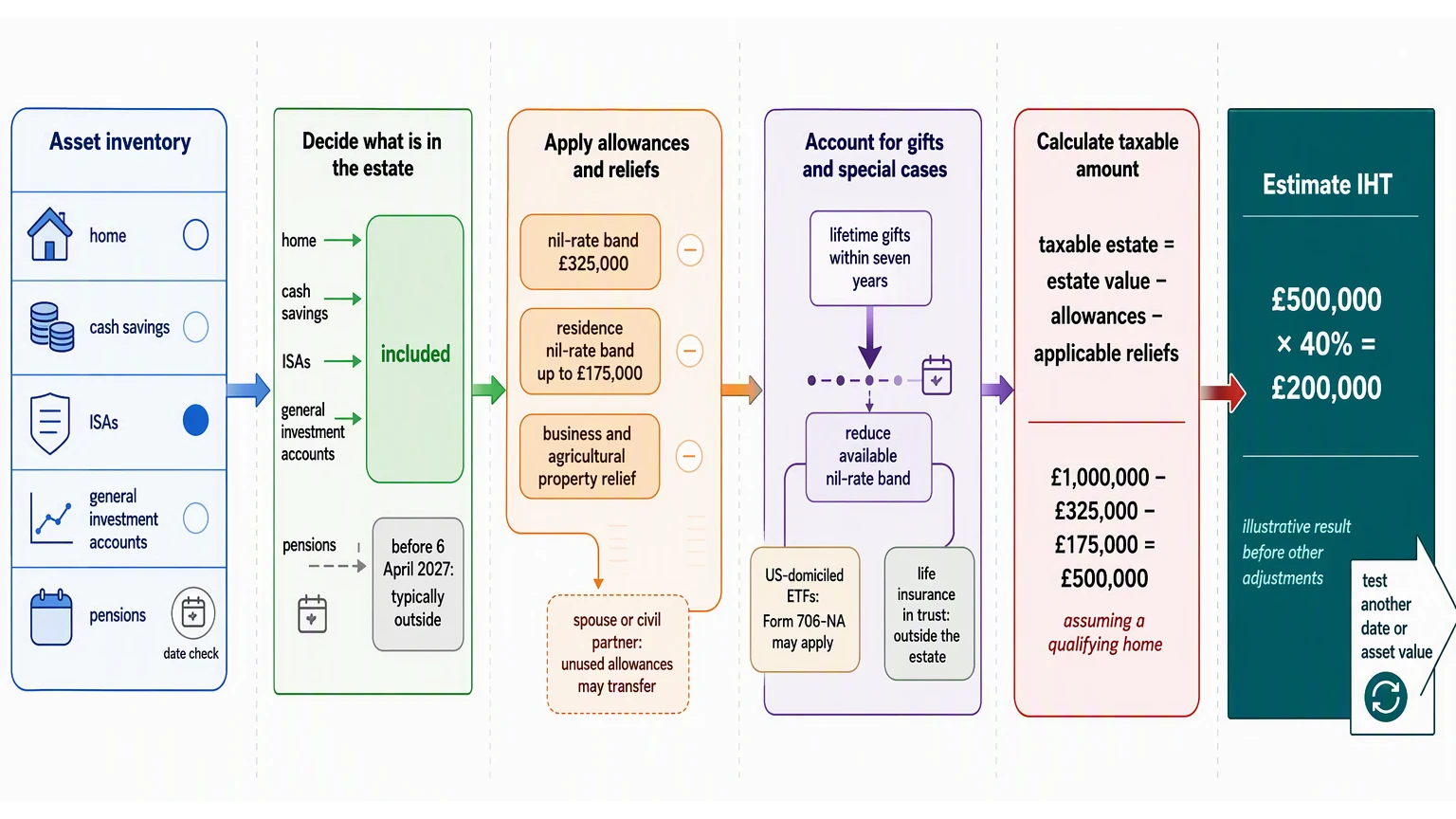
Let’s walk through the logic a typical UK estate tax calculator uses, step by step. It starts with a baseline: every individual gets a nil-rate band of £325,000 — frozen since 2009 and set to stay that way through 2030-31. Anything above that is potentially taxable. If you own a home and plan to pass it to children or grandchildren, you may also qualify for the residence nil-rate band of £175,000. However, that additional allowance tapers away for estates worth over £2 million — losing £1 of relief for every £2 above the threshold.
The calculator then works on the total of everything in your ‘estate’ for inheritance tax purposes, which you add up yourself: your home, savings, ISAs, general investment accounts, and — from April 2027 — most unused pension funds. And here’s the twist that surprises many investors: pensions are currently not counted, while ISAs emphatically are. That wrapper designed to protect your savings from tax while alive actually makes them more exposed to tax when you die. Lifetime gifts made more than seven years ago typically fall outside the estate; business assets stay in it, but qualifying ones get business relief.
Consider a single investor with a £1 million estate. The calculator subtracts the £325,000 nil-rate band, then the £175,000 residence band (assuming a qualifying home). That leaves £500,000 taxable. Multiply by 40% — you get £200,000 in inheritance tax. Now contrast a married couple with full allowances: they can transfer any unused nil-rate bands and residence nil-rate bands between them. That potentially allows a combined £1 million tax-free threshold — meaning the same £1 million estate could pass entirely without tax.
The real power of an estate tax calculator, though, is that you can toggle the variables. Add your unused pension to the estate total to see the position after April 2027 — suddenly pensions become taxable, and the figures shift. Add a history of gifts; include business assets; adjust property value. The maths is simple multiplication and subtraction. The insight is in seeing which inputs change the result — and by how much.
Estate tax calculator in practice: real tools, real numbers, real strategies
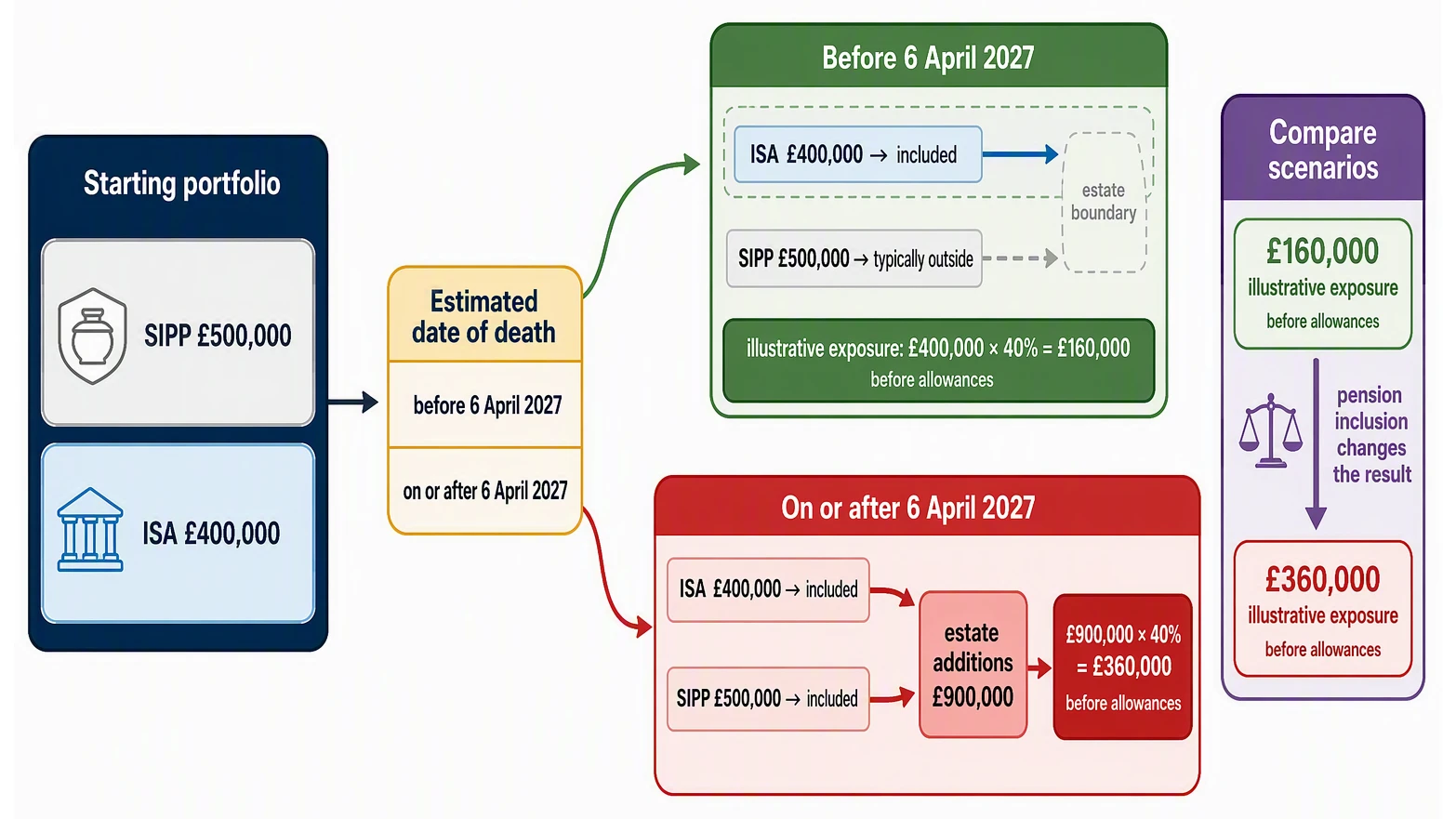
A good estate tax calculator doesn’t just produce a single number — it lets you test “what if” scenarios, and the stakes are higher than ever. The most revealing input is the estimated date of death, which matters because of two specific rule changes: the April 2027 pension rule change (which will bring unused pension funds and lump-sum death benefits into the estate for IHT) and the April 2026 business-relief changes (which limit 100% relief to the first £2.5 million of property that would otherwise get 100% relief, with the excess at 50%; property eligible only for 50% relief stays at 50% and does not use the allowance). Run the numbers for an investor with a £500,000 SIPP and a £400,000 ISA. If they die before 6 April 2027, the SIPP typically sits outside their estate — only the ISA is exposed. On or after that date, both the SIPP and the ISA fall inside the estate, potentially adding £500,000 to the taxable value. The difference in the IHT bill can be radical: 40% before allowances is £160,000 on the ISA alone against £360,000 on both, and after a £325,000 nil-rate band (one person, no other assets, gifts or reliefs) the bill swings from £30,000 to £230,000.
What strategies do these calculators reveal beyond simple timing? A critical one involves fund domicile. For non-US investors, US-domiciled ETFs are US-situated assets, and a nonresident noncitizen estate generally has to file Form 706-NA once those holdings exceed $60,000 — a filing threshold, not a tax-free band. The $15 million federal basic exclusion applies to US citizens and residents and does not automatically extend to a UK nonresident noncitizen, while the federal estate-tax rate runs up to 40%. The UK-US estate tax treaty may relieve some or all of the tax, but it has to be claimed, so the paperwork risk is real. A calculator can test the arithmetic of switching to Irish-domiciled UCITS equivalents, like Vanguard’s or iShares’ Irish ETFs, which sidestep that exposure entirely. The same situs logic (the tax applied by the country where the asset is located) runs the other way for non-UK residents holding UK shares. Using life insurance as liquidity is another approach: you take out a policy written in trust, so the payout sits outside your estate and provides cash to pay the IHT bill at the standard IHT rate of 40% — or the reduced IHT rate of 36% if at least 10% of the net estate goes to charity.
The point of a good inheritance tax portfolio tool is that you can ask “should I move my US ETFs to Irish equivalents?” or “does holding AIM shares at 50% relief still leave a tax bill?” and get a usable answer before you act. But remember: every calculator is a planning aid, not definitive tax advice. The numbers change as rules change, and only a qualified adviser can confirm what applies to your specific estate. For understanding how your IHT investments UK portfolio behaves across different scenarios, these tools are invaluable — but they remain tools, not guarantees.
The key metrics your estate tax calculator must model (and why)
A competent estate tax calculator must first ask about your UK residence history. Since 6 April 2025, the old domicile test has been replaced by a long-term residence test: if you have lived in the UK for 10 of the previous 20 tax years, your entire worldwide estate — including foreign property, overseas investment accounts, and international holdings — falls into the UK inheritance tax (IHT) net. A calculator that skips this question could massively underestimate your liability. For example, a UK resident with a €500,000 holiday home in France and a US brokerage account worth $400,000 would need those assets declared if the 10-year test is met; otherwise, they might wrongly assume only UK assets count.
Second, the calculator must include a pension inclusion toggle — ideally a date selector for death before or after 6 April 2027. This is critical because the same £300,000 pension pot may typically sit outside your estate (if death occurs before that date) or be inside it (if on or after it). Pensions are currently not an asset of your estate for IHT purposes, while ISAs emphatically are — meaning the wrapper designed to protect your savings from tax while alive actually makes them more exposed to tax when you die. A simple slider lets you model both scenarios.
Third, business and agricultural property relief (BPR/APR) has changed dramatically. From April 2026, the first £2.5 million of property that would otherwise qualify for 100% relief receives 100% relief, with any excess at 50% relief; property that qualifies only for 50% relief keeps 50% relief and does not use the allowance. AIM shares now attract only 50% relief, not the previous 100%, and do not use the £2.5 million allowance. Imagine a farmer with a £4 million estate, all farm property that would otherwise qualify for 100% relief: under the new rules, £2.5 million gets 100% relief, and the remaining £1.5 million gets 50% relief — so £750,000 is chargeable before the nil-rate band, and after a £325,000 nil-rate band the bill is £170,000. An old-style calculator that applied 100% relief to everything would show zero tax, while a naive 40% flat-rate calculator would show £1.6 million. Both are dangerously misleading.
Fourth, the calculator must model the residence nil-rate band (RNRB) — currently up to £175,000 per person — and the £2 million taper threshold. Once your net estate exceeds £2 million, the RNRB tapers away by £1 for every £2 over, vanishing entirely at £2.35 million. Without this, a £2.1 million estate could be over- or under-taxed by tens of thousands.
Fifth, non-exempt lifetime gifts made within seven years must be tracked, as they eat into the nil-rate band in order of age (oldest gifts first); exempt gifts, such as those within the £3,000 annual exemption, do not. Finally, spouse or civil partner transfers of unused allowances — both the standard nil-rate band and the RNRB — need to be captured, as many widows and widowers inherit unused relief worth hundreds of thousands.
The takeaway: simple ‘estate value × 40%’ calculators are now dangerously misleading. With only 4.72% of UK deaths currently producing an IHT charge — yet liabilities rising 5% year-on-year to £7.03 billion — the nuance matters enormously. ARIA PM’s free inheritance tax calculator handles the residence nil-rate band and its taper, gifts in the last seven years and transferred spouse allowances; for residence history and pension timing, adjust the estate total you enter yourself. It does not handle business or agricultural relief: the residence band taper is worked out on the estate before those reliefs, so subtracting relief from the total you enter can wrongly restore the residence band, and an estate with such property needs a separate calculation or an adviser.
Common estate tax calculator mistakes — and how to avoid them
Even the best estate tax calculator is only as reliable as the assumptions you feed it — and retail investors routinely feed it wrong ones. Here are the five most frequent errors, all grounded in HMRC practice and current rules.
Mistake one: assuming all ISAs are tax-free on death. This is the single most dangerous assumption. An ISA wrapper stops income tax and capital gains tax while you are alive, but it does absolutely nothing for inheritance tax. Your entire ISA portfolio — cash, stocks, funds — sits fully inside your taxable estate. Instead, do this: Always include your full ISA value as a taxable asset in the calculator. If your estate exceeds the nil-rate band, that "tax-free" growth is about to be taxed at 40%.
Mistake two: treating all pensions as outside the estate without checking the date. Right now, unused defined-contribution pension pots and death benefits typically fall outside your estate for IHT. But the rules change on 6 April 2027. From that date, most unused pension funds and death benefits will be swept back into your estate for IHT purposes. Instead, do this: Enter your pension funds separately in the calculator today, but run a second scenario assuming they are included — that is your 2027 reality.
Mistake three: ignoring US estate tax exposure. This catches even sophisticated investors. Direct shares in US companies are US-situated assets. For funds, situs treatment depends on the legal wrapper, so a US-domiciled ETF is treated differently from an Irish-domiciled one holding the same stocks. Once US-situated assets exceed $60,000, a nonresident noncitizen estate generally has to file. The US federal estate-tax rate runs up to 40%, charged on the taxable US estate after deductions and any available credit, unless treaty relief applies. Instead, do this: In your calculator, flag any US-domiciled holding as a separate line item. Then check whether the UK-US double-tax treaty fully shelters your estate — many UK retail platforms list Irish-domiciled ETF versions precisely to avoid this trap.
Mistake four: forgetting the residence nil-rate band taper. The residence nil-rate band adds up to £175,000 of extra relief if your home passes to direct descendants — but that relief tapers away by £1 for every £2 once your total estate exceeds £2 million. A £2.1 million estate is over the £2 million threshold, so its residence relief has already begun to taper (a full £175,000 band falls to £125,000) — even though the house is worth only £500,000. Instead, do this: Enter your full estate value — including pensions if you are modelling 2027 — then check that the taper has been applied; not every calculator does it automatically.
Mistake five: entering only cash and investments while omitting life insurance and wrongfully assuming full business relief. Life insurance policies held in a trust fall outside your estate — but if the policy is not in trust, its payout falls into your estate. Many investors also assume all AIM shares get 100% business relief. The rules have tightened: many AIM and other "not listed" shares now qualify for only 50% relief. Instead, do this: Check every life policy's trust status before entering it. For business assets, use the revised £2.5 million allowance only for private-business interests and farms that would otherwise get 100% relief — then apply only 50% relief to AIM holdings, which no longer get 100% relief from 6 April 2026.
The overarching warning is simple: a calculator is only as good as the data you put in — and the assumptions you understand. Before you trust the output, make sure you have challenged every default setting.
Your practical action plan: using the estate tax calculator today
Here is your 30-minute practical action plan. It is not a morbid exercise — it is responsible stewardship of the wealth you have built, and it could easily save your family hundreds of thousands of pounds.
Step one: gather your current asset inventory. You need a single piece of paper (or a notes app) listing every significant pot: your home’s estimated value, cash savings, ISAs, general investment accounts, defined-contribution pensions, any business interests, and crucially — any US-domiciled funds or US property you hold. Do not guess the ISA figure; log in to your platform and write down the actual number. You need the truth, not a rough idea.
Step two: use a reputable estate tax calculator. Use ARIA PM’s free inheritance tax calculator (ariapm.ai) — it carries no charge at all, so never worry about pricing tiers or trials. ARIA PM handles survivorship adjustment, cost modelling, and regime stress-testing automatically — so you can focus on interpreting results rather than building the simulation. Run the numbers for two scenarios: a hypothetical death in 2026-27 (current rules, where the nil-rate band remains at £325,000 and pensions sit outside your estate) versus a death in 2027-28 (when pensions are expected to be pulled inside). The difference in the liability figure will likely be your single biggest insight from this exercise.
Step three: check your residence history. If you have been UK resident for 10 of the last 20 years, your overseas assets are in scope for UK inheritance tax portfolio planning. Non-long-term residents are generally only exposed to UK IHT on assets situated in the UK — but that exemption vanishes once you cross the 10-year threshold.
Step four: identify the ‘tax bombs’. Compare your asset list with the calculator output and note which asset class adds most to the liability. For most retail investors, it is a large ISA (the wrapper designed to protect you from income and capital gains tax while alive actually makes you more exposed when you die). From 2027, a large pension will join that list. Also flag any US-domiciled ETFs — the IRS requires Form 706-NA where a nonresident, noncitizen dies owning more than $60,000 of US-situated property.
Step five: consider one or two practical moves. Based on the calculator output, you might switch US-domiciled ETFs for Irish UCITS equivalents (which sit outside US estate tax rules), start a seven-year gifting programme to reduce the estate’s value, or review a life insurance policy written in trust to cover the potential bill. Do not try to fix everything at once — pick the single biggest ‘tax bomb’ and address that.
Step six: write down the key numbers and share them. Note your estimated IHT, available allowances, and residence band status. Share this with your spouse, your executor, or a financial adviser. HMRC statistics show that 4.72% of UK deaths, about 30,400 estates, resulted in an IHT charge in 2023-24 — the system is designed to catch people who do not plan. By contrast, you are now in the small group of investors who understand exactly where they stand.
You have spent 30 minutes today that could save your family a fortune. That is not morbidity — that is stewardship.
Key Takeaways
- For deaths before 6 April 2027, most pensions sit outside your estate for inheritance tax purposes, while ISAs sit inside it — so the ISA wrapper that shields your savings from income and capital gains tax leaves them fully exposed to a 40% IHT charge upon death.
- The Nil-Rate Band of £325,000 remains frozen until at least April 2031, so even modest portfolio growth can push a family home or a standard investment account over the threshold.
- An estate tax calculator reveals your actual IHT liability by subtracting the Nil-Rate Band from assets inside your estate, including ISAs, property, and general investment accounts.
- Only 4.72% of UK deaths triggered IHT in 2023-24, yet the total tax take rose 5% to £7.03 billion — the burden is widening beyond the traditionally wealthy to target ordinary retail investors.
- You can enter your estate’s total value into ARIA PM’s free inheritance tax calculator to see how it sits relative to the Nil-Rate Band, without building your own spreadsheet from scratch.
| Wrapper | Tax treatment while alive | Inheritance tax treatment on death | Key risk for estate planning |
|---|---|---|---|
| ISA | No tax on income or gains | Emphatically part of your estate | The wrapper that protects savings from income/capital gains tax makes them fully exposed to IHT |
| Pension (defined contribution) | Tax relief on contributions, tax-free growth | Usually not an asset of your estate for deaths before 6 April 2027; most unused funds included from that date | Beneficiaries usually pay no income tax on it if death is before age 75, but IHT can apply from 6 April 2027 |
| General investment account (GIA) | Subject to income tax and capital gains tax | Part of your estate at market value | No wrapper protections, but also no hidden IHT surprises |
| Premium Bonds | Tax-free prizes | Part of your estate | Easy to overlook in calculator inputs |
Comparison table: Common estate tax calculator mistakes vs. correct practice
| Mistake | What retail investors often do | What HMRC rules actually require | Impact on calculator output |
|---|---|---|---|
| Forgetting pensions are excluded | Include pension fund value in total estate | For deaths before 6 April 2027, most pensions are not an asset of your estate | Overstates potential IHT bill by thousands |
| Ignoring nil-rate band freeze | Assume the threshold rises with inflation | £325,000 frozen since 2009, no change until April 2031 | Underestimates true tax liability |
| Misreporting residence history | Assume domicile rules still apply | Old domicile test replaced by 10-year residence check (from April 2025) | Wrong residence status = wrong calculator result |
| Overlooking gifts made within 7 years | Forget to include lifetime gifts | Non-exempt gifts made in the 7 years before death count (exempt gifts, such as the £3,000 annual exemption, do not) | Undervalues the taxable estate significantly |
| Treating ISAs as tax-free on death | Believe ISA savings pass IHT-free | ISAs remain fully part of your estate | Misses a major planning opportunity |
Sources
- Inheritance Tax liabilities statistics: commentary - GOV.UK — Overview of UK Inheritance Tax thresholds, rules, and allowances.
- Inheritance Tax liabilities statistics - GOV.UK — Official statistics on Inheritance Tax liabilities and trends.
- Inheritance Tax thresholds and interest rates - GOV.UK — Current Inheritance Tax thresholds and interest rates.
- How Inheritance Tax works: thresholds, rules and allowances: Overview - GOV.UK — Detailed rules for long-term UK residents’ Inheritance Tax liability.
- Inheritance Tax if you’re a long-term UK resident - GOV.UK — Technical consultation on Inheritance Tax liability for pensions.
- Technical consultation - Inheritance Tax on pensions: liability, reporting and payment - GOV.UK — Commentary on Inheritance Tax liabilities statistics and data.