

You’ve just spent four hours analysing a FTSE 250 company. You settle on a “fair price” of £10 per share. The stock is trading at £7.50. That feels like a 25% bargain, so you buy. But your estimate is wrong. The company misses earnings, and the real fair value was £6. You didn’t buy a bargain — you paid 25% too much. That gap between what you think something is worth and the price you actually pay is your margin of safety. Get it wrong, and you don’t protect your capital; you burn it. This article answers a single question: how do you size that discount based on how confident you are in your own numbers? We skip the code and the theory. You will learn a practical approach using a Margin of Safety Calculator that adapts to your conviction, not the market’s mood. Every rule applies to UK stocks, funds and real examples you can use today.
What is a margin of safety calculator — and why you need one in 2026
You’ve done the research. You’ve built a DCF model or checked the dividend history. You’ve arrived at what you believe a share is worth — say, 100p. But when you look at the market price, it’s 80p. A 20% discount. Do you buy? Or do you wait for 70p, demanding a full 30% off? That hesitation — the fear of overpaying even when you think you’ve found value — is exactly why you need a margin of safety calculator.
A margin of safety calculator helps you decide what discount to demand before you buy a single share. It doesn’t hand you a magic number (“input value, get 30% off”) because that approach is dangerous. UK investors should treat it as a risk-management discipline, not as a fixed “buy at 30% below fair value” rule. A one-size-fits-all discount is especially risky when the market offers little cushion. Take a hypothetical market on 17 times earnings (an earnings yield of about 5.88%) with a 5.18% gilt yield and a 3.01% dividend yield: the earnings-yield premium over gilts is a thin 0.70 percentage points and the income cushion is negative, so you cannot blindly apply a historic 30% haircut. If you are less certain of your assumptions — if your growth estimates are shaky, or your terminal value is a guess — you need a larger discount. If you are more certain — say, a stable utility with regulated cash flows — you can accept a smaller one.
The formula is straightforward: margin of safety = (intrinsic value − market price) ÷ intrinsic value, expressed as a percentage. The real question the calculator answers is not “what discount can I get?” but “how much of my own over-optimism am I insuring against?” Because intrinsic value is inherently subjective — it depends on your assumptions about growth, margins, and risk. The calculator’s job is to protect you from those assumptions being wrong.
ARIA PM Home handles survivorship adjustment, cost modelling, and regime stress-testing automatically — so you can focus on interpreting results rather than building the simulation.
The margin of safety calculator doesn’t give you false precision. It gives you a structured way to admit, “I could be wrong — and I’m pricing that possibility in.” In a market where the yield cushion is thin, that honesty is the only real protection you have.
How the margin of safety formula works — step by step in plain English
Let’s start with the raw mechanics. The margin of safety formula is simple arithmetic:
(Estimated Intrinsic Value-Market Price) ÷ Estimated Intrinsic Value
If you think a share is worth £10 and it trades at £7, the margin is (£10-£7) ÷ £10 = 0.30, or 30%. That 30% is the buffer between what you pay and what you believe the business is worth.
The trouble is that intrinsic value is never a single number. It lives inside a range, because every assumption you feed into it — future growth rates, profit margins, the right discount rate — is an opinion, not a fact. So instead of one entry in the formula, you need three.
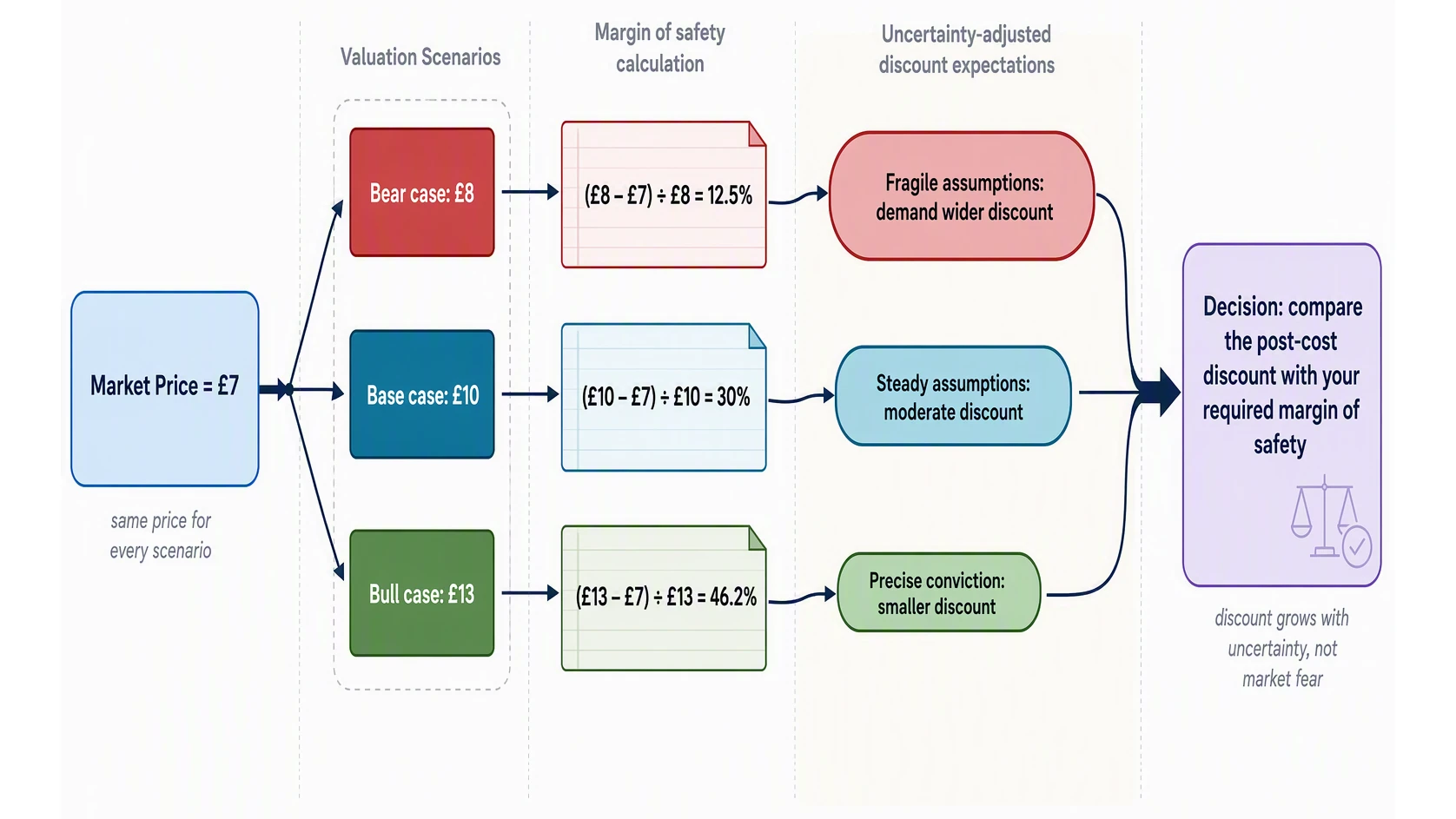
Imagine a FTSE 250 company with straightforward earnings. You build three scenarios:
- Bear case: margins compress, revenue stalls. Intrinsic value = £8 per share.
- Base case: steady growth, in line with history. Intrinsic value = £10.
- Bull case: a new product line lifts returns. Intrinsic value = £13.
Each scenario implies a different discount at today’s market price. But the critical question — the one that turns the formula from a calculator into a decision tool — is which scenario you trust more. If you have high conviction in the base case and see the bear scenario as unlikely, you can accept a smaller discount, perhaps 15%. If the company is cyclical and your base case rests on fragile assumptions, you might demand 35% before buying. The discount should shrink or grow not with market fear, but with the precision of your own conviction.
A 10% to 25% discount is a common starting range for developed-market equities. In the hypothetical market above, a P/E ratio of 17.0× (an earnings yield of approximately 5.88%) gives a rough benchmark for where the broad market trades. But UK-specific costs eat into any apparent discount. Stamp Duty Reserve Tax at a flat 0.5% on purchases of most UK shares (AIM shares are exempt), platform fees, and the dealing spread between bid and ask prices — especially for small-cap or illiquid shares — can erase a 5% margin before you even own the stock. If your calculated discount is 12% and your total transactional frictions amount to 2%, your real starting buffer is only 10%.
This is why the formula is a starting point, not a conclusion. It flags an opportunity, but it does not confirm one. For a practical way to test these ranges, run each scenario’s intrinsic value through the margin of safety calculator. Tools like ARIA PM Home handle survivorship adjustment and cost modelling automatically, so you can focus on interpreting results rather than building the simulation.
Remember: you are not buying a discount to a number. You are buying protection against the possibility that your number is wrong.
Margin of safety in practice: real UK tools, funds and examples
Let’s move from theory to the concrete. The margin of safety is not a fixed percentage you apply to a single intrinsic value; it is the price you pay for the risk that your estimate itself is wrong. The discount should shrink or grow not with market fear, but with the precision of your own conviction. Here is how that plays out in real UK portfolios and tools.
The Temple Bar Investment Trust provides a vivid example. Its managers explicitly buy undervalued UK companies, and by applying a margin of safety through valuation discipline, the trust delivered a 33.9% NAV total return in 2025. This is not about guessing a fair value and buying 40% below it — it is about buying only when the price provides a cushion against your own forecasting errors. Fidelity Special Values takes a similar approach: its managers evaluate downside risk first, asking how much they could lose if their thesis is wrong, and only then consider the upside.
For the DIY investor, practical tools exist to formalise this discipline. A DCF calculator with scenario analysis shows you how wide your range of possible outcomes is: the wider that range, the larger the discount you should demand. Stockopedia screens for value using quality filters, but remember it is a research tool, not a guarantee: a screen that flags a stock at a 30% discount to its estimated intrinsic value still depends on the quality of that estimate.
A classic stock-level pattern is the Graham-style net-net: a cash-generative business trading below its net current asset value. If the market later re-rates it, the discount has protected you while you waited. The lesson: the discount protects you even while the market refuses to agree with your valuation.
Contrast these micro-level opportunities with the market as a whole. In the hypothetical market above, the forward dividend yield is 3.01% while the 10-year gilt yields 5.18%, a gap of over two percentage points; AJ Bell’s October 2026 Dividend Dashboard shows the same pattern in real data, with a 3.3% forecast FTSE 100 dividend yield for 2026 against a 5.40% 10-year gilt. That means an income-only margin of safety does not exist at the index level, and in the hypothetical example the earnings-yield premium over gilts is a thin 0.70 percentage points. Any margin of safety must therefore come from earnings growth, not just dividend income — and that growth is far harder to predict, demanding a wider discount.
ARIA PM handles survivorship adjustment, cost modelling, and regime stress-testing automatically — so you can focus on interpreting results rather than building the simulation.
Ultimately, the margin of safety is a function of your uncertainty, not a market signal. A low-conviction estimate demands a wide discount; a high-conviction one can tolerate a narrower gap. That is the practical distinction — and the core habit to build.
The key inputs that make or break your margin of safety calculation
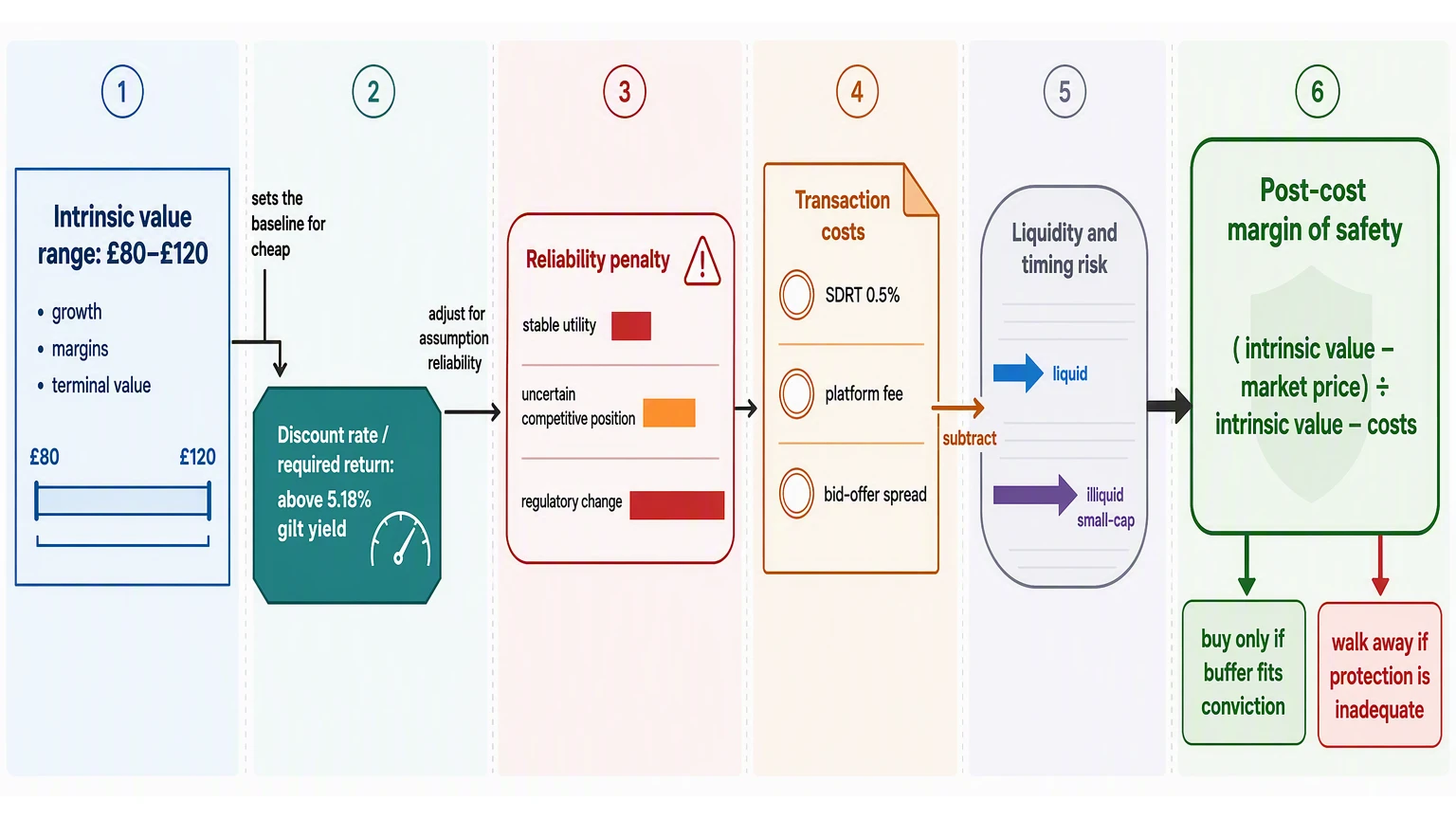
A margin of safety calculation is only as good as the five inputs behind it. Garbage in, garbage out is not a cliché here — it is an arithmetic certainty. Here is what the calculation needs from you, and why each input either protects you or misleads you.
First, your intrinsic value estimate should be a range, not a single number. That £100 you arrived at is usually an estimate produced by assumptions about growth, margins, reinvestment, competition, interest rates, taxes, terminal value, and management. If you think the stock is worth £80-£120, enter the lower bound as your intrinsic value to size the discount. If you only use £100, you assume precision you do not have.
Second, your discount rate or required return sets the baseline for what “cheap” means. The gilt yield (5.18% in the hypothetical example) is your risk-free alternative: if a stock does not beat that after tax and costs, you are taking risk for no reward. But the example’s 3.01% forward dividend yield (AJ Bell put the FTSE 100’s 2026 forecast yield at 3.3% in October 2026) shows that dividend income alone does not beat gilts. Your discount rate must be higher than the gilt yield; how much higher depends on the stock’s risk.
Third, the reliability of your assumptions acts as a penalty factor. Policy uncertainty makes forecasts less reliable, so if you are forecasting cash flows for a company exposed to regulatory change, you should widen the discount. Your conviction level is the real lever here. If you are unsure about a company’s competitive position, demand a bigger discount.
Fourth, transaction costs eat returns before you start. Purchases of most UK shares incur Stamp Duty Reserve Tax (SDRT) at a flat 0.5% (AIM shares are exempt). Dealing costs eat into small-cap value returns: the bid-offer spread on a £5 stock can be 2% each way. A margin of safety that does not account for these frictions is an illusion.
Fifth, liquidity and timing risk matters most for unlisted or small-cap holdings. PISCES private-market investments or illiquid small-caps need a larger discount because you cannot exit quickly. Your target discount should reflect that you may wait years for the market to recognise value.
The most important input is your own conviction level — not market fear or greed. ARIA PM handles survivorship adjustment, cost modelling, and regime stress-testing automatically, so you can focus on interpreting results rather than building the simulation.
Common margin of safety mistakes — and how to avoid them
Common margin of safety mistakes — and how to avoid them
Mistake 1: Treating a low P/E as proof of margin of safety. A share trading on eight times earnings looks cheap — until you learn profits are collapsing. The ratio is backward-looking; margin of safety must be forward-looking. Check whether the earnings base is sustainable. A low P/E in a declining business is a value trap, not a discount. The true margin of safety lies in your ability to forecast future cash flows, not in a multiple pulled from a screen.
Mistake 2: Applying a fixed 30% discount to every intrinsic value estimate. Some businesses — say, a regulated utility with predictable cash flows — might need only a 10% discount to compensate for estimation error. A cyclical miner with volatile earnings might need 50%. The margin of safety should shrink or grow with the precision of your own conviction. If you cannot articulate why 30% is the right number, you are guessing, not calculating.
Mistake 3: Ignoring the tax wrapper. Holding a dividend-paying stock in a general investment account when it could sit inside an ISA changes your effective return. The £20,000 ISA limit means you can shelter gains and dividends from tax entirely. On a £10,000 holding yielding 4%, the £400 of dividends fits inside the £500 allowance on its own, but once your other dividends use the allowance up, basic-rate tax at 10.75% takes £43 a year: modest, but compounded over a decade it matters. Work out the tax impact before you commit capital.
Mistake 4: Forgetting that margin of safety is not portfolio safety. A concentrated position in one 'cheap' stock remains dangerous, however wide your discount. The FTSE All-Share’s 24.0% total return in 2025 shows how quickly markets can run — and how easily a single misjudgement can erase progress. Diversified protection means applying margin of safety across uncorrelated positions, not betting the portfolio on one deep-discount idea. The Markowitz Portfolio Optimisation: Plain English article explains how to balance conviction with spread.
Mistake 5: Assuming the market will recognise value quickly. Convergence between price and intrinsic value is uncertain in timing. Your thesis may be correct — but if it takes three years to play out while the market prefers fashionable growth stocks, your total return suffers. Patience is a necessary assumption, not an optional virtue.
Mistake 6: Double-counting risk. Using ultra-conservative cash flows, a high discount rate, and then a large purchase discount piles pessimism on pessimism. The result is rarely a better investment — it is a false sense of prudence that may leave you sitting in cash while reasonable opportunities pass. State your assumptions explicitly: "I have assumed 3% revenue growth and a 10% discount rate; the 25% purchase price buffers the risk that revenue grows at 1% instead." When you write them down, you expose double-counting.
Finally, consider the real yield context. With UK CPIH inflation at 3.6% in the year to September 2026, a gilt yielding 5.18% (the hypothetical example above) offers a real return of about 1.5% before tax (1.0518 ÷ 1.036 − 1), assuming inflation persists, so bonds are no longer a guaranteed loser. If your equity margin-of-safety estimate does not exceed that real yield by a meaningful gap, the 'safety' may be illusory. Use a Capital Gains Tax Calculator to understand your post-tax hurdle, then size your discount accordingly — not from habit, but from honesty about what you do not know.
Your action plan: using a margin of safety calculator today
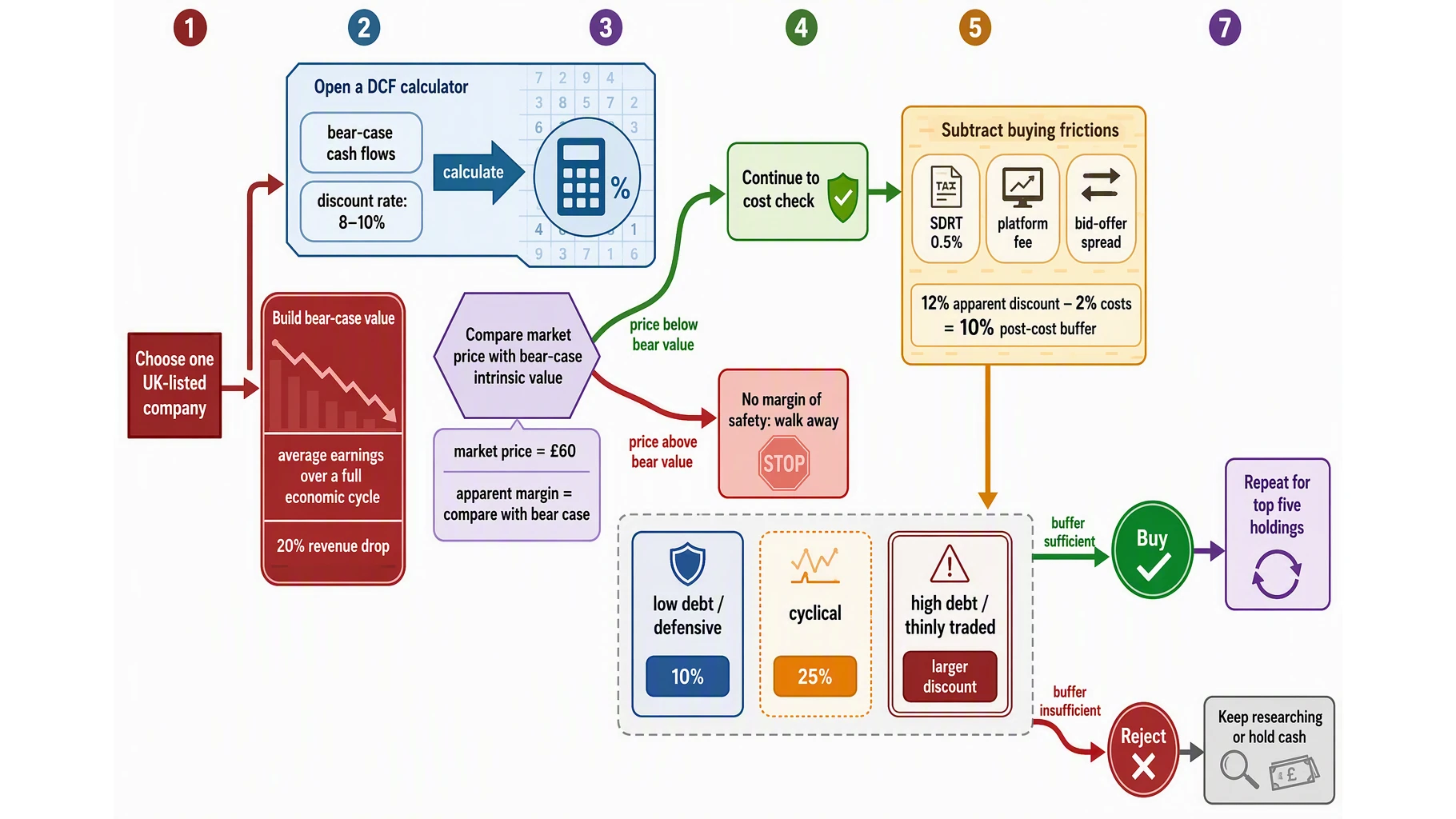
Pick one UK-listed company you already own or are seriously considering. Do not start with a spreadsheet or a Python script. Start with a bear-case value — your worst plausible estimate of what the business is worth. For example, take the company’s average earnings over the last full economic cycle (avoid peak-year numbers). Or apply a 20% revenue drop to its most recent normal year, then run that through a simple earnings multiple. This is not your base case; this is your floor. Check the current market price against that bear-case value. If the stock trades above it, there is no margin of safety on any reasonable definition — you are paying more than the worst plausible outcome, so any estimation error works against you. Half of the battle is admitting that.
Next, open a free online DCF calculator. Input your bear-case cash flows and a discount rate that reflects the company’s cost of equity (commonly 8-10% for a stable UK firm). Do not fudge the terminal value. Look at the output: what is the implied value per share? If the stock trades at £60, the apparent margin against your base case might look large, but against this bear case you may find none. As Professor Damodaran has argued, valuation uncertainty should affect the required margin — it should vary across investments, not be a universal 20%, 30%, or 50% rule.
Now subtract the real costs of buying. Purchases of most UK shares incur 0.5% Stamp Duty Reserve Tax (a flat charge, not a tiered property tax; AIM shares are exempt). Add your platform fee and the bid-offer spread. On a typical platform, costs can eat 1-1.5% of your position before you have even owned it for a day. You are looking for a genuine discount after those deductions.
Decide whether the resulting discount is large enough given three things: the company’s debt level, its cyclicality, and its liquidity. A high-debt, cyclical, thinly-traded stock needs a substantially wider margin than a low-debt, defensive FTSE 100 name. A common rule of thumb is a 10% to 25% margin of safety on the share price, with larger margins reserved for riskier stocks. If your post-cost discount falls below that range for a risky holding, walk away.
Repeat this for your top five holdings. You will quickly see where your portfolio is genuinely protected and where you are relying on hope. If cash is your alternative, remember that with CPI at 3.5% (September 2026), cash has no margin of safety unless returns exceed inflation — which most current accounts do not. ARIA PM handles survivorship adjustment, cost modelling, and regime stress-testing automatically — so you can focus on interpreting results rather than building the simulation.
Remember: at the end of 2023, UK equity funds made up only 11.5% of UK investors’ fund assets (Investment Association), reducing concentration risk but introducing overseas currency exposure. That low allocation itself may be a signal worth studying with a Markowitz approach. The margin of safety is not a fixed number; it is a price you pay for the uncertainty in your own estimate. Size it honestly.
Key Takeaways
- Your margin of safety must shrink or grow with the precision of your own conviction, because the discount insures against your estimate being wrong, not against market volatility.
- A fixed 30% discount is dangerous when cushions are thin: in this article’s hypothetical market, a 0.7-point earnings-yield premium over gilts and a negative income cushion mean you cannot blindly apply historic rules.
- Calculate the required discount by asking how much of your own over-optimism you need to cover, not by choosing a round number.
- A stable utility with regulated cash flows might need only a 10% discount; a speculative growth stock with a guessed terminal value might need 40% or more.
- The formula — (intrinsic value minus market price) divided by intrinsic value — forces you to declare your specific intrinsic value assumptions before you can size the discount.
| Approach | Core Question | When to use it | Risk profile | Example |
|---|---|---|---|---|
| Fixed percentage (e.g. always 20%) | Is the market price below my intrinsic value by a standard amount? | Low-effort screening, especially when you trust your valuation | Ignores uncertainty in your estimate-same discount for a stable utility and a volatile tech stock | Intrinsic value = 100p, buy at 80p regardless of conviction |
| Conviction-adjusted margin of safety | How confident am I that my intrinsic value is right? | When you have done deep research and can estimate a range | Adjusts discount to reflect how precise your estimate actually is | Intrinsic value = 100p, buy at 50p if low confidence, or at 90p if high confidence |
Three common mistakes vs. the correct approach
| Mistake | What it looks like | Why it is dangerous | The right way |
|---|---|---|---|
| Treating low P/E as proof of safety | Buying at P/E of 8 assuming 20% margin of safety | Profits may be collapsing-a backward-looking ratio cannot protect you | Calculate intrinsic value using forward earnings and a bear-case scenario |
| Using a single “right” number | £10 intrinsic value, so buy only below £8 | Your estimate might be wrong by 30% or more-a single discount ignores that risk | Build a range: best case, base case, worst case-then apply the biggest discount to the worst case |
| Applying the same margin to every stock | Always requiring a 20% discount regardless of business quality | A predictable cash-generating utility needs less protection than a cyclical miner | Shrink the discount for high-conviction, predictable businesses; grow it for speculative or volatile ones |
Sources
- Consumer price inflation, UK - Office for National Statistics — Official UK CPI data for adjusting investment return expectations against inflation.
- Amendment to Individual Savings Account Regulations 2026 - GOV.UK — Proposed ISA rule changes affecting tax-free investment allowances from 2026.
- The Individual Savings Account (Amendment) Regulations 2026 - GOV.UK — Government consultation on refining ISA regulations for retail investors.
- PS25/20: Supporting informed decision making: Final rules for Consumer Composite Investments | FCA — FCA final rules on informed decision-making for Consumer Composite Investments.
- fca.org.uk — FCA discussion paper on potential new disclosure rules for investment products.
- United Kingdom Stock Market: current P/E Ratio — Current UK stock market P/E ratio as a benchmark for valuation comparisons.