

You buy shares in a profitable FTSE 250 firm, then it slips into a loss-making year and the expected tax shield on its debt may be delayed or lost. Your position just became riskier without the company’s borrowing changing. The WACC Calculator at the 25% UK corporation tax rate reveals this trap. A typical model assumes the tax shield is a fixed, reliable discount on your cost of debt, but that assumption fails the moment profits turn negative. This article answers one question: how do you measure a tax shield’s real value when your company might not pay tax at all? You do not need a finance degree. You need plain rules for self-directed investors, not a developer’s spreadsheet.
What is a WACC Calculator — and why it matters for your portfolio
You’ve probably wondered how professional investors decide whether a stock is genuinely cheap or just unloved. They don’t guess. They use a benchmark called the Weighted Average Cost of Capital — essentially the minimum return a company must earn to keep both its lenders and shareholders happy. Think of it as the company’s personal break-even cost of money.
A WACC calculator automates this maths. You feed in a few inputs — the company’s debt level, its borrowing cost, the risk premium demanded by shareholders, and the corporation tax rate — and it spits out a single percentage. That number becomes your hurdle rate: if the company’s return on invested capital exceeds its WACC, it’s creating value. If not, it’s destroying it.
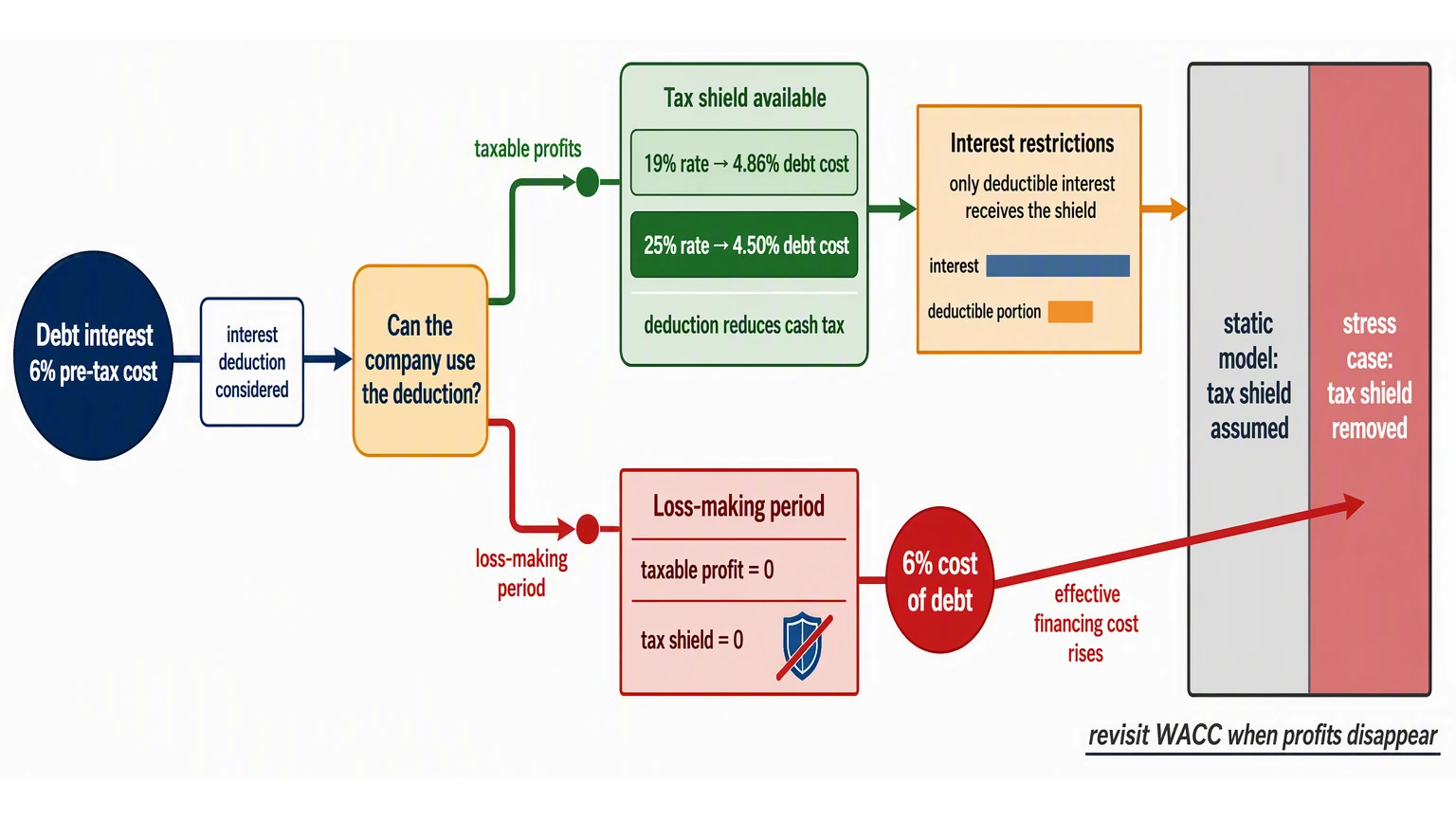
Here’s where the UK context gets interesting. With the main UK corporation tax rate set at 25% for profits above £250,000, the tax shield on debt has real bite. In the conventional wacc formula, the cost of debt is reduced by the tax rate (cost of debt × (1-tax rate)). At 25%, that’s a noticeable saving. To give you a concrete sense of scale: imagine a company with £100m of debt costing 6% interest. At 25% tax, the annual tax saving from the interest deduction is roughly £1.5m — about £360,000 more each year than the same deduction was worth at the old 19% rate. Across a decade, that difference compounds meaningfully.
But here’s the central insight that static models miss: the tax shield isn’t guaranteed. If a company slips into a loss-making period, the deduction no longer cuts its own tax bill for that year. The relief may still be usable straight away, by carrying it back against the previous year’s profits or surrendering it to profitable group companies for the same period; where those routes are unavailable it is carried forward and delayed, or, in the worst case, never used. That makes the true cost of debt more volatile than a simple percentage suggests. A thoughtful investor will stress-test what happens when the tax shield disappears, for example by rerunning ARIA PM’s free WACC calculator with the tax rate set to 0%. This hidden lever — the volatility of the tax shield — is exactly the kind of edge retail investors can use to judge whether a company’s valuation makes sense, without needing an MBA.
How the WACC formula actually works — a step-by-step guide in plain English
Let’s walk through the weighted average cost of capital (WACC) formula with a real UK example — no abstract theory, just the numbers and what they mean for your portfolio decisions.
WACC is simply the average return a company must earn on its investments to satisfy everyone who has given it money: shareholders (equity) and lenders (debt). Think of it as the company’s minimum performance hurdle. If a project returns less than the WACC, it’s destroying value; if it returns more, it’s creating wealth.
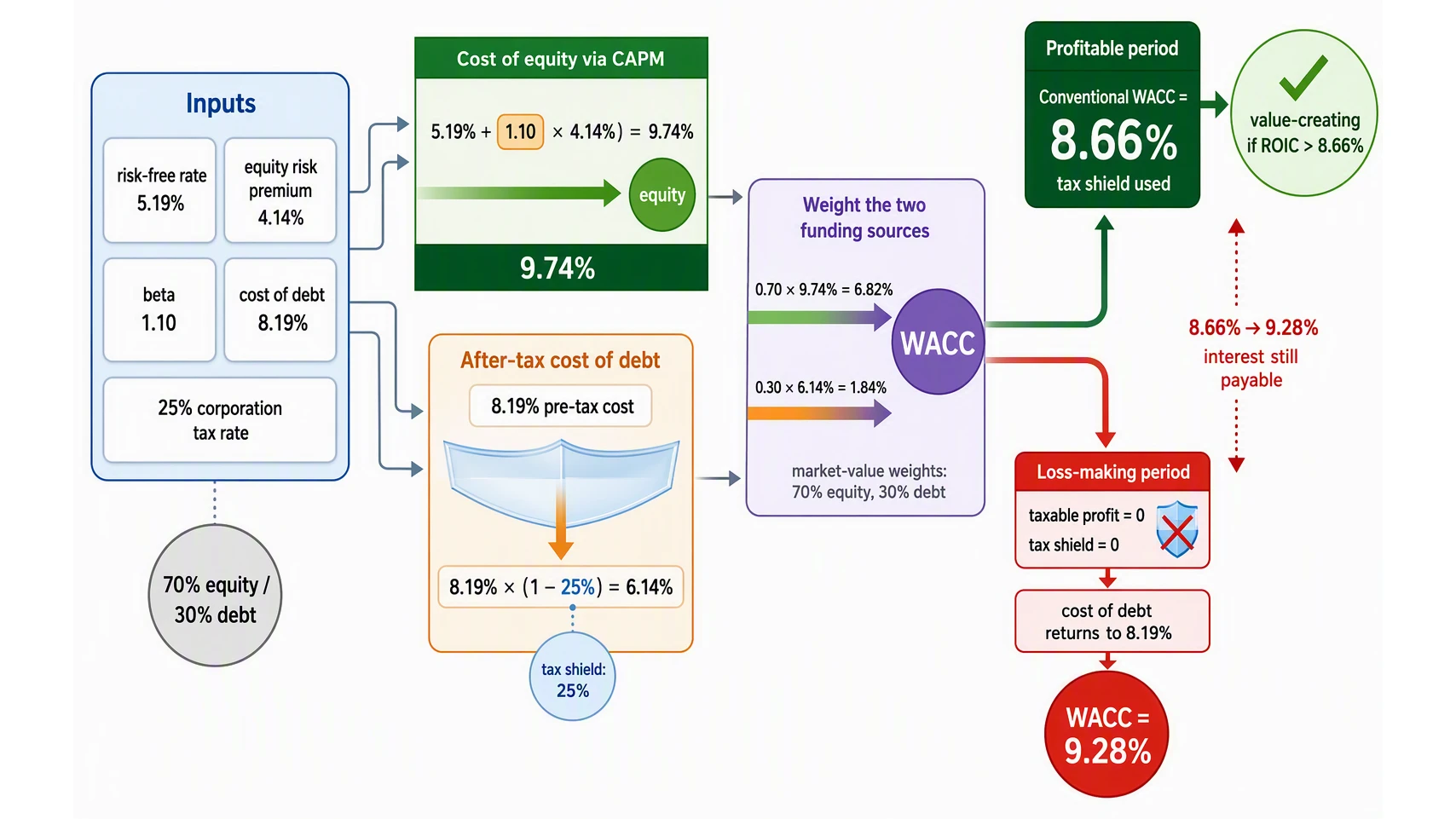
The formula has two building blocks. First, the cost of equity — the return shareholders expect for taking on the risk of owning the stock. We estimate it using the Capital Asset Pricing Model (CAPM), which you can explore with our CAPM Calculator. The formula starts with the risk-free rate (the Bank of England’s 10-year par gilt yield, 5.19% on 9 September 2026), then adds the equity risk premium (the extra return investors demand for holding equities over risk-free assets: 4.14%, Damodaran’s implied premium for mature markets on 1 September 2026) multiplied by the company’s beta (an estimate of how much the stock moves with the market: here, 1.10 means its returns are estimated to move 10% more than the market’s, on average). The cost of equity is: 5.19% + (1.10 × 4.14%) = 9.74%.
Second, the after-tax cost of debt. The company borrows at the risk-free rate plus a spread (here, 5.19% + 3% = 8.19%). But because interest payments are tax-deductible, the government effectively subsidises borrowing. At the 25% UK corporation tax rate, every £1 of interest creates 25p of tax relief, turning that 8.19% pre-tax cost into 6.14% after tax. (For context, a 6% pre-tax borrowing cost becomes 4.5% after tax under the same logic.)
Now weight each by the company’s capital structure — 70% equity, 30% debt. The WACC is (0.70 × 9.74%) + (0.30 × 6.14%) = 8.66% (approximately).
What this example reveals — and what static models hide — is that the 25% tax shield is fragile. A company that falls into a loss-making period gets no cut in its own tax bill that year. The relief may still be used through carry-back or current-period group relief, or be carried forward and so delayed, but in a no-usable-relief scenario the effective cost of debt jumps back to 8.19%, and the 8.66% WACC becomes 9.28% — a swing that can reclassify a marginal investment from viable to value-destructive. Changing debt levels or beta amplifies the effect further.
Understanding this dynamic is critical when using a WACC calculator to value UK stocks. Tools like ARIA PM handle survivorship adjustment, cost modelling, and regime stress-testing automatically — so you can focus on interpreting results rather than building the simulation.
WACC in practice: real UK examples and tools you can use today
Let’s get practical. You can test how the 25% corporate tax rate changes the numbers yourself today, using a free online wacc calculator tuned for UK assumptions. Sites like UKCalculator’s WACC tool (marked as verified in April 2026) let you plug in a company’s equity and debt values, borrowing cost, and Equity Beta: that estimate of a stock’s sensitivity to market moves, which drives the cost of equity via the CAPM formula. The real insight is in the dial: switch the corporation-tax assumption from 19% to 25% and watch the weighted average cost of capital shift.
That shift looks small in isolation — on a 40% debt structure with a 6% pre-tax cost of debt it works out at about 14 basis points — but it compounds across multi-billion-pound investment programmes. Consider how UK water companies like Affinity Water and Pennon Group operate: their PR24 models and price-review submissions commonly build in the 25% main corporation-tax rate. Those firms justify decades-long infrastructure plans using a WACC that assumes the tax shield is stable. Yet the central thesis here is uncomfortable: the tax shield’s value is not constant. In a loss-making year (and water companies have had them, when inflation-linked revenue caps clashed with surging debt costs), that shield may be deferred or lost, amplifying capital structure (use) risk in ways static models hide.
The concrete action for you: go to one of those calculators, enter a well-known UK company’s approximate debt ratio and borrowing cost. Use an Equity Beta of around 0.7 for a utility or 1.2 for a mid-cap industrials firm. Then toggle the tax rate from 19% to 25%. The difference is small but real. If a company has £500 million of debt at 5% interest and a 1.0x debt-to-equity ratio, that six-point tax-rate change saves roughly £1.5 million in annual financing cost — money that either drops to the bottom line or funds a dividend. ARIA PM handles survivorship adjustment, cost modelling, and regime stress-testing automatically — so you can focus on interpreting results rather than building the simulation.
This exercise is not about predicting the exact weighted average cost of capital to two decimal places. It’s about developing a feel for how financing assumptions drive valuation. Pair this with a DCF calculator to see whether that lower WACC justifies a higher share price, or use the CAPM calculator to stress-test how a rising Equity Beta changes the cost of equity.
The two biggest numbers that change everything — debt ratio and tax rate
Let’s start with the most powerful lever a retail investor can pull in any WACC calculator: the debt-to-equity ratio. In our base case, a company financed with 70% equity and 30% debt produces a WACC of 8.66%. That is the middle of the road. Now, shift the capital structure to 60% equity and 40% debt — a more aggressive use of borrowing — and the WACC drops to about 8.30%. Why? Because debt is cheaper than equity, especially after you account for the tax deduction on interest payments. Conversely, if the company plays it safer with 80% equity and only 20% debt, the WACC rises to 9.02%. That 0.72 percentage-point swing between the two extremes might look modest on paper, but over a decade, the compounding effect is material — imagine £10,000 growing at 8.30% versus 9.02% per year. The weighted average cost of capital formula always rewards use in a static model, but that reward comes with a hidden trap, which we will get to shortly.
The second big number is the tax rate itself. Change nothing else in the WACC formula except the corporation tax rate, and watch the result shift. At 0% tax (the no-usable-relief scenario, as if the company could never use the deduction) the WACC is 9.28%. Drop the UK main rate to the previous 19%, and WACC falls to 8.81%. At today's 25% rate, it settles at 8.66%. The pattern is clear: each 1% increase in the tax rate reduces WACC by roughly 0.02 to 0.03 percentage points for a typical company. That is a small number, but it accumulates. Over a long holding period, a 0.61 percentage-point gap between 0% and 25% tax assumptions adds up to real pounds in your pocket — or, if you get the assumption wrong, a significant miscalculation of a company's true cost of capital.
But here is the insight the static model hides, and the reason you need to look beyond the WACC calculator output. The tax shield is not a guaranteed discount. A company must have taxable profit to use it, now or in another period. If a firm has high debt but thin or volatile profits (or worse, recurring losses), that 25% tax rate overstates the shield in its cost of capital. Loss carry-back and current-period group relief can keep the deduction working without delay; where those routes are unavailable the relief is carried forward and the shield is delayed, and if the relief can never be used the true cost of debt is its pre-tax level. This is where a retail investor can spot red flags. If you see a highly indebted company with erratic earnings, the WACC the calculator spits out is too optimistic. A useful tool like ARIA PM handles survivorship adjustment and regime stress-testing automatically. To see what happens to the cost of capital when profits disappear, rather than assuming the tax shield lasts forever, rerun the WACC calculator with the tax rate set to 0%.
For UK investors, there is another subtlety. 25% is the UK main rate for companies with profits above £250,000, not a universal effective tax rate. Many smaller listed firms pay less, and some pay more through surcharges. A calculator should not automatically apply 25% to every UK company. If you are evaluating a retailer or a property investment trust with significant debt, compare its effective tax rate over the last three years against the statutory rate. A persistent gap may mean the company is not getting the full benefit of the tax shield — and that makes its debt less cheap than the WACC formula assumes. Before you rely on any output, always check whether the company is actually profitable enough to use the deduction. That single check separates a realistic valuation from a misleading one.
Common mistakes investors make with WACC — and how to avoid them
A static assumption of 25% is the first mistake many investors make, but the real danger is treating the tax shield as a guaranteed discount on borrowing. Let us walk through the six most frequent pitfalls.
1. Using 25% for every UK company. The headline rate does not apply universally. The small-profits rate of 19% applies to profits of £50,000 or less, with marginal relief phasing in the rate between that threshold and £250,000. Many growth-stage AIM-listed companies, or those with modest profits, will pay far less than 25%. If you apply the full rate to their WACC, you overstate the tax shield and understate the true cost of capital. Rule: Check the company’s effective tax rate in its last three annual reports, not just the statutory headline.
2. Ignoring interest restrictions. The UK Corporate Interest Restriction can limit deductions once a group’s net interest expense exceeds £2 million a year, the minimum allowance every group gets. Under the default fixed-ratio method, the cap is 30% of tax-EBITDA, but no more than the group’s worldwide net interest expense (the debt cap); a group can instead elect the group-ratio method, which can permit a higher deduction when its third-party borrowing is high relative to its earnings. A 6% borrowing cost does not become 4.5% (75% of 6%) if the company cannot deduct the full interest amount. The shield applies only to the proportion of interest that is actually deductible. Rule: Adjust the after-tax cost of debt for any disallowed interest — use the group’s interest cover ratio as a guide.
3. Using book values instead of market values. Many investors pull the debt-to-equity ratio straight from the balance sheet. Book equity often bears no relation to market capitalisation, especially for older companies with retained earnings or intangibles. A ratio that looks conservative on paper can reveal aggressive use when market values are used. Rule: Use the market value of equity (share price × shares outstanding) and the market value of debt (or its fair-value estimate) for any WACC calculation that drives an investment decision.
4. Confusing the company’s tax rate with your personal tax rate. The corporate WACC is about the firm’s capital structure, not your dividend tax band or capital gains position. Your personal tax situation — the £500 dividend allowance, the £3,000 CGT exempt amount, or your ISA wrapper — is a separate evaluation. Mixing them leads to a cost-of-capital figure that is meaningful to nobody. Rule: Keep corporate cost-of-capital analysis inside the company’s tax regime, then overlay your personal tax treatment at the portfolio level as a separate step.
5. Treating WACC as fixed. The weighted average cost of capital shifts with every interest-rate decision, risk-premium change, or performance cycle. The September 2026 gilt yield of 5.19% produces a materially different WACC than the yield prevailing two years ago. Rule: Re-estimate WACC at least quarterly, and always use current risk-free rates and equity-risk-premium estimates, not trailing averages.
6. Overlooking loss-making periods. This is the hidden risk the conventional formula ignores. If a company reports losses, it has no taxable profit of its own to shield that year: interest is still payable in cash, and the relief keeps its timing only if it can be carried back or surrendered to group companies for the same period; otherwise it is carried forward and delayed. If it can never be used, the after-tax cost of debt reverts to the pre-tax rate, making the real cost of borrowing much higher than the textbook calculation suggests. Rule: Stress-test WACC under a loss scenario. As a no-usable-relief scenario, assume a zero tax shield for any period where the company is not generating taxable profits, and revisit the company’s history of tax-paying status.
A 25% assumption may overstate the tax shield where losses, tax attributes, international structures, or UK interest restrictions prevent full deductibility. The ARIA platform handles survivorship adjustment, cost modelling, and regime stress-testing automatically — so you can focus on interpreting results rather than building the simulation.
Your practical action plan: using WACC to make better investment decisions
Here’s your practical action plan. You do not need a finance degree to master this — just a willingness to question a number most investors take on trust.
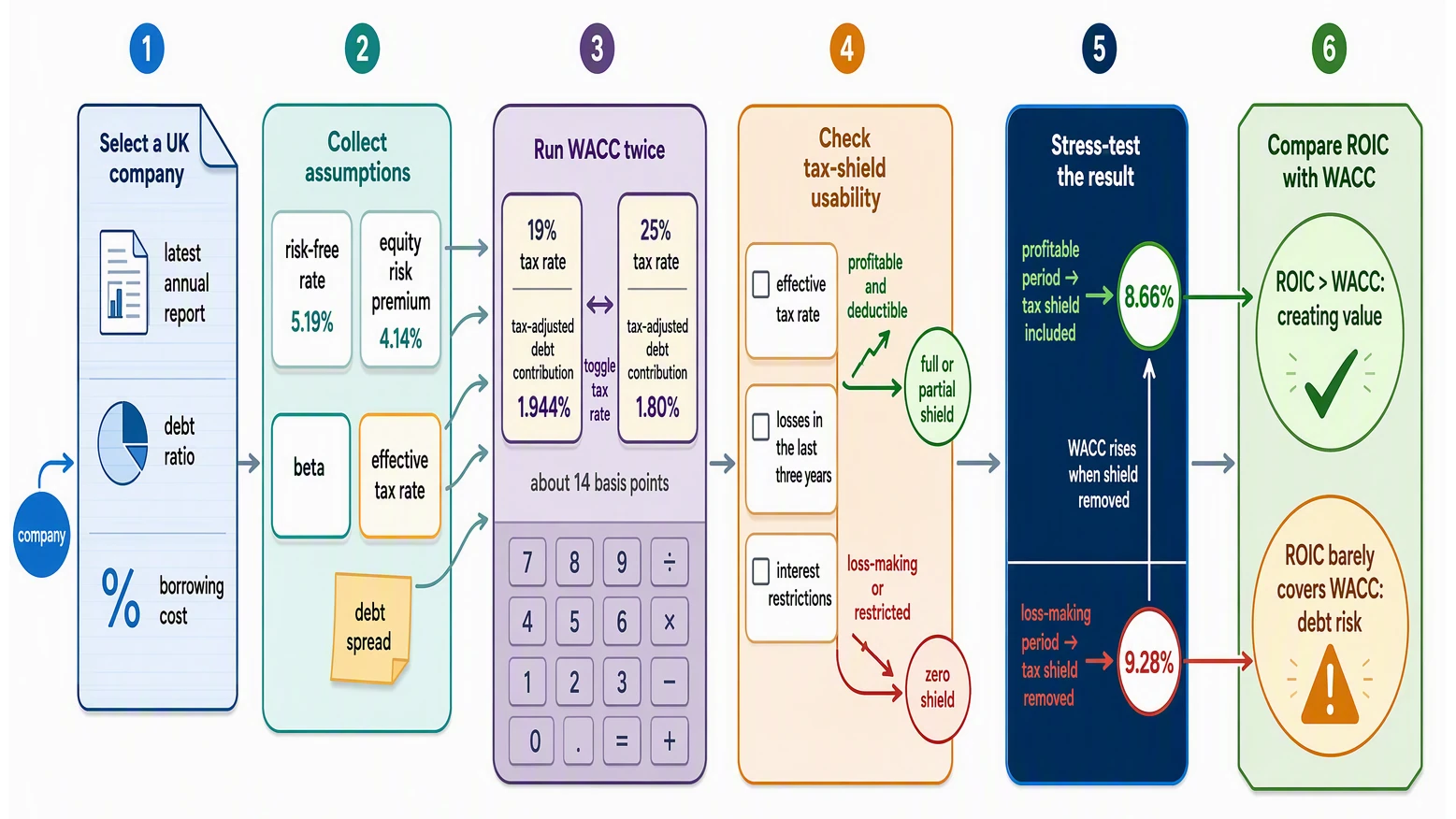
Step 1: Find a free, UK-focused WACC calculator. Begin with UKCalculator, and read the WACC material on the CLFI site. UKCalculator’s tool asks for the corporation tax rate (its guidance suggests 25% for profits above £250,000) and is labelled always free. Bookmark it: you will use it repeatedly.
Step 2: Pick a UK company you are considering for your portfolio. Open its latest annual report (the ‘strategic report’ section is fine) and note three numbers: its debt-to-equity ratio, its credit rating (or the interest rate it pays on borrowings), and its effective tax rate. If the company has profits between £50,000 and £250,000, remember that Marginal Relief applies: the average tax rate is not 25% but a tapered rate between 19% and 25%, while each extra £1 of deductible interest in that band saves 26.5p (the marginal rate). Use that marginal rate for the tax shield, not the headline rate, or your WACC will be wrong.
Step 3: Input reasonable assumptions. For the risk-free rate in a UK valuation, this example uses the 10-year gilt yield: the Bank of England’s 10-year par yield was 5.19% on 9 September 2026 and about 5.3% to 5.4% through October 2026. For the equity risk premium, use an implied mature-market proxy: on 1 September 2026 Damodaran's implied mature-market proxy sat at 4.14% — a mature-market figure, not a UK-only statistic. Pull the company’s beta from Yahoo Finance or Simply Wall St, and check which index it is measured against. For the debt spread, use the company's own borrowing cost over the 10-year gilt; a spread of around 3.00% is the working assumption the worked example below uses. Be conservative.
Step 4: Run the WACC calculation twice — once at 19% and once at 25%. The difference is smaller than most people expect. A company with 40% debt and a 6% pre-tax cost of debt shows a tax-adjusted debt contribution of 1.944% at 19% and 1.80% at 25% — about 14 basis points of total WACC. Small, but on a long-duration asset even a few basis points move enterprise value by millions.
Step 5: Compare the resulting WACC to the company’s return on invested capital (ROIC). This is the core test. If ROIC sits comfortably above WACC over several years, the company is compounding value. If ROIC barely covers WACC, every pound of debt is a risk you are not being paid to take.
Step 6: Check profitability history. If the company reported a loss in any of the last three years, reduce the effective tax benefit in your WACC calculation, down to zero for those periods if the losses cannot be carried back, carried forward or group-relieved. A tax shield that can never be used is worth nothing, and one that is deferred is worth less. The conventional WACC formula assumes permanent profitability; real-world investing requires you to adjust for the volatility the formula ignores.
The free platform ARIA PM handles survivorship adjustment, cost modelling, and regime stress-testing automatically — so you can focus on interpreting results rather than building the simulation.
Mastery of WACC does not require advanced finance training — just curiosity and a willingness to question assumptions. A retail investor who understands this one metric is already ahead of most market participants.
Key Takeaways
- At the 25% main UK corporation tax rate, the tax shield on debt is worth £1.5m annually on a £100m loan at 6% interest.
- This shield can be delayed, reduced or lost during loss-making periods, making the true cost of debt spike higher than the standard WACC model suggests.
- Static calculators hide this risk: a company’s WACC is not a fixed number but a volatile range that depends on its ability to generate taxable profits.
- Investors using a Dividend Yield Calculator must discount future payouts more heavily for firms with volatile earnings, as the tax shield cannot be relied upon every year.
- A portfolio tool that stress-tests for loss-making regimes captures the real cost of capital better than a simple static WACC input can.
| Aspect | Static WACC Assumption | Dynamic WACC Approach |
|---|---|---|
| Tax shield treatment | Fixed 25% reduction on cost of debt | Variable, dependent on ability to use |
| Loss-making periods | Tax shield still assumed | Tax shield may be delayed, reduced or lost |
| Risk visibility | Hidden, amplified by formula | Explicitly modelled |
| Best suited for | Profitable, stable companies | Cyclical or recovering businesses |
| Investor mistake | Overvaluing debt-heavy firms | Underestimating downside risk |
| Practical tool | Standard WACC calculator | Scenario analysis with free UK calculator |
Common Mistakes in WACC Tax Shield Calculations
| Mistake | What investors do | What actually happens | Better approach |
|---|---|---|---|
| Fixed tax rate | Assume 25% forever | Rate can change; losses can delay or remove the shield | Test multiple tax scenarios |
| Ignoring debt ratio | Use any ratio without context | 70% equity vs 30% debt gives 8.66% WACC | Always use company-specific use |
| Guaranteed shield | Treat tax saving as certain | Shield only cuts tax when there is taxable profit to use it | Model with and without shield |
| Over-reliance on single tool | Trust one WACC calculator blindly | Different tools give different results | Use verified UK-focused calculator (UKCalculator's WACC tool) |
| Static lifecycle | Same WACC for all periods | Shield varies with earnings cycles | Run annual scenarios for 3-5 years |
Sources
- Finance Act 2026 — Finance Act 2026 enacts the 25% corporation tax rate for UK companies.
- Corporation Tax rates and allowances - GOV.UK — Corporation Tax rates and allowances confirms the current 25% main rate.
- Capital allowances: new first-year allowance and reducing main rate writing-down allowances - GOV.UK — Capital allowances details how asset depreciation affects tax shields and WACC.
- The reform of transfer pricing, permanent establishment and Diverted Profits Tax - GOV.UK — Transfer pricing reforms impact multinational firms' effective tax rates and WACC.
- Stamp Duty Reserve Tax — UK Listing Relief - GOV.UK — Stamp Duty Reserve Tax relief changes may affect equity costs in WACC.
- Listing applications, amendments, suspensions and cancellations | FCA — FCA listing rules influence cost of equity for UK-listed retail investor stocks.