

You have two retirement pots — one tax-free, one taxable. A Pension Drawdown Calculator tells you which to empty first. Sequenced poorly, the “lowest tax now” approach drains your most efficient pot early. Depending on your allowances, balances and other income, that can shrink your overall portfolio lifespan, because more of your later income is taxed at higher rates. The result can be higher total tax paid, not lower. This article shows you when that ordering logic backfires. You will learn how to sequence SIPP withdrawals to minimise lifetime tax, not just this year’s bill. No coding knowledge is needed. If you manage your own drawdown, this is how you stop leaving money on the table.
What is a pension drawdown calculator — and why it matters for your SIPP
Here’s the contradiction that trips up thousands of new retirees every year: the strategy that looks cheapest today often costs you the most over your lifetime.
A pension drawdown calculator is a tool that models how different withdrawal orders affect how long your money lasts. It does not just calculate this year’s tax bill — it projects the cumulative, compounding effect of every choice, year after year. With 349,992 new drawdown plans opened in 2024/25 — a 25.5% rise, per FCA data — and roughly 55% of those people using no regulated advice, this decision is being made every day without professional help.
The stakes are high. The most consequential insight is this: sequencing withdrawals to minimise your immediate tax bill can raise your long-term tax exposure. Why? Because it ignores the compounding interaction between portfolio growth, future tax brackets and the unspoken risk that the “lowest tax now” strategy can inadvertently drain your most tax-efficient pots first. You might, for example, exhaust your dividend allowance (currently £500 of dividend income) or burn through your £20,000-a-year ISA allowance timeline without realising that drawing from a general investment account first — even if it triggers capital gains tax today — could keep your pension pot compounding tax-free for years longer.
Think of your retirement pots like a set of buckets. If you drink from the smallest, most-advantaged bucket first because it tastes sweetest today, the larger, less-efficient buckets may have to work much harder, and pay more tax, later. Interactive Investor found that 49% of its SIPP drawdown customers took the full 25% tax-free lump sum: a big step to take without modelling the long-term impact on your portfolio’s lifespan.
This article promises a plain-English framework to think about the order you take SIPP income, grounded in real data — not personal advice. Before you stress-test your own withdrawal order, track your pots side by side in a tool like ARIA PM, which handles survivorship adjustment, cost modelling, and regime stress-testing automatically — so you can focus on interpreting results rather than building the simulation. The goal is simple: help you understand the trade-offs so you can ask better questions — of a financial adviser, or of yourself.
How a pension drawdown calculator actually works: a step-by-step guide
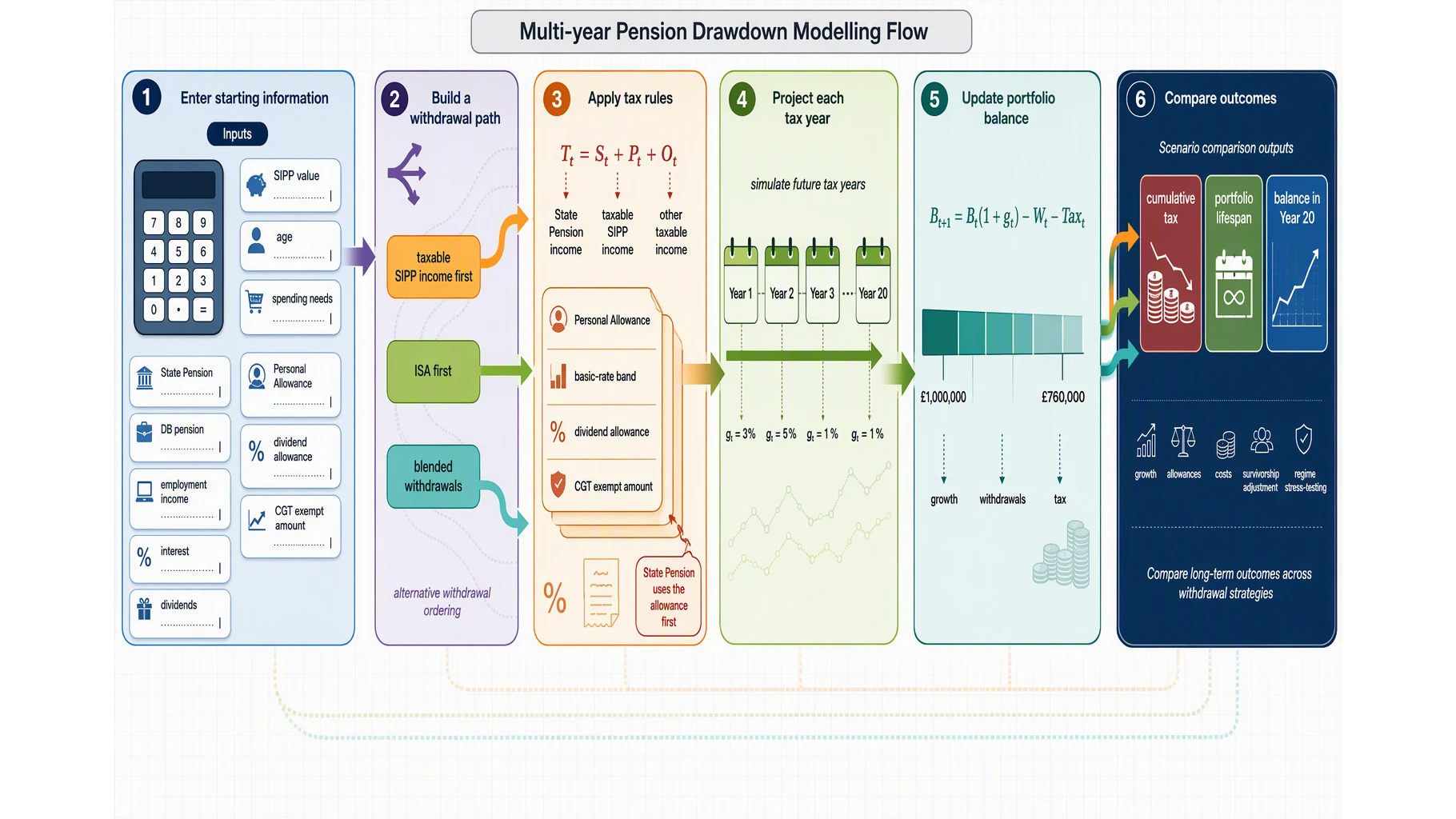
Under the hood, a pension drawdown calculator is performing a series of what-if simulations across your entire retirement timeline. It starts by asking for the same information you would need to map out your finances on paper: your SIPP value, your other income streams — whether that is the State Pension, a defined-benefit (DB) pension, employment income, interest, or dividends — your spending needs, your age, and your current tax allowances (the Personal Allowance of £12,570, the basic-rate band, the dividend allowance of £500, and the CGT exempt amount of £3,000).
The basic logic is surprisingly straightforward: the calculator models different "paths" through your pots. For example, it might test taking taxable SIPP income first, withdrawing from your ISA savings before touching your SIPP, or a blended approach that pulls from both simultaneously. The crucial step happens next: the calculator projects each path forward across multiple tax years, applying your assumed investment growth and adjusting for future tax-bracket changes.
This is where the real-world complexity emerges. Consider someone receiving the full new State Pension of £12,547.60. Their Personal Allowance is almost entirely used up before they take a penny from their SIPP. A calculator that naively assumes the full £12,570 allowance is available for pension income would dramatically overstate the tax efficiency of SIPP withdrawals. A sophisticated model accounts for this by deducting your State Pension from your allowance first.
The calculator’s value isn't in producing a single "correct" number — it is in comparing scenarios. The most consequential trade-off is between minimising your tax bill today and minimising it over your full retirement. Drawing tax-free money first (ISA or tax-free cash) might appear cheaper now, but if you drain your most tax-efficient pots early, you can shorten the portfolio's lifespan, depending on your allowances, balances and other income. The real insight is that sequencing withdrawals to chase immediate tax savings can inadvertently expose you to higher future tax rates, because a larger taxable pension is left to draw later.
This approach also helps you see how your withdrawal order interacts with other decisions, such as deferring your State Pension — a move that adds roughly £13.94 extra a week for life to a full new State Pension for every 52-week deferral — and how that changes your available allowance in later years.
This is not personal advice; it is a way to understand the mechanics. The goal is to compare paths — especially the tension between low tax now and low tax over your full retirement — so you can make an informed choice about your withdrawal order.
Pension withdrawal order in practice: real examples and platforms
The Pension withdrawal order in practice: real examples and platforms
Industry data from Interactive Investor shows how widely retirement strategies diverge in practice. Among its SIPP drawdown customers from April 2019 to March 2025, 49% withdrew the full 25% tax-free lump sum, while 29% took less than 10% of their tax-free entitlement. Those are two radically different opening moves, and each sets a different trajectory for long-term portfolio survival. Separately, in ii’s 2023 Great British Retirement Survey, 25% had used some or all of their withdrawals to repay debts or a mortgage — a decision that trades future portfolio growth for immediate financial relief.
A hypothetical couple, Colin and Jean, shows a deliberate alternative. They hold roughly £1 million across pensions and savings, targeting a £40,000 annual household income. They take £15,800 each year from each partner’s pension using only their tax-free cash (PCLS) entitlements, then top up from ISAs and investment bonds. The result is a fully tax-free income structure — no income tax at all — while the rest of their pension pots stays invested and growing. But by the logic of this article it is worth testing against a version that also uses each partner’s £12,570 personal allowance with taxable pension income, because that allowance otherwise goes unused every year.
A hypothetical ‘Mr Pink’ demonstrates a phased crystallisation. He crystallises 80% of his £500,000 SIPP, takes £100,000 tax-free to repay his mortgage, and leaves the residual £300,000 invested within the crystallised account. He then draws £10,000 a year — a pace that, with no other income, stays within his personal allowance and avoids triggering higher-rate tax. By phasing, he preserves access to future tax-free cash on the uncrystallised £100,000 and keeps the bulk of his portfolio working. Only around 45% of drawdown entrants in 2024/25 used regulated financial advice, which means most retirees are navigating these trade-offs alone — often without a clear view of how withdrawal order affects portfolio longevity.
Platform functionality is also evolving around drawdown. The Aberdeen SIPP’s ‘Drawdown Price Lock’ (on its adviser platform) locks in the platform charge rate a client pays when they move into drawdown, with monthly rechecks. This matters because costs, like the order of crystallisation — which pot, in which tax year — compound over decades.
The scale of this market is enormous. FCA data shows total pension withdrawals reached £70.9 billion in 2024/25, up 35.9%, with tax-free cash alone hitting £18.3 billion — a 62.6% surge amid speculation about future rule changes. Drawdown now accounts for approximately 36.4% of all pension plans accessed for the first time. As more retirees enter this territory, the order they draw income from different pots can affect not just this year’s tax bill, but whether their portfolio survives the full retirement horizon. Tools like ARIA PM handle survivorship adjustment, cost modelling, and regime stress-testing automatically — so you can focus on interpreting results rather than building the simulation. Understanding the mechanics through a pension drawdown calculator is the essential first step before committing to any withdrawal sequence.
This section explains the trade-offs and real-world strategies. It is not personal financial advice — speak to a regulated adviser before making pension withdrawal decisions.
The key metrics and scenarios your drawdown calculator should compare
The key metrics and scenarios your drawdown calculator should compare
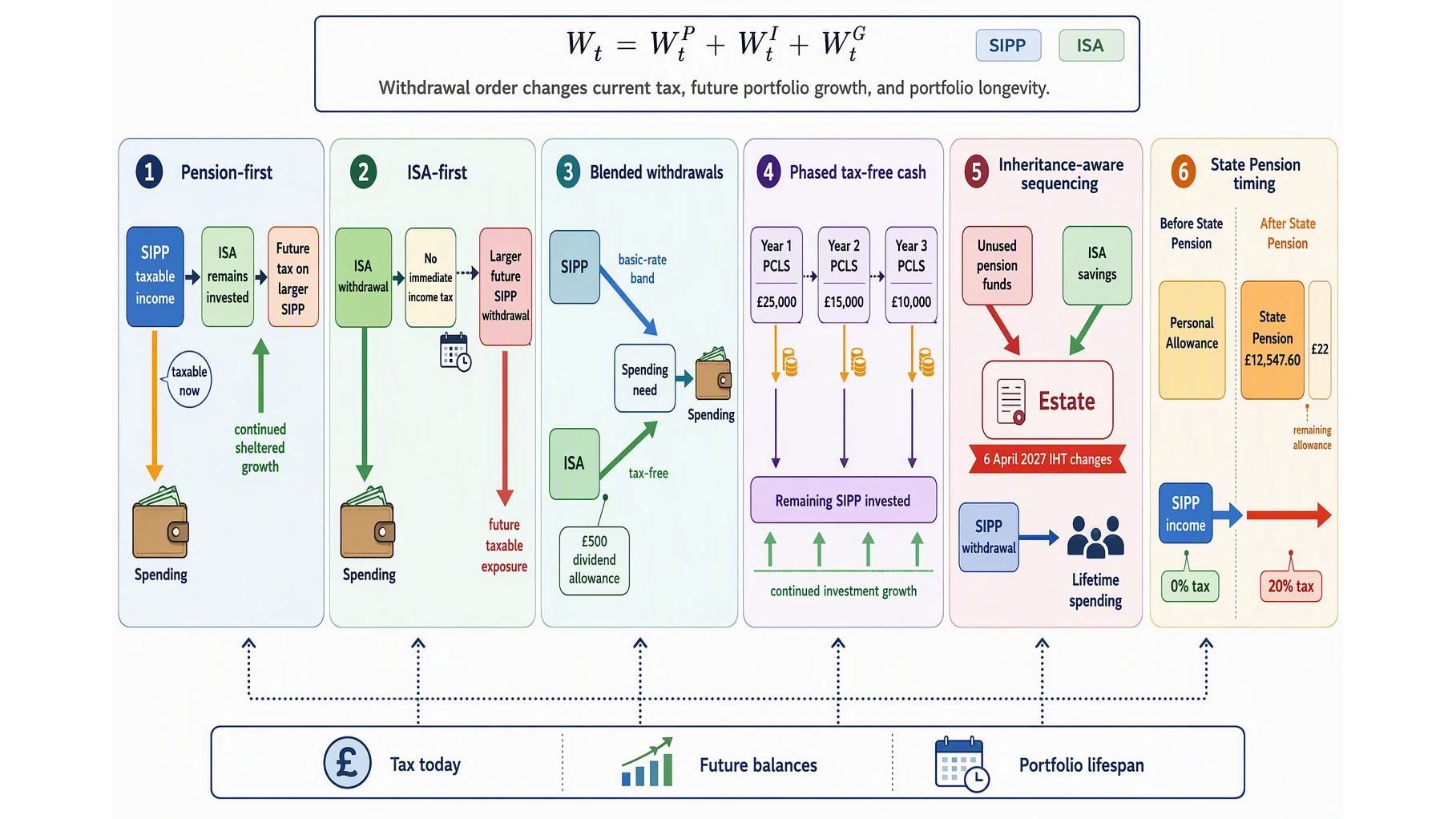
A competent drawdown calculator lets you test the tax consequences of your withdrawal order before you commit. Running these six scenarios side-by-side, using 2026/27 rates, reveals how much the sequence of withdrawals — not just the total — determines what you keep. This is not personal advice; it is the mechanical logic you need to understand the numbers.
1. Pension-first — draw taxable SIPP income early and leave ISAs untouched. Before: you pay income tax on every taxable pound above your personal allowance now, but the ISA continues growing tax-free. After: the SIPP shrinks while the ISA keeps growing, so later spending can come from the ISA without adding to your taxable income. The short-term tax pain is real — but if it uses allowances and lower bands you would otherwise waste, it can lower your lifetime tax bill.
2. ISA-first — use tax-free ISA money while the pension stays invested. Before: no immediate income tax, because ISA withdrawals are tax-free. After: the SIPP compounds without being eroded by withdrawals, so future taxable income can be significantly higher. If you live long enough to deplete the ISA, the remaining pension, beyond any tax-free cash, is then subject to your marginal rate at that point — possibly pushing you into a higher bracket than you are in today.
3. Blended withdrawals — take just enough SIPP income to fill the basic-rate band, then cover the rest from ISAs. Before: you use your £12,570 personal allowance and the next £37,700 at 20%, so the blended tax rate stays below 15%. After: you preserve more of the ISA for later years, and the SIPP is drawn down gradually rather than all at once. The dividend allowance of £500 for 2026/27 means any dividend income outside an ISA above that amount is taxed at 10.75% even within the basic-rate band — so a blended strategy also manages that cliff edge.
4. Phased tax-free cash — take pension commencement lump sums (PCLS) in several chunks rather than one 25% lump sum. Before: a single PCLS crystallises 25% of the whole pot tax-free at once. After: taking PCLS in stages leaves the rest of the pot uncrystallised, so future tax-free cash stays available. Taking only tax-free cash, whether in one go or in stages, does not normally trigger the Money Purchase Annual Allowance (MPAA) , which limits future pension contributions to £10,000 a year. If you take more than the tax-free cash from a flexible pension (taxable drawdown income or an UFPLS), the MPAA is triggered — so phasing tax-free cash without taking taxable income can keep future contribution options open.
5. Inheritance-aware sequencing — model the impact of the 6 April 2027 IHT changes, which will bring most unused pension funds into the estate for Inheritance Tax. Before: the conventional wisdom was "preserve the pension for your children because it sits outside your estate." After: once pension funds become part of the estate for IHT, the old logic collapses. Taking more from the SIPP during your lifetime and gifting surplus income, or using ISAs that already sit inside your estate, may actually reduce the overall IHT bill. The calculator should show the IHT difference explicitly.
6. State Pension timing — compare the tax treatment before and after State Pension starts. Before State Pension age, your personal allowance covers more of your other income because there is no State Pension to stack against it. After: the full new State Pension of £12,547.60 uses all but £22.40 of your personal allowance, making the taxable part of your SIPP income (beyond any tax-free cash) taxable at 20% almost from the first pound. The calculator should show your marginal rate before and after this change, because it can shift a blended strategy from 0% tax to 20% on the same withdrawal amount.
You do not need to run all six. The point is to identify which two or three scenarios are most relevant to your own tax position, pot size, and inheritance goals. ARIA PM handles survivorship adjustment, cost modelling, and regime stress-testing automatically — so you can focus on interpreting results rather than building the simulation.
Common pension drawdown sequencing mistakes — and how to avoid them
Let’s look at the most destructive sequencing errors, and how a pension drawdown calculator can help you sidestep each one.
Mistake 1: Taking the full 25% tax-free cash immediately, without a plan. That lump sum feels like a win, but it is not economically free. Once the money leaves the tax-advantaged SIPP, it can only grow inside a general investment account or an ISA (capped at £20,000 a year). Any future dividends or capital gains outside the ISA are taxable — the £3,000 CGT annual exempt amount is quickly eaten up, and dividend tax at 10.75% to 39.35% applies above a tiny £500 allowance. By contrast, money left inside the SIPP grows free of income tax and CGT until withdrawal. An alternative worth testing: phase your tax-free cash gradually, using UFPLS (Uncrystallised Funds Pension Lump Sum) or partial withdrawals to keep the bulk of the pot sheltered. Let compounding work inside the wrapper as long as possible.
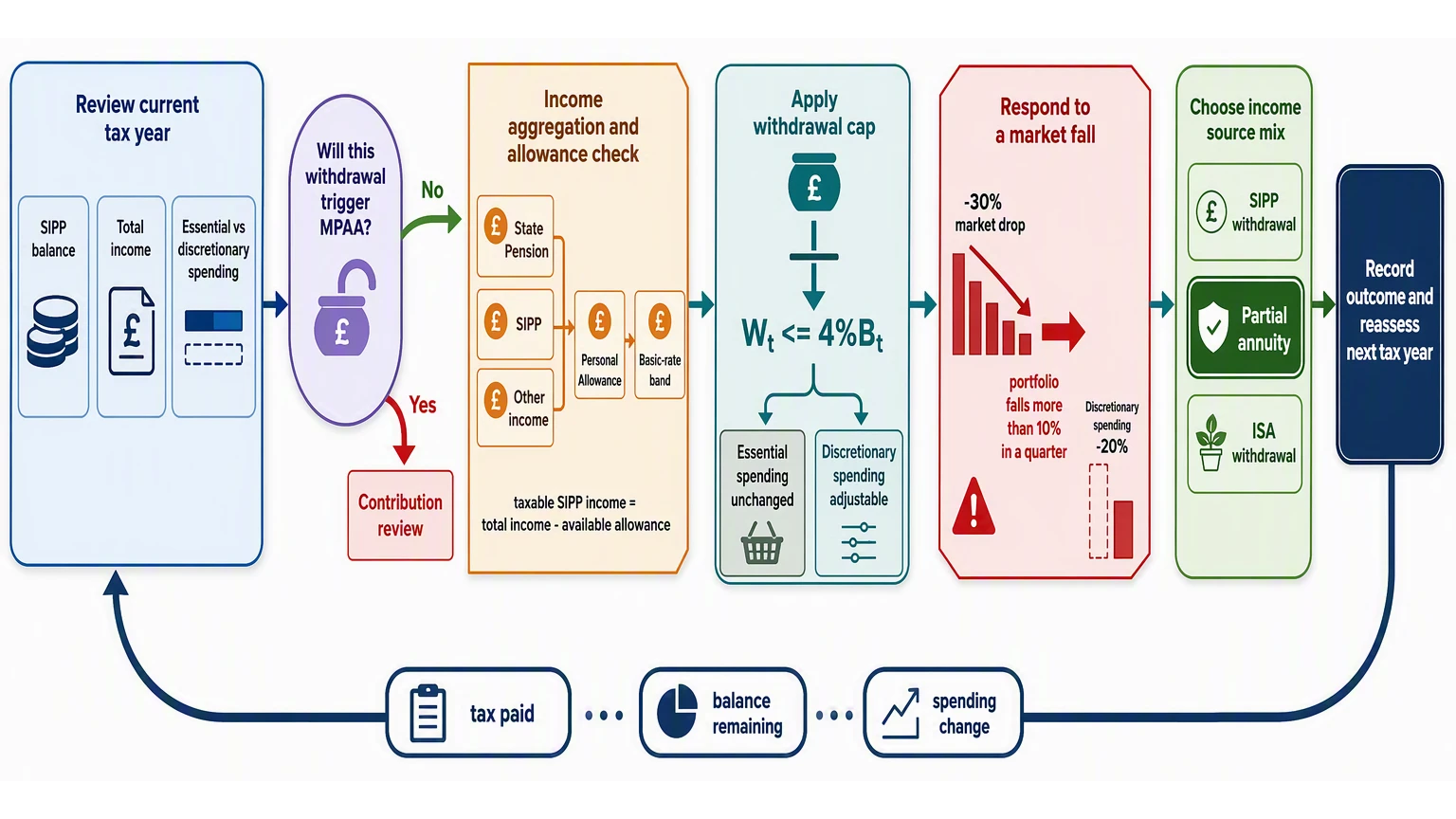
Mistake 2: Ignoring the Money Purchase Annual Allowance (MPAA). The moment you flexibly access pension benefits — even a small income — your future tax-relieved DC contributions drop to £10,000 a year. If you plan to keep working and contributing, this is a disaster. Contribute £10,001 and you pay tax on the excess at your marginal rate. Sequence your drawdown so you do not trigger the MPAA until you are certain you have finished accumulating.
Mistake 3: Assuming the Personal Allowance is fully available. The full State Pension is now £12,547.60. That leaves a scant £22.40 of tax-free allowance before basic-rate tax applies. Many retirees draw SIPP income on top of this and are shocked by the 20% bill. A pension drawdown calculator that models your taxable income from all sources — not just SIPP withdrawals — prevents this rude surprise.
Mistake 4: Treating drawdown and annuities as mutually exclusive. Industry data shows drawdown represented roughly 36.4% of all first-time pension-access plans, while annuities were only 9.2%. Yet annuity sales rose 7.8% in 2024/25, and the growth in drawdown was much stronger at 25.5%. Pure drawdown risks exhausting pots too soon — or forcing unnecessary austerity. A partial annuity can cover essential income, letting the remainder of the SIPP take more investment risk. You are not forced to choose one.
Mistake 5: Not adjusting spending after market falls. Managing sequence risk is often as much about spending flexibility as asset allocation. If you keep drawing the same nominal amount after a 30% market drop, you lock in losses and shrink the portfolio permanently. The remedy: write a rule — reduce discretionary withdrawals after a 10%+ portfolio drop. ARIA PM handles survivorship adjustment, cost modelling, and regime stress-testing automatically — so you can focus on interpreting results rather than building the simulation.
Before any SIPP withdrawal, ask:
- Am I triggering the MPAA prematurely?
- What is my total taxable income this year (State Pension plus SIPP plus other)?
- Am I taking tax-free cash I cannot efficiently reinvest?
- Could a small annuity cover my essential costs?
- Has my portfolio dropped more than 10% — and if so, am I cutting discretionary spending?
Get the order right for your allowances, balances and other income, and your portfolio can last longer. Get it wrong, and you can pay more tax and retire early on less. A drawdown calculator that models these trade-offs is the single best safety net available.
Getting started with your pension drawdown strategy: your action plan today
Getting started with your pension drawdown strategy: your action plan today
Forget perfect. The goal is a sensible starting point that you can adjust. The central insight — that the cheapest tax path today can silently shorten your portfolio’s life — means your action plan must test order, not just amounts. Here are four concrete steps you can take right now. This is not personal advice; it’s the mechanical framework you’ll take to an adviser or apply yourself using free tools.
Step 1: Gather your numbers. You need three figures on paper: the total value of your SIPP, every other income source you expect (your State Pension statement, any defined benefit pension letters, employment income, interest from savings, and dividend payments from general investment accounts), and your annual spending needs split into essential costs (mortgage, bills, food) and discretionary spending (holidays, hobbies). Without the split, you cannot test what happens if the market drops.
Step 2: Run the ‘State Pension test’. For most people, the State Pension occupies nearly all of their Personal Allowance. The full new State Pension is roughly £12,547.60 per year. That leaves about £22.40 of tax-free headroom — meaning every pound of taxable SIPP income (the part beyond any tax-free cash) you take beyond that tiny amount is taxed at 20%. If you have other income — a part-time job, a rental, or dividends — the picture tightens further. Knowing where you stand against this single number determines whether drawing from your SIPP first is efficient or disastrous.
Step 3: Run at least two scenarios on a free calculator. Use MoneyHelper’s retirement income calculator, and check the rules on the FCA’s website. Run one scenario taking SIPP income first, one using ISAs first, and a blended approach that takes some of each, entering the SIPP income each path implies. Watch what happens to the portfolio’s lifespan under each path. A platform like ARIA PM handles survivorship adjustment, cost modelling, and regime stress-testing automatically — so you can focus on interpreting results rather than building the simulation. The key output is not the tax bill for year one; it’s whether the portfolio still supports your spending in year 20.
Step 4: Write a simple withdrawal rule for yourself. For example: ‘I will take no more than 4% of my current portfolio value in any year, and if my portfolio falls by more than 10% in a quarter, I will reduce discretionary withdrawals by 20% until it recovers.’ This rule protects against pension pot exhaustion risk — the danger of depleting the fund through poor sequencing when markets are down. It is not a prediction; it is a circuit breaker.
Review this plan every year, especially after tax changes such as the 2027 inheritance tax rules coming into force. Remember: you do not need a perfect strategy. You need a logical starting point and the discipline to revisit it — because the order you withdraw today affects how much you have to spend every year after.
Key Takeaways
- Sequencing withdrawals to minimise your immediate tax bill can raise your long-term tax exposure by draining your most tax-efficient pots first and, if later income then lands in higher bands, shorten your portfolio’s lifespan.
- Drawing from your ISA early feels cheap now, but it leaves a larger pension pot to be drawn later, when more of it may be taxed at higher rates: the pension’s growth is sheltered, its withdrawals are not.
- Taking the full 25% tax-free lump sum, as 49% of Interactive Investor drawdown customers did, risks shortening your portfolio’s lifespan if you have not modelled the long-term impact.
- Withdrawing from a general investment account first may trigger capital gains tax today, yet it can preserve your pension’s tax-free compounding for years longer.
- A pension drawdown calculator models the cumulative, compounding effect of each withdrawal order year after year, revealing which sequence lasts longest for your allowances, balances and other income.
Each row is a scenario, not a ranking: which one lasts longest depends on your allowances, account balances and future income.
| Strategy | Immediate Tax Impact | Long-Term Portfolio Lifespan | Key Risk |
|---|---|---|---|
| Lowest tax now (drain tax-free cash first) | Low | Can be shorter if later taxable income lands in higher bands | Depletes most tax-efficient pots early, leaving more taxable income for later |
| Balanced withdrawal (mix of taxable and tax-free) | Moderate | Can be longer if it keeps more income in lower bands | Requires careful annual rebalancing |
| Tax-bracket targeting (fill lower bands first) | Low to moderate | Can be longer, depending on future income | Ignores future tax bracket changes and portfolio growth compounding |
| Delay all taxable withdrawals | Minimal now | Depends on later tax rates | May force larger taxable withdrawals later, pushing you into higher brackets |
| Withdraw from growth assets first | Low if within allowance | Can be shorter if it lowers the portfolio's expected return | Sacrifices future returns by removing capital that would compound tax-efficiently |
Comparison Table 2: Common Drawdown Mistakes vs. Best Practice
| Mistake | What Happens | Best Practice | How a Calculator Helps |
|---|---|---|---|
| Taking full 25% tax-free cash immediately | Lost opportunity for that lump sum to grow tax-free inside the SIPP | Withdraw only what you need now; leave the rest invested | Models the long-term cost of early lump-sum removal |
| Ignoring future tax bracket changes | Can mean higher tax in later retirement due to pot depletion order | Sequence withdrawals to stay below key thresholds each year | Simulates marginal rate creep over your whole retirement |
| Draining non-taxable pots first | Can shorten the portfolio's life if later taxable income lands in higher bands | Compare it with mixing taxable and tax-free withdrawals; the better order depends on your allowances, balances and future income | Shows the compounding effect of removing tax-free capital early |
| Only testing one withdrawal order | Misses cheaper long-term alternatives | Run at least two of the six scenarios above | Lets you compare "lowest tax now" vs. "lowest tax lifetime" side by side |
| Failing to adjust after market changes | Locked into a suboptimal sequence | Re-run the calculator annually with updated pot values | Provides dynamic "what-if" simulations across your timeline |
Sources
- Inheritance Tax on unused pension funds and death benefits - GOV.UK — Explains inheritance tax rules for unused pension funds and death benefits.
- Income Tax rates and allowances for current and previous tax years - GOV.UK — Details current and past income tax rates and allowances for UK taxpayers.
- How the State Pension works - Tax Confident — Describes how the State Pension works and its interaction with personal pensions.
- Retirement income market data 2024/25 | FCA — Provides data on retirement income market trends and consumer choices in 2024/25.
- PS25/22: Supporting consumers’ pensions and investment decisions: rules for targeted support | FCA — Outlines new FCA rules for targeted support to help consumers with pension decisions.
- Retirement income advice: good practice and areas for improvement | FCA — Highlights good practice and areas for improvement in retirement income advice.