

You’ve just sold enough shares to trigger a capital gain, and now you’re staring at spreadsheets wondering if you’ve breached HMRC’s £3,000 exempt amount — or if your dividend income has crept past the new £500 allowance. Get it wrong, and you’re facing a tax bill you didn’t budget for, or worse, a penalty for late reporting. This article cuts straight to the choice between Sharesight vs Ghostfolio, and why it matters more than ever for UK investors in 2026. You’ll learn which tool saves you from doing your own tax maths, and which hands you total control — but at the cost of becoming your own tax administrator.
What Is Sharesight vs Ghostfolio — and Why It Matters for Your Portfolio
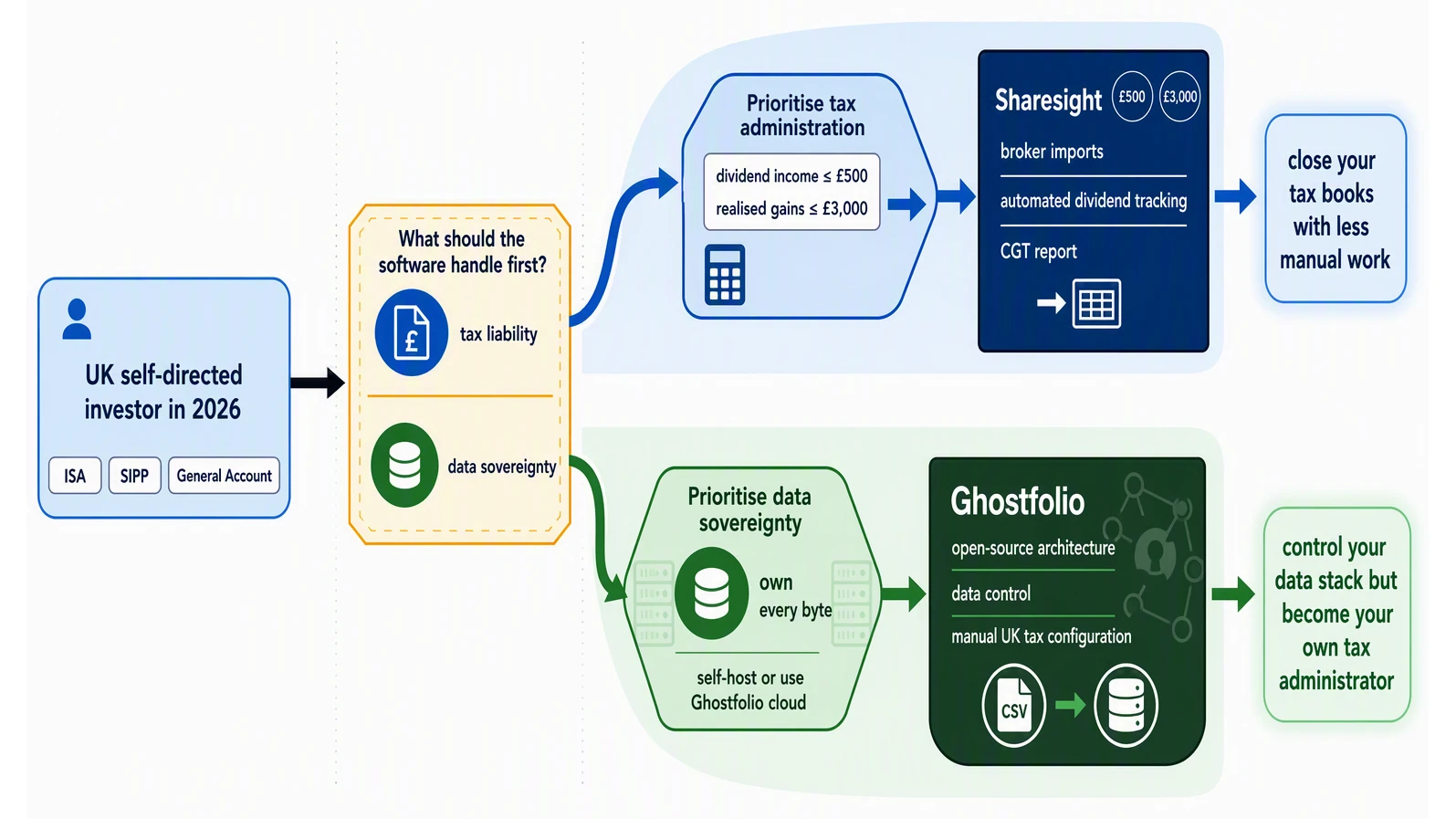
If you are a UK self-directed investor managing an ISA or SIPP in 2026, the first fork in the road is not which tool has the prettiest chart. It is whether you believe your portfolio software should close your tax books for you — or let you own every byte of your data. This is the real tension between Sharesight and Ghostfolio, and getting it wrong means either fighting spreadsheets every April or surrendering control of your investment history to a third party.
Sharesight is a paid commercial tracker built around automated tax reporting. Its June 2026 update added UK-specific tax settings, and it produces tax reports from direct broker imports that you can check against the £500 dividend allowance and £3,000 CGT annual exempt amount for 2026/27. It claims over 600,000 cumulative users. Ghostfolio is the open-source alternative: free to self-host, or $48/year for its Premium cloud plan. It reports around 2,169 monthly active users — roughly 0.36% of Sharesight’s reported figure, or a 277× scale difference. Ghostfolio’s architecture puts you in control, but its UK tax logic requires manual configuration.
The choice is not about cost. Sharesight starts at $0 for a Free tier (1 portfolio, 10 holdings) and $7/month billed annually for Starter. Ghostfolio is technically free if you run it yourself. The real question is: Do you want the software to be your tax administrator, or do you want to be your own?
If you hold a £20,000 ISA and a SIPP with UK-listed shares, Sharesight records the 0.5% Stamp Duty Reserve Tax on purchases and reports your dividend income, so you can see it against the £500 allowance — above which the basic rate is 10.75%. Ghostfolio can track those holdings, but you must configure the SDRT, the dividend bands, and the CGT exempt amount manually. One saves you an evening of admin per year; the other saves you from ever sharing your data with a vendor.
This is the core tension: automated tax time savings versus data sovereignty. Neither tool gives you portfolio-level analytics such as optimisation or backtesting — for that, you would look at a free platform like ARIA PM Home, which handles survivorship and cost modelling automatically. But on the axis that matters most to a UK retail investor in 2026, you first decide whether you value a closed tax book or a closed data stack.
For further context on how these tools compare to other UK-focused trackers, see our full guide on the Best Portfolio Tracker for ISA and SIPP: UK Options Compared.
Why UK Retail Investors Care About This Choice in 2026
For a UK self-directed investor in 2026, the choice comes down to a single, practical question: how much is your time worth? With the dividend allowance now at just £500 and the CGT annual exempt amount sitting at £3,000, the margin for error has shrunk. Miss your dividend allowance by even a few pounds from a VWRP distribution, and you owe 10.75% tax on the excess as a basic-rate payer — or 39.35% if you are an additional-rate taxpayer. Realising a gain just £50 over the exempt amount triggers an 18% or 24% charge on the entire excess.
This is where the tools diverge in lived experience. Sharesight, at $18/month (roughly $216/year), automates that entire record-keeping burden. It tracks every dividend payment against your £500 allowance and logs each realised gain against your £3,000 exempt amount across trades on the LSE — whether you are holding HSBC, Lloyds, or a multi-asset ETF. When self-assessment season arrives, you hand your accountant a pre-computed report. For a portfolio of ten or more holdings, that saves you somewhere between five and ten hours of manual spreadsheet work per tax year. At even a modest hourly rate, $216/year effectively pays for itself.
Ghostfolio, by contrast, costs $48/year. Its AGPL-3.0 open-source codebase has attracted 9,176 GitHub stars and 310 contributors, and its hosted tier is genuinely affordable. But it does not track your UK dividend allowance or your realised gains against the £3,000 CGT threshold. It tracks price history and performance. You must calculate every tax line yourself — reconciling broker statements, applying the correct dividend tax rate, and manually netting losses against gains. That is time you spend, every year.
Both tools also share a conspicuous gap: neither offers portfolio optimisation, backtesting, or risk analytics. If you want to stress-test your asset allocation or run a mean-variance optimisation, you will need a dedicated platform — ARIA PM handles that analysis automatically, so you can adjust your strategy without building the simulation yourself.
For the investor who dreads tax admin and values their evenings, Sharesight is the practical choice. For the investor who prioritises data sovereignty and is comfortable being their own tax administrator, Ghostfolio saves the subscription cost but transfers the labour to you. There is no universal right answer — only the honest one about how you want to spend your limited hours. For a deeper comparison of UK-specific trackers, see our guide to the Best Portfolio Tracker for ISA and SIPP: UK Options Compared.
How Sharesight and Ghostfolio Actually Work: A Plain-English Guide
Let’s walk through how each tool actually works in practice, because the difference is not about which has prettier charts — it is about where the work lands.
Sharesight: you want your tax liability managed by the software
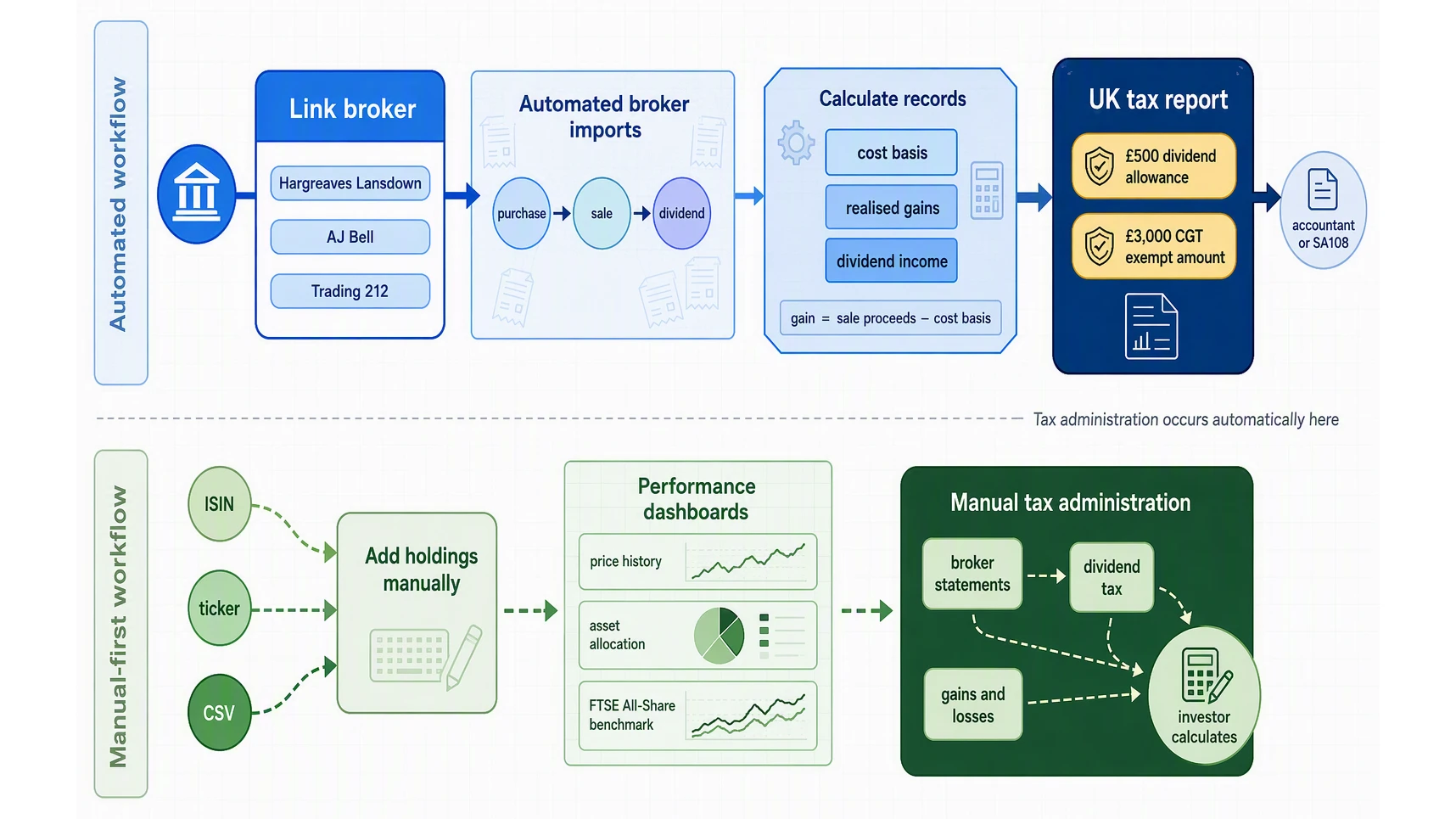
You start by signing up (Standard is $216/year, Premium is $279/year) and linking your broker. Sharesight supports automated feeds for over 200 broker import sources — so if you use Hargreaves Lansdown, AJ Bell or Trading 212, your trades, dividends and corporate actions flow in without you touching a spreadsheet. Once everything is connected, the system tracks every purchase, sale and dividend in real time. It calculates your cost basis, your realised gains, and your dividend income. Then — and this is the critical bit for UK investors — its UK tax settings let you report dividend income and gains against the £500 dividend allowance and the £3,000 CGT exempt amount. You can see, at any point, how close you are to those limits. Come tax-year end, Sharesight produces a report you can hand to your accountant or use to fill in your SA108. It does not execute trades — no tool here does — but it closes your books for you.
Ghostfolio: you want your data on your own terms
Ghostfolio starts differently. You can use the free cloud plan, or if you want data control, you self-host the open-source software. Ghostfolio has recorded 3.12 million Docker Hub pulls — a distribution count rather than a user count, but a sign that self-hosting is well trodden. The Premium cloud plan costs $48/year ($4/month) and handles hosting for you — no code needed. However, you then manually add holdings by ISIN, ticker, and number of shares, or you import a CSV. Ghostfolio shows you performance dashboards, asset allocation, and benchmarks like the FTSE All-Share. It does not calculate UK tax liabilities. It will not tell you how much dividend tax you owe, or whether a sale pushes you over the £3,000 CGT allowance. You become your own tax administrator. If that sounds manageable for a small ISA-only portfolio, it is. If you hold a General Account with frequent trades, the manual work adds up.
The real decision: tax liability vs data sovereignty
Between Sharesight and Ghostfolio, your first choice is really which problem you solve first. Sharesight automates your tax reporting and broker connections, then charges you annually. Ghostfolio hands you data ownership for zero software cost (if you host it yourself), but leaves you to build your own tax logic. That distinction matters more than any feature table. Neither tool offers portfolio-level analytics such as optimisation or backtesting — for that, you would need a platform like ARIA PM which is free and handles survivorship and cost modelling automatically. And if you want to explore how your asset allocation could be improved without running your own simulations, the Markowitz Portfolio Optimisation: Plain English guide walks through the concepts step by step.
Which one should you pick?
Choose Sharesight if you hold a General Account and want your dividend allowance and CGT reports done for you — the automated broker feeds alone save hours each month, and the tax logic is built in. Choose Ghostfolio if you are ISA-only (where CGT and dividend tax do not apply), you trust your own spreadsheet for tax tracking, and you want to own every byte of your portfolio data. Both are read-only trackers; neither will rebalance your portfolio for you. For that, you might look at our Portfolio Rebalancing Spreadsheet: Free Excel Template — it is manual, but it works. The fork in the road is clear: do you want to automate tax or data? Because you cannot automate both with these two tools alone.
Sharesight vs Ghostfolio in Practice: Real Examples with UK Investments
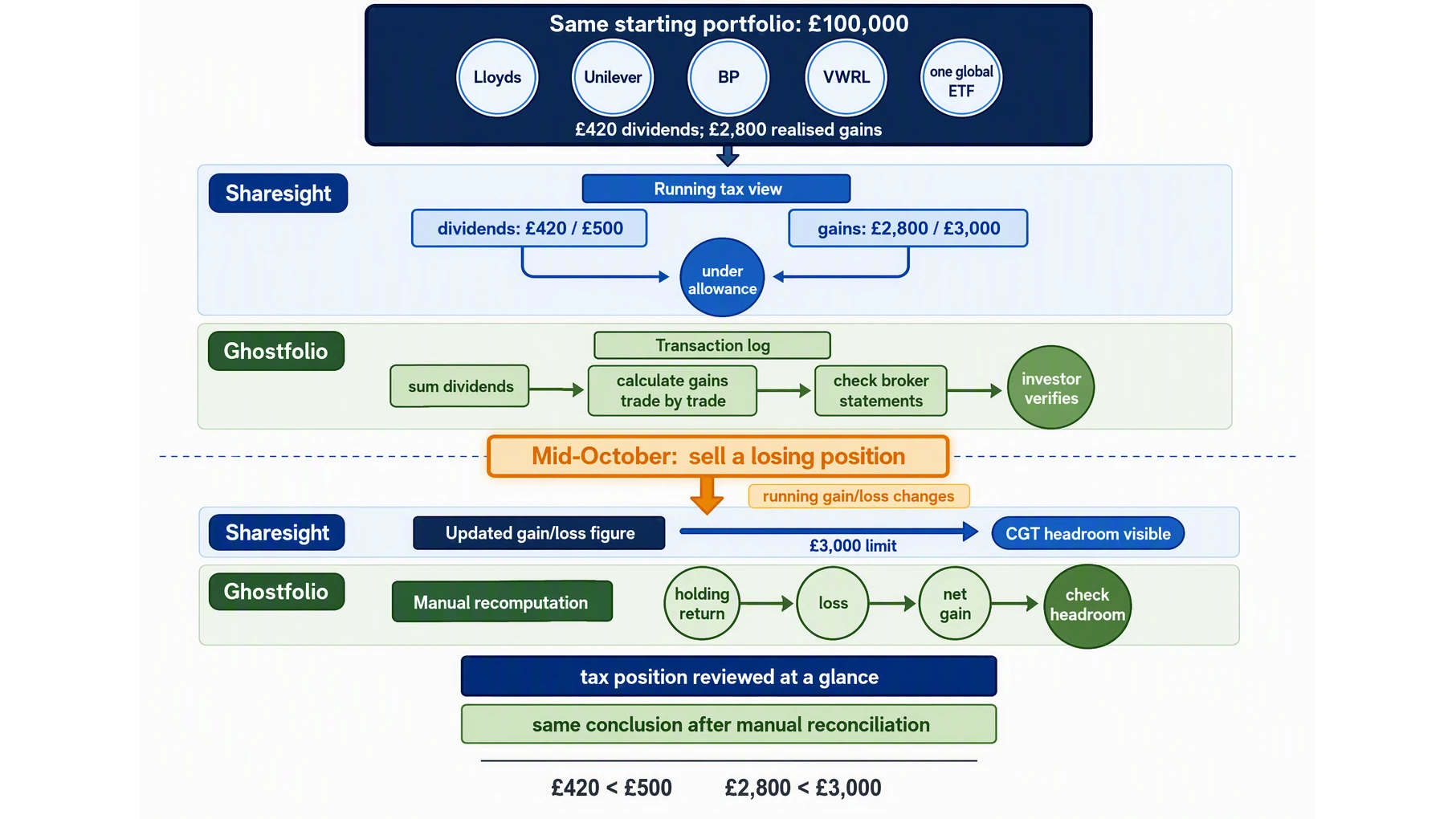
Picture two portfolios at the start of the 2026/27 tax year. Each holds exactly the same £100,000 spread across five UK equities — Lloyds, Unilever, BP — and one global ETF, VWRL. Both investors receive £420 in dividends during the year (comfortably under the £500 dividend allowance) and realise £2,800 in gains (under the £3,000 CGT annual exempt amount). On Sharesight, the tax reports show both figures against the allowances at a glance: dividend income under £500, gains under £3,000. Your broker or ISA provider remains the authoritative source for what you actually owe — a tracker is a monitoring and record-keeping layer, not a compliance system. On Ghostfolio, the portfolio value is tracked beautifully, but the investor must manually sum the dividends from each holding’s transaction log and calculate gains trade by trade to verify the same conclusion. That is the core distinction in practice — one tool closes your books for you, the other shows you the raw materials and leaves the accountancy to you.
Now consider the investor actively harvesting losses to stay under the CGT allowance. They sell a losing position in mid-October, and Sharesight’s running gain/loss figure updates immediately, flagging how much headroom remains before the £3,000 limit is reached. Ghostfolio has no such threshold alert; the investor must check each holding’s return separately and keep a mental running total. For a self-directed investor managing a SIPP alongside an ISA, that ongoing mental arithmetic quickly becomes a chore — especially across multiple brokers or transfer dates.
The cost comparison depends entirely on portfolio size. A small portfolio under five holdings might fit Sharesight’s free tier (one portfolio, up to ten holdings), making it viable at zero cost. For a 20-holding portfolio, Sharesight Starter at roughly $7 per month (paid annually) covers up to 30 holdings, while Ghostfolio Premium costs approximately $48/year — about $4/month — and supports unlimited holdings. Research indicates Sharesight Starter costs 75% more than Ghostfolio Premium, meaning the gap between the two products widens as your portfolio grows. For a 40-holding portfolio with multiple accounts, Sharesight’s paid tier becomes expensive relative to Ghostfolio’s flat-rate cloud plan.
Neither tool offers portfolio-level analytics such as optimisation, backtesting, or risk metrics — you won’t find a Markowitz efficient frontier in either. ARIA PM handles survivorship adjustment, cost modelling, and regime stress-testing automatically — so you can focus on interpreting results rather than building the simulation. If data sovereignty is your priority and you’re comfortable being your own tax administrator, Ghostfolio’s self-hosted open-source model gives you full ownership. If your priority is closing your tax year without spreadsheets, Sharesight’s dividend and CGT reporting saves you real time — especially as you approach the £3,000 gain limit and need to decide whether to sell or defer.
The practical choice for UK investors in 2026 comes down to this: do you want to manage your tax liability or your data stack? If you want to minimise year-end effort, Sharesight’s direct broker imports and automated UK tax reports are hard to beat. If you want to own every byte of your data and never pay a subscription, Ghostfolio’s open-source architecture is the clear path — but you’ll need to build your own tax logic. For deeper portfolio analysis that neither tool provides, consider ARIA PM’s free platform, which fills the gap in optimisation and risk analytics without adding a subscription cost.
Common Mistakes Investors Make When Choosing Between the Two
Mistake 1: Assuming 'open source' means free forever — and forgetting the true cost of self-hosting. Ghostfolio does not charge a licence fee, but that is only the starting point. You must provision your own server, keep it online, and apply security updates yourself. If you choose Sharesight's paid tiers instead, the Standard tier costs $216/year and Premium costs $279/year — that is 350% and 481% more, respectively, than Ghostfolio's $48/year hosted plan. Meanwhile, the time you spend maintaining the infrastructure is time you are not reviewing your portfolio or filing your tax return on time.
Mistake 2: Forgetting that Sharesight's free tier only holds 10 holdings. UK investors often start small, drip-feeding monthly contributions into an ISA or SIPP. It is easy to cross the 10-holding threshold — one ETF, two individual stocks, a couple of investment trusts, and suddenly you have 11 positions. When the free tier locks, you either upgrade or lose access to your data. At that point, the cost saving you thought you were getting by avoiding an open-source self-hosting project evaporates. A quick Portfolio Health Check can reveal how close you are to that limit before you commit.
Mistake 3: Believing Ghostfolio can replace HMRC reporting. Ghostfolio is a portfolio tracker, not a tax calculator. It has no native understanding of the £500 dividend allowance, the £3,000 CGT annual exempt amount, or the 10.75% basic rate dividend tax that applies once that allowance is used up. UK investors have been caught out — late-filing penalties because they assumed the tool would handle their tax computation. You must export data manually and run the calculations yourself. If you value closing your books each year without manual spreadsheets, Sharesight’s automated CGT and dividend reports are the pragmatic choice.
Mistake 4: Ignoring the scale difference. Ghostfolio reports 2,169 monthly active users; Sharesight has 600,000. That is a 277× difference in reported user numbers — Sharesight's cumulative investors against Ghostfolio's monthly actives, which are not like-for-like measures. When a UK broker changes its API or a tax rule shifts, Sharesight is far more likely to adapt quickly. Ghostfolio’s developer community is smaller and slower to respond to UK-specific needs. For a self-directed investor managing an ISA or SIPP, relying on a tool with limited traction means more manual workarounds — precisely what you are trying to avoid.
The bottom line: Don’t choose based on price alone. If you are comfortable becoming your own tax administrator and maintaining a server, Ghostfolio gives you data sovereignty. If you would rather pay for automation and want a tool that closes your tax year for you, Sharesight is the safer bet. For a free alternative that fills capability gaps neither tool addresses — such as survivorship adjustment or cost modelling — ARIA PM handles those analytics without asking you to self-host or file tax returns manually.
Your Action Plan: Deciding Between Sharesight and Ghostfolio Today
Here is the "Your Action Plan: Deciding Between Sharesight and Ghostfolio Today" section for the article, written to your specifications.
Your Action Plan: Deciding Between Sharesight and Ghostfolio Today
The critical insight is that for a UK self-directed investor in 2026, the choice between Sharesight and Ghostfolio is not about cost or self-hosting — it is about whether you first decide to manage your tax liability or your data sovereignty. Sharesight’s automated dividend allowance and CGT reporting saves you from manual work, while Ghostfolio’s open-source architecture lets you own the data but forces you to become your own tax administrator. The tool that suits you depends on whether you prioritise closing your books each year without effort or controlling your data stack from the ground up. Here is your practical, four-step action plan.
Step 1: Assess your portfolio size and complexity. If you are comfortable spending a few hours a year on manual tax calculations, start with Ghostfolio’s free cloud plan — and Sharesight’s own free tier stops at 10 holdings, so a larger portfolio makes that comparison paid-for-paid. No self-hosting is required, and you can test its clean interface immediately. If you hold more than 10 positions, or if you already pay an accountant to handle your tax return, try Sharesight’s free single-portfolio tier first. The complexity of tracking dividend allowances across multiple holdings quickly overwhelms a manual approach.
Step 2: Test-drive the tool that matches your workflow. For Sharesight, connect your broker — most UK platforms are supported — and let it run for one month. Check the automated dividend tracking and preview the CGT report. It should show you exactly how your £500 dividend allowance and £3,000 CGT exempt amount are being consumed. For Ghostfolio, import your portfolio CSV or add holdings manually. Use it for two weeks to see if you can live without tax automation. Ghostfolio’s community dashboard shows 9,176 GitHub stars and 310 contributors, and its growth of +23.1% in GitHub stars during 2025-2026 reflects a vibrant open-source ecosystem, but that community does not handle your HMRC obligations.
Step 3: Calculate your annual tax admin time honestly. If you spend more than five hours per year reconciling dividends and gains, Sharesight’s $216/year plan may save you £50+ per hour of your time. For a higher-rate taxpayer paying 35.75% on dividends above the allowance, a single missed calculation could cost more than the subscription. Ghostfolio, by contrast, costs nothing to self-host or $48/year for its hosted premium tier — but you must audit every entry yourself.
Step 4: Make the final call based on what you just learned. For $279/year, Sharesight Premium offers unlimited holdings and full tax reports, including ISA tax-free tracking. For $48/year, Ghostfolio Premium offers privacy and control. Neither is wrong — but one matches your workflow. If you want automated tax compliance without thinking about it, choose Sharesight. If you trust your own bookkeeping and value data sovereignty, choose Ghostfolio. And if you need portfolio-level analytics — survivorship adjustment, cost modelling, or regime stress-testing — that neither tool provides, remember that ARIA PM handles those automatically, so you can focus on interpreting results rather than building the simulation.
Key Takeaways
- The core decision for a UK self-directed investor in 2026 is whether you want Sharesight to automatically calculate your tax liability against the specific £500 dividend allowance and £3,000 CGT exempt amount, or whether you prefer Ghostfolio’s open-source architecture that forces you to manually configure all UK tax logic.
- Sharesight’s June 2026 update with direct broker imports and automated UK tax settings saves you a full evening of admin each April, whereas Ghostfolio requires you to manually track Stamp Duty Reserve Tax, dividend bands, and CGT allowances.
- Ghostfolio’s free self-hosted option gives you complete data sovereignty, but you become your own tax administrator; Sharesight’s $7/month Starter tier is a direct trade of control for convenience.
- The 277× scale difference between Sharesight’s 600,000 users and Ghostfolio’s 2,169 monthly active users reflects a practical gap in UK-specific tax logic development, not just popularity.
- If you hold a £20,000 ISA and a SIPP with UK-listed shares, the choice comes down to this: accept limited third-party data sharing for automated dividend allowance and CGT reports, or self-host Ghostfolio and manually reconcile your own tax bands against HMRC rules.
| Decision Factor | Sharesight | Ghostfolio |
|---|---|---|
| Tax handling | Automated tracking of £500 dividend allowance and £3,000 CGT exempt amount; generates ready-to-use reports | No built-in UK tax features; you must manually calculate dividends and capital gains yourself |
| Data ownership | Software-as-a-service (SaaS); your data lives on Sharesight's servers | Open-source; you self-host the software, so you fully control the data and its storage location |
| Time commitment | Minimal once set up — software manages tax calculations and portfolio events | Medium to high — you must maintain your own server, keep it online, and reconcile all tax figures manually |
| Cost structure | Paid subscription (typically tiered by number of holdings) | Free software licence; you pay for your own cloud hosting and server maintenance |
| Best suited for | Investors who want to close their tax year without manual spreadsheet work | Investors who prioritise data privacy and are comfortable acting as their own system administrator |
Practical Workflow Comparison: The £100,000 Portfolio Example
| Portfolio Activity | Sharesight Workflow | Ghostfolio Workflow |
|---|---|---|
| Receiving £420 in dividends across five UK equities | Automatically records dividends, tracks against the £500 allowance, and reports any excess | You must manually enter each dividend payment and track the running total against the allowance yourself |
| Realising a capital gain of £2,800 on a VWRL sell order | Automatically calculates gain, applies the £3,000 CGT exemption, and shows remaining allowance | You calculate the gain manually using purchase cost data; no automatic CGT exemption tracking |
| Year-end tax filing preparation | Generates a one-click report showing dividend income, capital gains, and allowance usage | You compile a spreadsheet from your transaction history — no automated tax summary available |
| Adding a new investment mid-year | Simply add the trade; the software updates all tax calculations in real-time | You enter the trade manually; future gain calculations require you to track the cost basis on your own |
| Server maintenance and data backups | Handled entirely by Sharesight — nothing for you to do | You must schedule backups, apply software updates, and monitor server uptime yourself |
Sources
- Pricing | Sharesight UK — Sharesight UK pricing page showing subscription tiers and costs for UK investors.
- Ghostfolio-Open Source Wealth Management Software — Ghostfolio open-source overview explaining its community-driven, self-hosted model.
- Supported markets | Sharesight UK — Supported markets page detailing UK stock exchanges and funds tracked by Sharesight.
- Ghostfolio-Open Source Wealth Management Software — Ghostfolio FAQ on self-hosting requirements and setup for UK users.
- Sharesight product updates-June 2026 | Sharesight Blog — Sharesight June 2026 product updates, featuring new features relevant to UK investors.
- Hacktoberfest 2025 - Ghostfolio — Ghostfolio Hacktoberfest 2025 blog highlighting community development and contributions.