

You hit £500,000 in your ISA, quit your corporate job at 45, and realise you still need £800 a month to cover your bills — but your safe withdrawal rate only throws off £650. That gap is the problem this article solves. Barista FIRE in the UK hinges on a single, non-negotiable rule: earning at least £6,708 a year — the Lower Earnings Limit of £129 a week — on a part-time job buys you a qualifying year towards the State Pension. Without those National Insurance credits, your retirement income is permanently lower. You will learn whether a 16-hour week actually covers the earnings threshold, or whether you are quietly paying a stealth tax on your own future. No spreadsheets or code required — just a honest look at the maths that decides whether your plan works or fails.
What is Barista FIRE — and why it changes your retirement maths
Imagine this: you are in your mid-40s. You walk away from the corporate ladder, the commute, the quarterly reviews. You take a job at a local bookshop or a garden centre. It pays the bills for a few “luxury” items, while your investment portfolio covers the rest of your living costs. That is Barista FIRE — a strategy where your savings do most of the heavy lifting, and a pleasant, low-stress part-time job covers the gap.
If you have read any US personal finance blogs, you know the American version of this is mostly about healthcare. They work part-time for the employer’s health insurance. In the UK, the NHS removes that anxiety entirely. So what is the real UK-specific significant improvement? It is not your withdrawal rate. It is your National Insurance (NI) credits.
Here is the central thesis that changes your retirement maths: Barista FIRE in the UK is not a portfolio-optimisation problem — it is a state-pension-eligibility optimisation problem. The part-time wage is merely a tool. The real wealth decision is whether that wage is high enough to clear the Lower Earnings Limit (LEL) . If it is not, you are paying a stealth tax on your own retirement income — losing a qualifying year toward the full State Pension.
From 6 April 2026, the employee LEL is £129 per week, or £559 per month (roughly £6,708 annualised). That is a low bar. You could earn median full-time UK earnings of £39,039 and that is not the target — the target is the LEL. Earn above that in your part-time role, and you automatically build a qualifying year of NI contributions.
Why does this matter? The full new State Pension is £241.30 a week, or £12,547.60 a year. Every missing year reduces that entitlement permanently. By working a part-time job that clears £129 per week, you protect an inflation-linked income stream for life. That is a far more valuable trade-off than squeezing an extra 0.5% out of your portfolio’s return.
Contrast this with the US framing. An American Barista FIRE retiree obsesses over the “4% rule” and premium subsidies. In the UK, the maths is simpler: find a part-time role that pays above £129 per week. That is the keystone. Use a Portfolio Rebalancing Calculator to keep your investments structured, but the primary decision is not about asset allocation — it is about that earnings threshold. Many investors also track their tax position, which is where a Savings Calculator helps visualise the gap between your dividend allowance (£500) and your trading income. And because your State Pension can be deferred by 1% for every 9 weeks (roughly 5.8% a year) to boost it further, protecting those NI qualifying years is the most efficient safety net you can build. ARIA PM handles survivorship adjustment, cost modelling, and regime stress-testing automatically — so you can focus on interpreting results rather than building the simulation.
How Barista FIRE actually works: the income-gap formula, NI credits, and the magic of 16 hours a week
Let’s start with the numbers that make Barista FIRE concrete. The core calculation is surprisingly simple: the size of the portfolio you need depends on the gap between what you spend and what your part-time job pays.
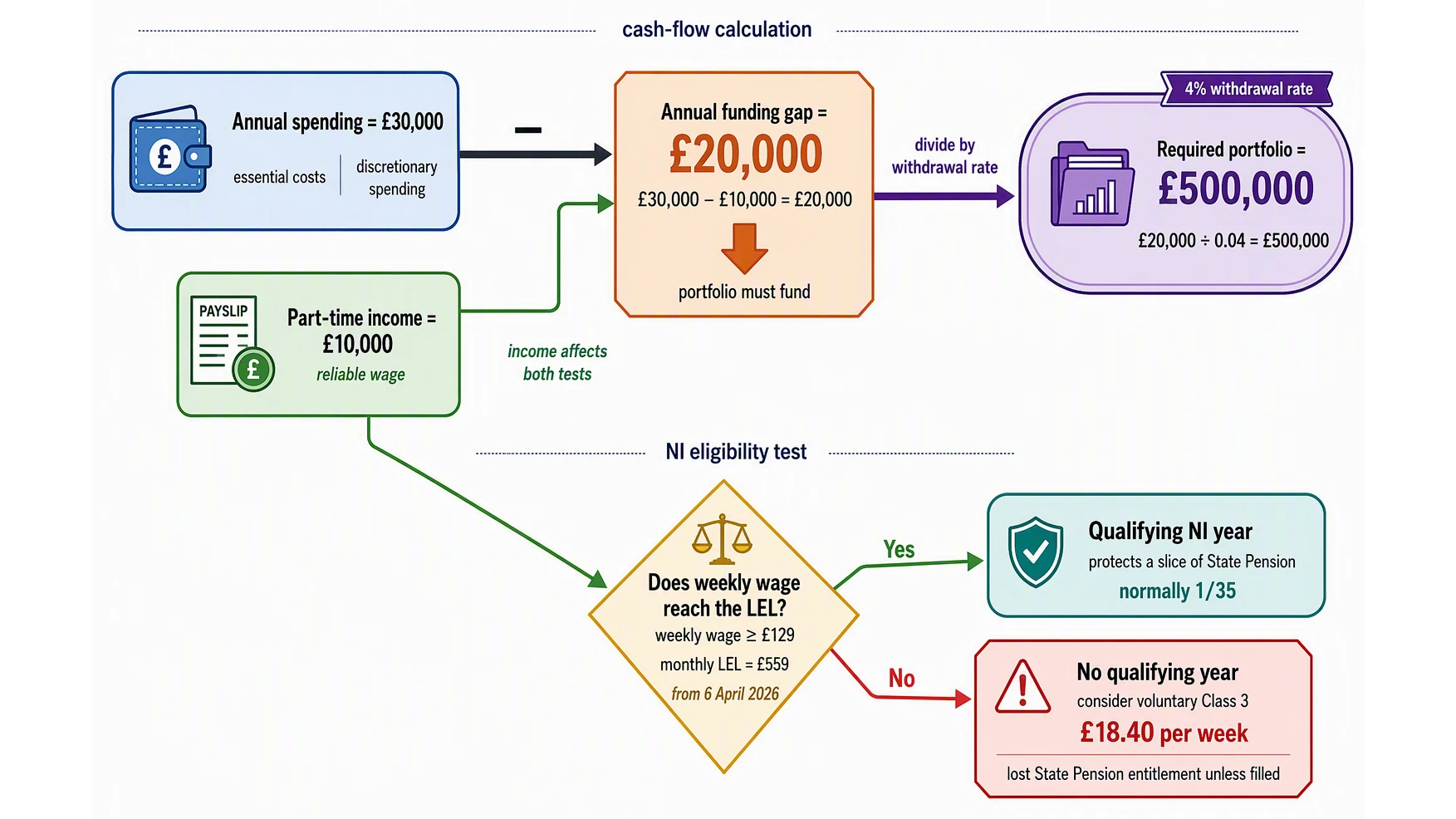
Imagine you need £30,000 a year to cover your life — housing, food, travel, the occasional treat. You find a part-time role that pays £10,000 a year. That leaves a £20,000 gap. At a sustainable 4% withdrawal rate, you multiply that gap by 25. The result: a portfolio of £500,000. Compare that to full FIRE, where you’d need to cover the entire £30,000 yourself — a £750,000 portfolio. That £250,000 difference is the freedom Barista FIRE buys you.
But here’s the twist that most UK-focused guides miss. That part-time wage isn’t just cash flow — it’s a tool for buying National Insurance credits, and that is where the real wealth decision lives.
Each qualifying year of NI contributions locks in a slice — normally one thirty-fifth — of the full State Pension, which is £241.30 per week in 2026/27, roughly £12,548 annually. A post-2016 record normally needs 35 qualifying years for the full rate. Fail to earn above the Lower Earnings Limit (LEL) of £129 a week (£559 a month), and you lose that year’s entitlement unless you pay voluntary Class 3 contributions at £18.40 per week. That is effectively a stealth tax on your own retirement income: you work, but you don’t accrue the state benefit your work should earn.
Now for the magic of 16 hours a week. At the April 2026 National Living Wage of £12.71 per hour, working just 10 hours per week generates about £6,708 annually — comfortably above the LEL. Work 16 hours and you earn roughly £10,575, which also stays safely under the £12,570 Personal Allowance, meaning zero income tax and zero employee NI. Your entire wage goes into your pocket while buying a full qualifying year toward the State Pension.
The calculation transforms. Instead of asking “Can my portfolio survive a 4% withdrawal rate?”, you ask “Does my part-time wage clear the NI earnings threshold?” If the answer is yes, you’ve just bought a guaranteed inflation-linked income stream for life, with a portfolio that needs to support only the gap. Tools like our Savings Calculator help you model the gap, and platforms such as ARIA PM handle the survivorship adjustment and cost modelling automatically — so you can focus on whether those 16 hours per week work for your life, not on building spreadsheets.
The real insight: Barista FIRE in the UK is an NI-eligibility optimisation problem, disguised as a portfolio problem. Get the wage right, and the portfolio does less than half the heavy lifting.
Real UK examples: what Barista FIRE looks like in practice
The most instructive UK example isn't a theoretical spreadsheet — it’s a real couple with a £1.7 million portfolio (excluding their home) who appeared on Monevator in March 2025. They’d already reached full financial independence. The wife intended to keep working part-time after FI. That is Barista FIRE at the high-asset end: part-time work as a lifestyle choice, not a financial necessity. Her wage buys National Insurance credits toward the state pension, and those credits are worth far more than the marginal income itself — because a full state pension (£11,502 a year) is an inflation-linked, sovereign-guaranteed annuity that no private product can replicate.
A more instructive benchmark is the Part-time Analyst, also from Monevator (September 2025) — a 35-year-old in northern England who left full-time work after calculating that part-time income, investment withdrawals, and expenses broke even. That is the core Barista FIRE arithmetic: your portfolio only needs to bridge the gap between what you earn and what you spend. Use the required portfolio calculation: subtract your reliable part-time income from annual spending, then divide by your withdrawal rate. At a 4% withdrawal rate, that gap multiplied by 25 gives your target portfolio. If your part-time wage covers £10,000 of a £30,000 spend, you need a £500,000 portfolio — not £750,000.
Quietly Saving’s ‘Future Fund’ illustrates the accumulation phase: approximately £410,000 as of July 2026. That blogger is still working, but has modelled that a drop to part-time hours is viable once the portfolio crosses roughly £350,000 to £400,000. The platform UpTheGains publishes a framework using a Stocks and Shares ISA for pre-pension bridge capital and a SIPP for later income, with the same worked example: £30,000 spending, £10,000 earned, £500,000 target. Saxo UK’s education guide explicitly distinguishes Barista FIRE from Coast FIRE — in Coast FIRE you stop contributing entirely; in Barista FIRE the part-time wage is active, and its primary financial function is to keep building NI qualifying years.
These are self-reported cases using ordinary diversified funds (Vanguard VWRL, iShares ETFs) — not a special ‘Barista FIRE fund’. The individuals used Savings Calculator tools and Portfolio Historical Performance: How to Analyse Your Returns guides to stress-test their assumptions. None should be taken as a guarantee, but they do reveal the central truth: Barista FIRE in the UK is a state-pension-eligibility optimisation problem, not a portfolio one. The Inflation Rate Calculator shows why — even small shortfalls in state pension years compound into large real-income gaps over a thirty-year retirement.
The ISA-pension bridge: why most UK guides get this wrong
Here is the "The ISA-pension bridge: why most UK guides get this wrong" section for your article.
The single most important insight to grasp about Barista FIRE in the UK is this: it is not a portfolio optimisation problem. It is a state-pension-eligibility optimisation problem. The part-time wage you earn is merely a tool to buy National Insurance (NI) credits, and the real wealth decision is whether that wage is high enough to cover the earnings threshold. Failing that means you are effectively paying a stealth tax on your own retirement income.
Most guides fixate on the withdrawal rate. They assume you will lean on your investments from day one. But that logic treats your part-time income as a side benefit rather than the primary mechanism. In reality, the gap between stopping full-time work at, say, age 45 and claiming the state pension at 67 is 22 years. Every year you earn below the Lower Earnings Limit (currently £6,396 a year) you lose a qualifying year toward the full state pension unless you pay a Voluntary Class 3 NI contribution — £18.40 a week, or about £956.80 for 52 weeks. Multiply that across two decades and you are looking at roughly £21,000 in voluntary payments just to keep your state pension whole.
Now consider the arithmetic. Your part-time job needs to cover your Annual funding gap — the difference between your total spending and the income from that work. If your wage is high enough to earn the NI credit for you, you save the £956.80. If it is not, that cost comes directly out of your portfolio. At a Conservative withdrawal rate (3%-3.5%) , drawing an extra £956.80 a year for 22 years requires an additional lump sum of roughly £21,000 to £28,000 in today’s portfolio value — purely to fund the NI gap. That is money that will never compound for you. Industry research suggests that if your full target is £750,000, the NI stealth tax alone consumes roughly 3-4% of your total pot before you have taken a single pound in discretionary spending.
This is where the structure of your savings vehicle matters enormously. Withdrawals from a General Investment Account (GIA) trigger Capital Gains Tax (annual exempt amount £3,000; rates on share gains 18% basic, 24% higher) and dividend tax (allowance £500, then 10.75% basic). Withdrawals from an ISA are tax-free. The decision to draw your living expenses from an ISA versus a GIA is not a marginal tax optimisation — it is the difference between paying the stealth tax and not. Many retirees assume they can simply pull from a GIA first to let the ISA grow, but that approach can backfire if the GIA gains push you above the CGT threshold.
Rather than guessing at the numbers, you can use tools like ARIA PM — it handles survivorship adjustment, cost modelling, and regime stress-testing automatically, so you can focus on interpreting results rather than building the simulation. A good Savings Calculator can show you the compounding cost of those missed NI years, and an Inflation Rate Calculator will highlight how a £956.80 annual levy erodes in real terms over two decades. The key is to treat the NI credit as a fixed liability, not a discretionary expense — because the state pension is the only retirement income you cannot outlive.
Common Barista FIRE mistakes — and how to avoid them
The most dangerous Barista FIRE pitfall in the UK is treating your part-time income as a guaranteed bond. That £13,000 from 20 hours a week at minimum wage feels like a reliable floor — until you are made redundant, injured, or simply exhausted. The counter is stress-testing: what happens to your plan if that income drops by 75% for 12-24 months, or vanishes entirely? A portfolio that only works with consistent part-time wages is not retired — it is one employment gap away from crisis.
A related mistake is assuming any part-time job provides low stress. Hospitality or retail work at 16-24 hours weekly can be physically and emotionally draining, especially if your body is not used to it. **** shows that at £12.71/hour (2026-2027), 16 hours yields £10,575, 20 hours yields £13,218, and 24 hours yields £15,862 — but those figures do not capture the burnout risk. Consulting, freelance professional work, or compressed-hours career roles may be more sustainable, even if the hourly rate is lower.
Mistake 3 is ignoring the ISA-pension bridge. Your SIPP is locked until 57 (rising to 58 from 2028); your ISA is accessible whenever. If you FIRE at 45, you need a 12-13 year bridge funded entirely from ISAs and taxable accounts. A Pension Calculator helps you model this gap, but the principle is simple: do not put everything into a pension if you cannot survive without penalty until access age.
Mistake 4 is applying the US 4% rule uncritically to a 50-year UK retirement. Morningstar's 2026 UK research models a 30-year retirement with 90% success at a maximum 4.1% withdrawal rate; longer horizons demand lower rates or flexible spending that cuts withdrawals in poor markets. A Modern Portfolio Theory Calculator can stress-test these scenarios, but no fixed percentage guarantees safety over five decades.
Mistake 5 is leaving home without checking your National Insurance record. The 2026/27 Primary Threshold is £242 a week — below that you pay no employee NI, but you still earn a qualifying year provided you reach the Lower Earnings Limit of £129 a week. It is the LEL, not the Primary Threshold, that governs entitlement. A role paying £600 per month should normally clear the monthly LEL, but irregular shifts or multiple small employers may not. Check your State Pension forecast on gov.uk before reducing hours; identifying missing years while you still have full-time salary makes buying voluntary Class 3 credits far cheaper than doing so later.
Mistake 6 is overlooking housing costs as the biggest single variable. A mortgage-free homeowner in the North-East can live on £12,000 a year; a London renter paying £1,500 a month in rent needs £30,000 just for shelter. Every £1,000 of dependable part-time income — **** — reduces the required portfolio by roughly £25,000 at a 4% withdrawal rate, but that maths collapses if your housing cost is fixed and high. Housing flexibility reduces the required portfolio more reliably than optimistic investment assumptions.
Your Barista FIRE action plan: what to do this week, this quarter, and this year
Your Barista FIRE action plan: what to do this week, this quarter, and this year
This week
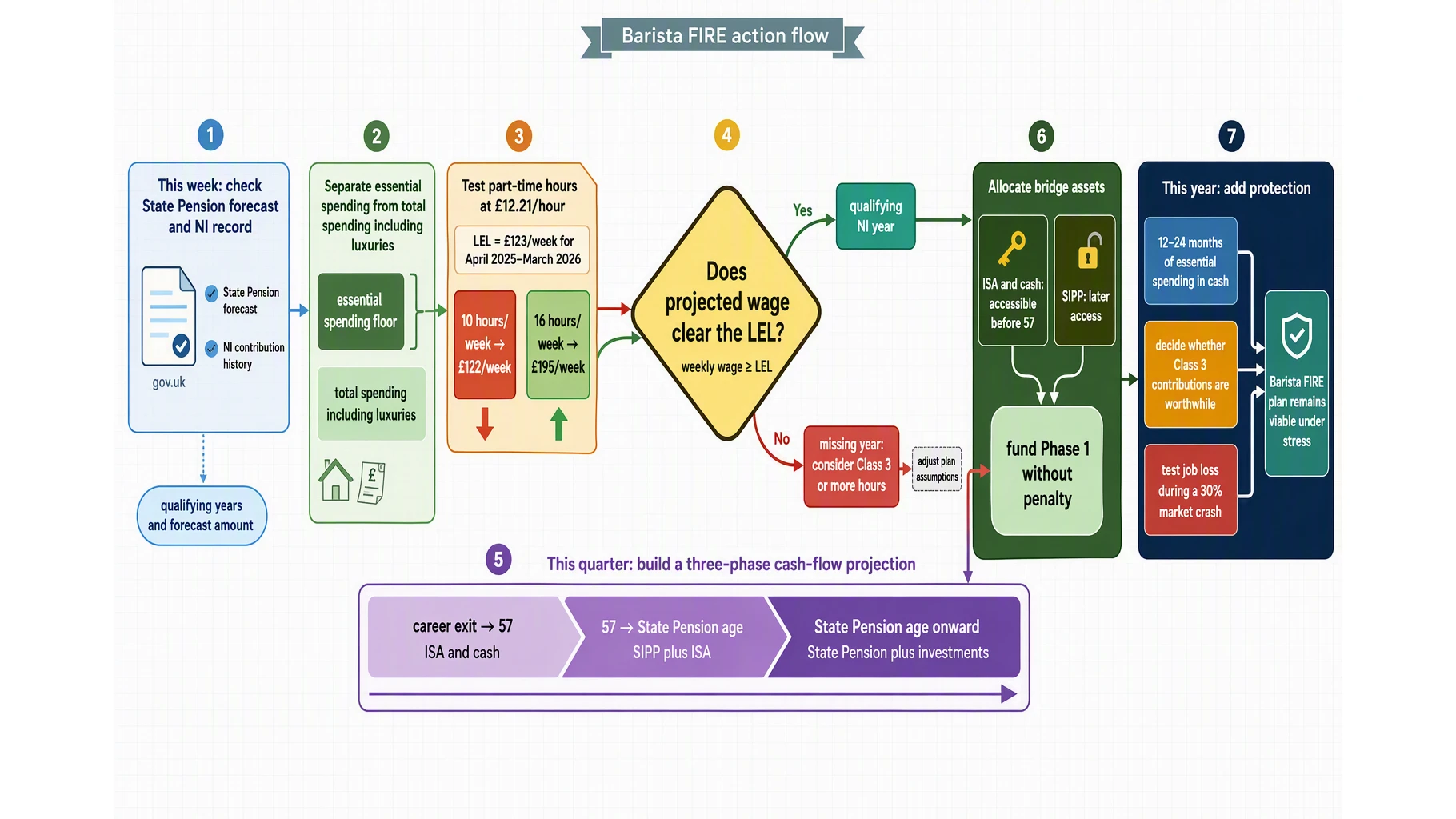
1. Check your State Pension forecast and NI record on gov.uk. Visit the official Check your State Pension service and log in via Government Gateway. Write down your number of qualifying years and your forecast amount at State Pension age. This single number is the foundation of your Barista FIRE plan — without it, you are flying blind.
2. Calculate your core annual spending (essential costs only) versus total spending. Strip out luxuries, holidays, and discretionary dining. What is the minimum your household needs to keep the lights on and food in the fridge? This is your essential spending floor — the figure your part-time wage and portfolio withdrawals must cover before you touch any buffer.
3. Work out the Lower Earnings Limit threshold and whether a 10-16 hour part-time job at £12.21 per hour would clear it. For the April 2025-March 2026 tax year, the national living wage is £12.21 per hour. Ten hours per week at that rate gives you approximately £122 per week — just below the £123-per-week threshold. Sixteen hours gives you roughly £195 per week, comfortably above it. If your chosen hours fall short, you will not earn a qualifying NI credit year, and your State Pension will not increase. Use the Pension Calculator to model the impact of missing years.
This quarter
4. Build a simple three-phase cash-flow projection: age at career exit → 57, 57 → State Pension age, State Pension age onward. Do not overcomplicate this — a single sheet of paper or a free online tool works fine. Phase one is the gap between leaving full-time work and age 57 (when you can access your private pension). Phase two runs from 57 until your State Pension begins. Phase three is the rest of your life. Each phase has different income sources and tax rules.
5. Determine your asset location: how much needs to be in ISAs and cash for the bridge phase versus how much can stay in pensions. The bridge phase (Phase one) must be funded by money you can access without penalty — ISAs and cash accounts. Pensions are locked until 57. A common mistake is putting too much into pensions early, then being forced to work longer than necessary. The Asset Allocation Calculator: ISA and SIPP Target Mix can help you visualise the split.
6. Identify at least two realistic part-time income sources and test whether they pay at least £129 per week. Industry research shows that 23.2% of UK jobs are classified as high-paid — you are unlikely to walk into one of those as a part-time Barista FIRE worker. Focus on roles where you have existing experience or a genuine interest. Common options include retail, hospitality, tutoring, administrative support, or freelance consulting. Verify that the wage clears the NI qualifying threshold. Several UK articles present the “4% rule” and “half the portfolio” framing too confidently — do not assume you can simply obtain a pleasant, low-stress job paying £10,000-£15,000 indefinitely.
This year
7. Start building a cash buffer equal to 12-24 months of essential spending. This buffer protects you during market downturns, job gaps, or unexpected expenses. It sits in an easy-access savings account, not invested in the market. Think of it as your safety net while you transition from full-time to part-time work.
8. If you have missing NI years, decide whether voluntary Class 3 contributions at £18.40 per week are worth it. The maximum State Pension is approximately £221 per week (2025/26). Each missing year reduces your entitlement by roughly £5-£6 per week for life. At £18.40 per week, you earn that back in about three years of retirement. For most people, filling gaps within the last six years (or going back further under specific extension rules) is a strong financial decision. ARIA PM handles survivorship adjustment, cost modelling, and regime stress-testing automatically — so you can focus on interpreting results rather than building the simulation.
9. Run a downside scenario: what happens if you lose the part-time job during a 30% market crash. This is not pessimism — it is realism. Your cash buffer covers essential spending while you search for a new role. Your portfolio withdrawals pause or reduce. And crucially, your State Pension qualifying years remain intact because you can still make voluntary contributions. The Minimum Variance Portfolio Calculator: Lowest-Risk Allocation can help you stress-test your portfolio’s resilience.
Barista FIRE gives you bargaining power over work, not a guarantee of early retirement — and that bargaining power is more valuable than any portfolio number.
Key Takeaways
- Barista FIRE in the UK shifts from a portfolio withdrawal problem to a state-pension-eligibility problem, where the part-time wage’s sole purpose is to clear the £129-per-week Lower Earnings Limit.
- Earning below that threshold costs you a qualifying year toward the full State Pension. That missing year permanently reduces your inflation-linked £12,547.60 annual income.
- The part-time job works as a tool to buy an NI credit for roughly £6,708 a year. This trade-off protects a far larger lifetime income stream than any marginal portfolio optimisation.
- A part-time wage that clears the LEL automatically builds a qualifying year without any extra paperwork. You do not need to earn the median UK salary to secure your full State Pension.
- Failing to cover the earnings threshold turns your part-time job into a stealth tax on your own retirement. You lose the benefit of the job entirely if it does not secure that qualifying year.
Table 1: Three Approaches to Early Retirement in the UK
| Dimension | Traditional FIRE | Lean FIRE | Barista FIRE |
|---|---|---|---|
| Primary goal | Full portfolio independence | Minimalist full independence | Part-time income + state pension eligibility |
| Portfolio requirement | 25x to 30x annual expenses | 25x to 30x very low expenses | Lower than full FIRE (gap between expenses and part-time wage) |
| State pension strategy | Optional, often ignored | Optional, often ignored | Central to the plan — must maintain NI credits |
| Key risk | Sequence of returns | Unexpected costs rising faster than inflation | Losing part-time job or falling below the NI earnings threshold (£6,956 in 2025/26) |
| Typical age range | 40 to 50 | 40 to 50 | 45 to 55 (with part-time work until state pension age) |
Table 2: UK State Pension NI Credits — Options for Barista FIRE Workers
| NI Credit Route | How It Works | Earnings Threshold Needed? | Best For |
|---|---|---|---|
| Part-time employment | Working 16+ hours/week at minimum wage (~£13,000/year) | Yes — must exceed £6,956/year | Most reliable route; builds other pension contributions too |
| Class 2 voluntary contributions | Self-employed workers pay £3.45/week | No | Freelancers, contractors, and side-hustle earners |
| Class 3 voluntary contributions | Anyone can pay £17.45/week to fill gaps | No | Those without any earned income and fewer than 35 qualifying years |
| NI credits for caring | Claiming Child Benefit or Carer's Allowance | No | Parents and unpaid carers |
| NI credits for unemployment | Claiming JSA or Universal Credit | No | Those between jobs or unable to work |
Table 3: The ISA-Pension Bridge vs. Traditional Drawdown
| Feature | ISA Bridge Strategy | Traditional Drawdown Strategy | Barista FIRE Adjustment |
|---|---|---|---|
| Access age | Any age (no penalty) | 57 (rising to 58 from 2028) | Use ISA to bridge from early retirement to age 57 |
| Tax treatment | Tax-free withdrawals | 25% tax-free lump sum, then income tax on withdrawals | Withdraw from ISA first; leave pension untouched until state pension age |
| State pension optimisation | No direct impact | No direct impact | Use part-time wage to earn NI credits (not to fund spending) |
| Sequence of returns risk | High in early years | Mitigated by phased withdrawals | Lower risk because part-time wage provides income floor |
| Best for | Retiring before age 55 | Retiring after age 55 | Anyone with 10+ years until state pension age |
Sources
- National Insurance Contributions (Secondary Class 1 Contributions) Act 2025 — Explains National Insurance contributions structure relevant to part-time employment.
- Employee earnings in the UK - Office for National Statistics — Provides UK employee earnings data to estimate part-time income levels.
- National Minimum Wage and National Living Wage rates - GOV.UK — Sets minimum wage rates for calculating realistic part-time earnings.
- Income Tax rates and Personal Allowances : Current rates and allowances - GOV.UK — Details income tax thresholds and personal allowance for net income planning.
- Employee workplace pensions in the UK - Office for National Statistics — Covers workplace pension statistics and auto-enrolment for passive savers.
- Individual Savings Accounts (ISAs): Overview - GOV.UK — Outlines ISA tax-free savings vehicles key for FIRE accumulation.