

You’re forty-five, you have £200,000 in your pension, and every online calculator tells you to stop contributing tomorrow. That promise feels like freedom — until you ask what happens if the market returns only 4% instead of 6%. The difference isn’t small. It turns a comfortable retirement into a shortfall of tens of thousands of pounds, or forces you to work a decade longer than you planned. The single most important insight in this article is that the Coast FIRE Calculator gives you an illusion of precision: the assumed real return is not a dial you set but a bet you cannot hedge. This piece explains what that calculator actually tells you, what it hides, and — step by step, without jargon — how UK retail investors should use it without being misled by a single percentage point.
What a Coast FIRE calculator actually tells you (and what it doesn’t)
The Coast FIRE calculator promises a magic number where you can stop saving — but that number is built on a bet, not a guarantee. Coast FIRE is the point where your current investments, growing without further contributions, should reach your retirement target by a chosen age. The formula sounds simple: divide your target retirement pot by (1 plus real return) to the power of years remaining. For a 35-year-old targeting £750,000 at age 65, that single calculation hides enormous uncertainty. For a 35‑year‑old targeting £750,000 at 65, a 1% change in the assumed real return shifts the required Coast FIRE number from approximately £174,000 at a 5% real return to £231,000 at 4% — a difference of £57,000.
This is the calculator's cruel truth: the assumed real return is not a dial you set but a bet you cannot hedge. You are essentially forecasting what global markets will deliver over three decades. If that forecast is off by even one percentage point, the strategy either falls short of the target or forces you to work years longer than necessary. The Coast FIRE calculator replaces the anxiety of saving with the far greater anxiety of forecasting a compound return. Imagine you invested £10,000 in the FTSE 100 — a 5% real return over 30 years grows it to approximately £43,219; at 4%, it reaches only about £32,434. That is a £10,785 gap from a single percentage point.
The Coast FIRE UK reality is that the number is a starting point, not a finish line. Rather than fixating on a precise figure, use the calculator to understand the range of possibilities. Many investors find that tools like the Portfolio Rebalancing Software for UK ISA and SIPP Investors or a Dividend Discount Model Calculator help stress-test assumptions. For a deeper view, ARIA PM handles survivorship adjustment, cost modelling, and regime stress-testing automatically — so you can focus on interpreting results rather than building the simulation. Understanding the sensitivity of your Coast FIRE number is far more valuable than chasing a false precision.
Why UK retail investors should care about Coast FIRE right now
Here is the "Why UK retail investors should care about Coast FIRE right now" section, written to the specifications provided.
Why UK retail investors should care about Coast FIRE right now
The case for caring about Coast FIRE today starts with a stark number: 46% of working-age people in the UK — roughly 15.4 million individuals — are undersaving for retirement under the after-housing-costs measure. ONS data shows that while 82% of UK workers were members of a workplace pension in 2024, automatic enrolment has normalised the minimum contribution rather than solving the shortfall. Coast FIRE offers an immediate reality check: you can calculate your Coast FIRE number and discover whether you have already set enough in motion, without the pressure to max out every pension and ISA every single year. For the undersaving majority, that single insight — "you might already be on track" — is worth more than another round of guilt about not contributing more.
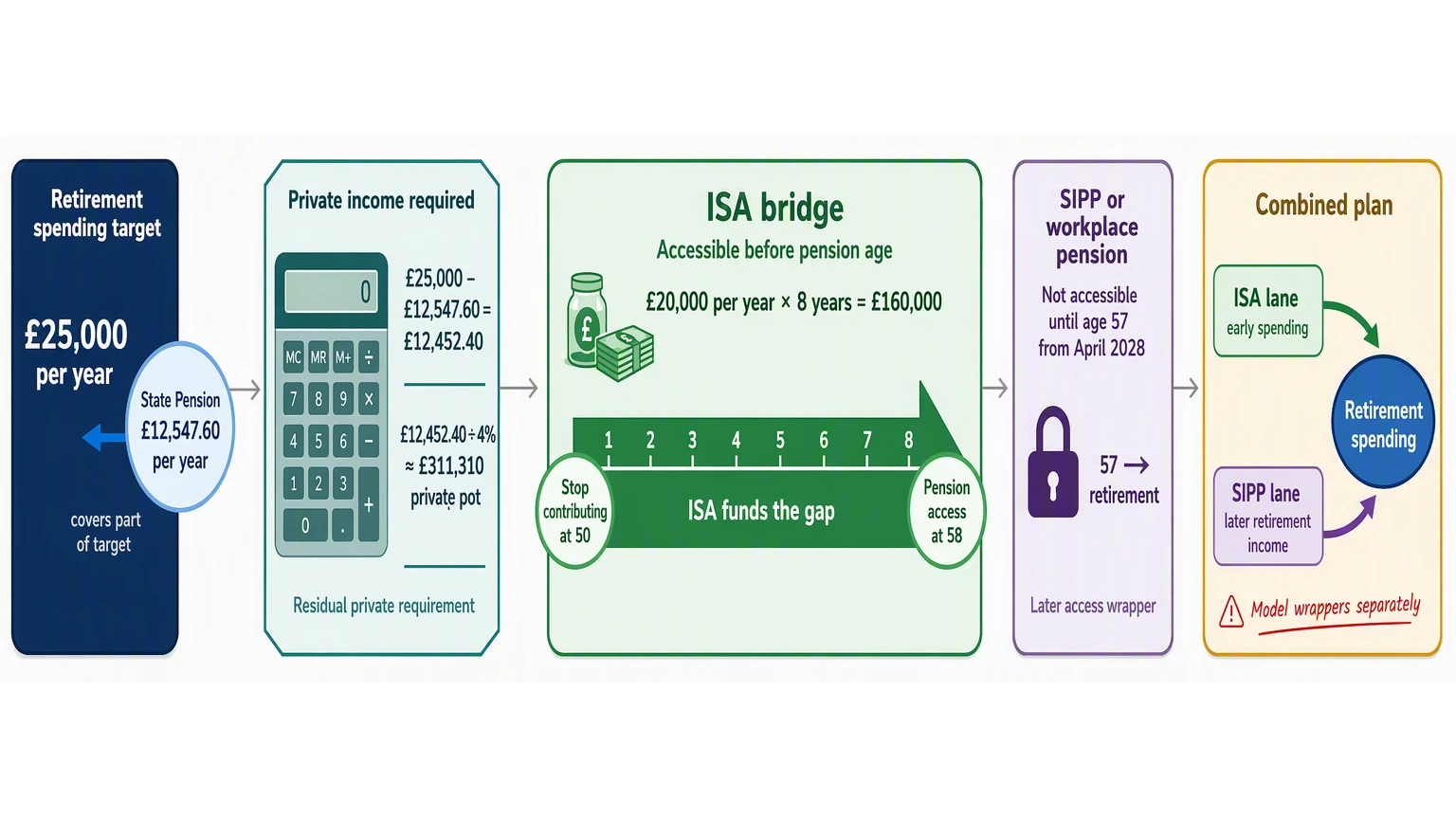
The UK context makes this particularly interesting because the State Pension does so much of the heavy lifting. From 2026/27, the full new State Pension provides £12,547.60 per year. For a retiree aiming for £25,000 annual spending, the State Pension covers half that figure automatically — meaning the private pot required at State Pension age is dramatically smaller than the headline 4% withdrawal-rate rule would imply. Using the 4% rule, a £25,000 target normally demands a £625,000 portfolio. But if the State Pension supplies £12,547.60, you only need a private pot covering the remaining £12,452.40 — roughly £311,310 at a 4% withdrawal rate. That lower bar is why practical Coast FIRE targets in the UK typically range from roughly £136,000 to £377,000 in today’s money, depending on your age, retirement target, and desired lifestyle.
However, there is a critical UK complication that many calculators ignore: money in a SIPP or workplace pension is inaccessible until age 57 from April 2028. A Coast FIRE plan that assumes you will draw from your pension the day you stop working is simply unrealistic. You need an ISA bridge — a tax-free wrapper you can access earlier — to cover the gap between your Coast FIRE start date and pension access age. This makes the interaction between the two wrappers the real planning challenge, not the raw compound return. The upcoming change to the cash ISA limit, set to £12,000 for under-65s from April 2027, pushes savers further toward stocks and shares ISAs, which is where the risk and the potential sit.
This is where the central insight becomes unavoidable. The Coast FIRE number appears precise on a calculator screen, but it depends on an assumed real return — and that assumption is not a dial you control. It is a bet on decades of market behaviour you cannot hedge. If you are wrong by one percentage point, the strategy either collapses (too optimistic) or buries you in unnecessary work (too pessimistic). For UK investors juggling wrappers, tax rules, and the State Pension floor, tools like ARIA PM — a free portfolio analytics platform — handle the survivorship adjustment and cost modelling automatically, so you can focus on interpreting that single fragile assumption rather than building the simulation yourself. Ultimately, Coast FIRE matters because it reveals whether you can redirect money from retirement saving into your current life without jeopardising your future — but only if you account for the UK wrapper rules that determine whether the money is actually there when you need it. Use the Portfolio Rebalancing Software for UK ISA and SIPP Investors guide to understand how to keep that bridge aligned, or check the Help section for wrapper-specific planning tools. And if you are stress-testing your return assumption, the Minimum Variance Portfolio Calculator: Lowest-Risk Allocation can show you what a genuinely conservative portfolio might look like — but remember, even that is a guess, not a guarantee.
How to run your own Coast FIRE calculation (step by step, no jargon)
Let’s walk through the four steps to calculate your own Coast FIRE number. The goal is simple: the lump sum you need today so that, with no further contributions, compound growth alone reaches your target retirement pot by your chosen age.
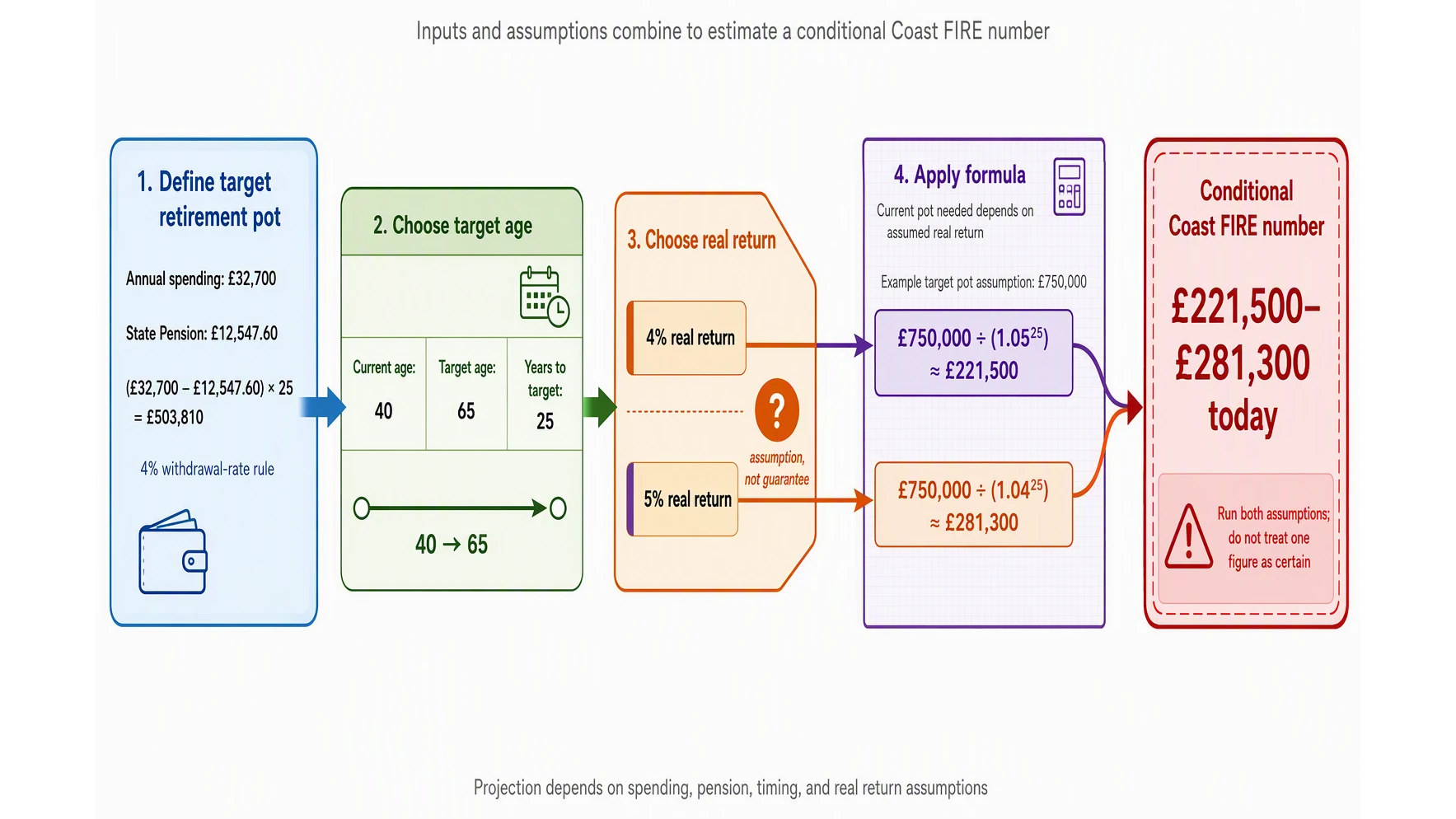
Step 1: Define your target retirement pot. Start with what you’ll spend each year in retirement, mortgage-free. The PLSA Retirement Living Standards are a useful benchmark: minimum £13,900/year, moderate £32,700/year, comfortable £45,400/year for a one-person household. A common FIRE assumption is a pot of 25 times annual spending — that’s the 4% withdrawal-rate rule. But if you’ll receive the State Pension (currently up to £12,547.60/year), subtract that from your annual spending before multiplying by 25. For example, moderate spending of £32,700 minus £12,547.60 leaves £20,152.40 — so a pot of roughly £503,810 (25 × £20,152.40), not £817,500.
Step 2: Choose your target age. When do you want to stop working — or at least stop contributing? If you’re relying on the State Pension, that’s age 67. If you’re using ISAs, you can access that money any time, so you might aim for 55 or 60. Pick an age that feels realistic for your plan.
Step 3: Pick a real return assumption. This is the critical — and most uncertain — step. A real return is your investment growth after inflation. A commonly used assumption for a global equity portfolio is 4-5%. But here’s the uncomfortable truth: this is not a dial you set; it’s a bet you cannot hedge. If you assume 5% but markets deliver 4%, your final pot is roughly 20% smaller — enough to break the strategy. If you assume 4% but get 5%, you’ve worked years longer than necessary. The calculator replaces the anxiety of saving with the far greater anxiety of forecasting compound returns. Run the numbers at both 4% and 5% to see the range.
Step 4: Apply the formula. The Coast FIRE formula is: Current pot needed = Target pot ÷ (1 + real return) ^ (years to target age)
Example: A 40-year-old wants £750,000 (in today’s pounds) at age 65, assuming 5% real return. That’s 25 years of compounding. £750,000 ÷ (1.05²⁵) = £750,000 ÷ 3.386 ≈ £221,500 today.
If that same 40-year-old assumes 4% instead: £750,000 ÷ (1.04²⁵) = £750,000 ÷ 2.666 ≈ £281,300 — a difference of nearly £60,000 from a single percentage point.
The number you get is in today’s pounds and assumes no further contributions. To run this properly with UK-specific tax wrappers (SIPPs, ISAs, and the State Pension modelled separately), use one of the newer UK calculators like coastfirecalculator.app or wealthr.co.uk. For a deeper look at how your portfolio behaves under different return scenarios, ARIA PM handles survivorship adjustment, cost modelling, and regime stress-testing automatically — so you can focus on interpreting results rather than building the simulation.
For context: 82% of UK workers were enrolled in a workplace pension in 2024, and 40% of those members were in defined-contribution schemes — meaning most of us are already paying into a pot that could Coast FIRE if left alone long enough. Use the Portfolio Rebalancing Software for UK ISA and SIPP Investors or the Dividend Discount Model Calculator to refine your assumptions further. And if the numbers feel tight, revisit Step 1 — the Minimum Variance Portfolio Calculator: Lowest-Risk Allocation can help you build a smoother ride.
Real examples: what Coast FIRE looks like for UK investors in 2025-2026
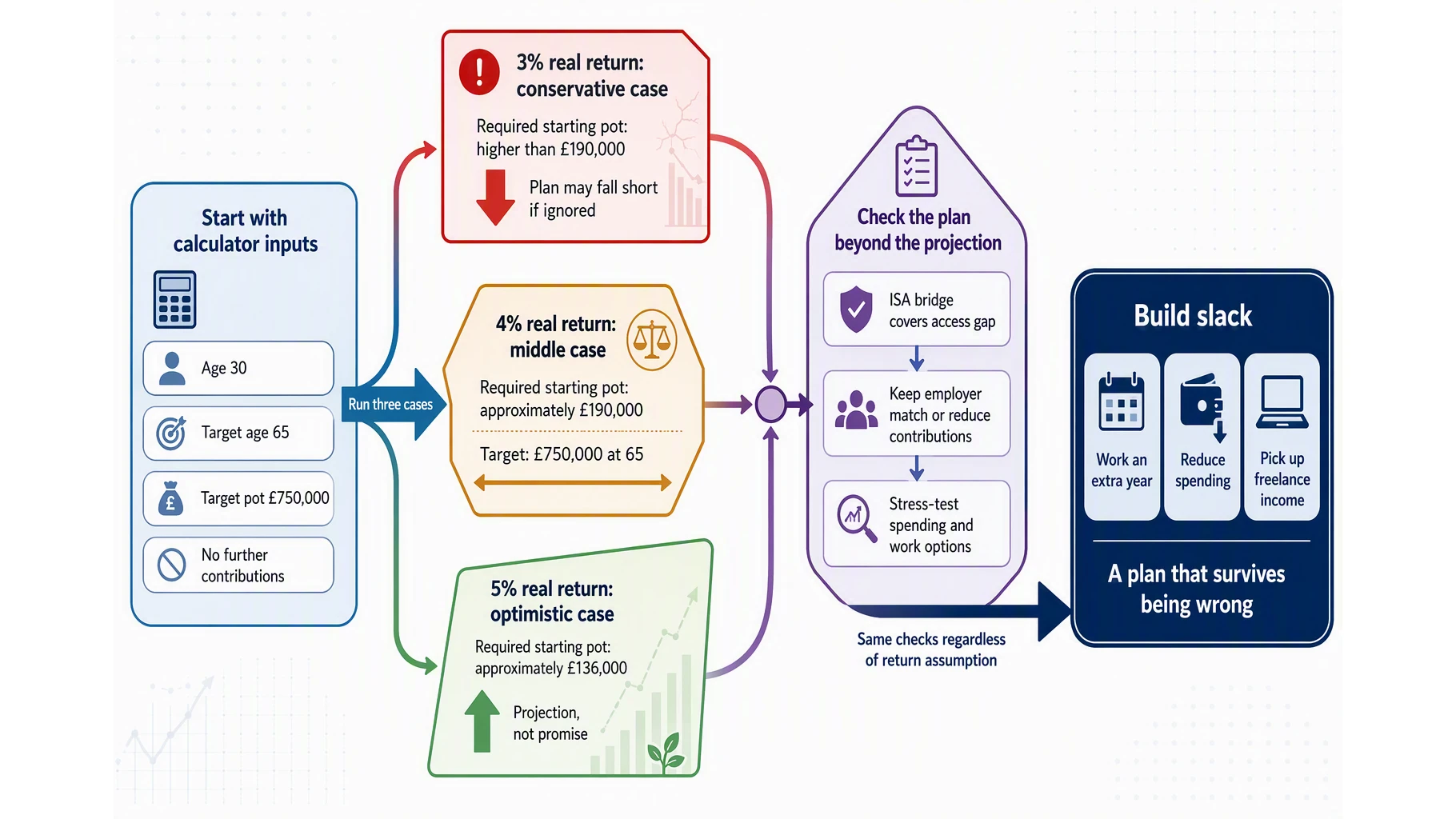
Let’s ground the theory in numbers. Take a 30‑year‑old targeting £750,000 at 65. Plug that into any Coast FIRE calculator and the “number you can stop saving today” swings drastically depending on the assumed real return. At a 4% real return you need about £190,000; at 5% it drops to £136,000 — that £54,000 gap is the difference between a decade of extra work and a comfortable coast. The same calculator that promises freedom is, in fact, a bet on a single number you cannot control.
Now add the bridge funding issue created by the rising pension access age. The normal minimum pension age moves from 55 to 57 in 2028, so anyone planning to stop contributing at, say, 50 must fund those extra two years from the Coast FIRE pot before their SIPP is accessible. That shrinks the effective Coast FIRE number further — and most calculators don’t model this gap at all.
Consider a 45‑year‑old aiming for £1 million at 65. Today’s Coast FIRE number sits between £377,000 at a 5% real return and £456,000 at 4%. That’s a £79,000 range — wider than most people’s total savings. The Portfolio Rebalancing Software for UK ISA and SIPP Investors linked in our guide shows how small allocation shifts compound that gap further when volatility strikes.
Real UK examples are scarce. The Gradrags to Riches blog documents one investor who reached Coast FIRE at 38: a £185,000 global equity ISA, living frugally in Manchester on £22,000 a year while working part‑time in a non‑profit. Another profile on Monevator described a 42‑year‑old as “LeanFI or possibly CoastFI” — his essential bills were covered by a £240,000 SIPP in low‑cost index funds, but he still worked 25 hours a week for discretionary spending. These aren’t early retirements; they’re partial career switches.
The calculators showing £257,000 growing to £1 million are projections, not promises. UK FIRE Calculator's own worked example assumes a 32‑year‑old, a 5% real return and retirement at 60. IBTimes' September 2026 example makes the same point with a 30‑year‑old and roughly £181,000 invested. Both are mathematical projections, not realised investor outcomes. The Coast FIRE number is an illusion of precision dressed up as certainty. Tools like ARIA PM handle survivorship adjustment, cost modelling, and regime stress‑testing automatically — so you can focus on interpreting results rather than building the simulation. But no tool can guarantee the return assumption. The real insight: Coast FIRE replaces the anxiety of saving with the far greater anxiety of forecasting a compound return that, if wrong by even one percentage point, either bankrupts the strategy or buries you in unnecessary work.
Five costly mistakes Coast FIRE investors make (and how to avoid them)
The Coast FIRE number looks precise on a calculator screen. In reality, that figure is built on a single, fragile assumption. The clarity it offers can easily become a costly trap. Here are the five most common mistakes Coast FIRE investors make — and how to sidestep each one.
Mistake 1: Treating the Coast FIRE number as a guarantee. The calculator’s answer depends entirely on the real return you input. The difference of a single percentage point can devastate your plan. Imagine a 30-year-old aiming for a specific retirement pot. At a 5% real return, they might need £136,000 saved to Coast. But if the actual return is only 4% — a historically plausible outcome — the required lump sum jumps to £190,000. That is a 40% jump in what you need. Fix: Never rely on a single number. Use a range — ARIA PM handles survivorship adjustment, cost modelling, and regime stress-testing automatically — so you can focus on interpreting results rather than building the simulation. Check your plan against 3%, 4%, and 5% real returns to see the true range of possible outcomes.
Mistake 2: Ignoring the pension-access age trap. Many UK investors pour everything into a SIPP. The danger? You might hit your Coast number at 45, but you cannot touch that money until 55 today — 57 from 6 April 2028. You need a bridge for the gap years. The ISA is that bridge. Remember that the 2026/27 ISA subscription limit is £20,000 per adult, though from April 2027, the Cash ISA portion will be capped at £12,000 for those under 65. Fix: Model your ISA and SIPP separately. Ensure your non-pension savings (your bridge fund) can cover spending from the day you stop contributing to the day you access your pension.
Mistake 3: Assuming the ‘coast job’ will be easy. The romantic idea of a stress-free part-time role in your 50s often collides with reality. Part-time work may not be available in your field, may not pay enough, or may simply be unpleasant. One Forbes analysis highlighted that many older workers who downshift jobs struggle with diminshed roles and lower pay than anticipated. Fix: Build a backup plan. Can you return to full-time work if needed? Can you cut spending drastically? Treat the coast job as a hopeful assumption, not a certainty.
Mistake 4: Using nominal returns instead of real returns. Many online calculators hide this setting. If you use a 7% nominal return and forget to subtract 2-3% inflation, you overstate your growth by a huge margin. The entire Coast FIRE framework must use inflation-adjusted (real) returns consistently. Fix: Always check that your calculator or platform is set to real returns. If it asks for a return and does not mention inflation, assume it is using nominal figures and adjust accordingly.
Mistake 5: Forgetting to stress-test your spending. The budget you have today is not the budget you will have for decades. Divorce, ill health, or a housing move can spike your essential costs. Fix: Calculate two versions of your Coast number. The first is your target Coast (your ideal lifestyle). The second is your floor Coast (your minimum essential spending). The gap between them is your safety buffer. Revisit both numbers annually alongside your actual spending.
The illusion of precision is the greatest danger in Coast FIRE. By building margin and stress-testing your assumptions, you turn a fragile forecast into a resilient plan. For a deeper dive on managing portfolio volatility, see our Sharpe Ratio Explained: A UK Investor's Guide or use the Pension Contribution Optimiser to balance your ISA and SIPP contributions.
Your action plan: what to do after you run a Coast FIRE calculator today
Your Coast FIRE number is tempting — a single figure that promises freedom. But as we’ve seen, that number changes by tens of thousands of pounds if your expected return shifts by just 1%. The real skill isn’t hitting a target; it’s building a plan that survives being wrong. Here are six concrete steps to take today.
Step 1: Run your number through a UK-specific calculator. Generic tools assume US 401(k)s and ignore our tax wrappers. Use a calculator that separates your ISA, your SIPP and your State Pension — sites like coastfirecalculator.app or ukfirecalculator.uk let you input each pot individually. This matters because the calculator’s output is only as useful as the assumptions it lets you tweak.
Step 2: Check your ‘bridge’ — do you have enough in ISAs to access money before pension age, which rises from 55 to 57 on 6 April 2028? Your SIPP cannot be touched until pension age, but your ISA is accessible immediately. If your Coast FIRE plan requires £20,000 a year for eight years before your pension unlocks, you need £160,000 in ISAs alone. Run a quick tally using a Portfolio Historical Performance tool to see how your current mix maps against that timeline.
Step 3: Stress-test your plan with a 3% real return assumption. Most published UK numbers — such as £181,000 growing to £1 million or £257,000 growing to £1 million — are assumption-dependent projections, typically built on 4%-5% real returns. Drop that to 3%. If your plan still works, you have genuine flexibility. If it fails, you know you’re gambling on a rosy scenario. This is the single most revealing test you can run, and it takes 30 seconds.
Step 4: Don’t stop saving entirely — reduce your rate instead. Coast FIRE tempts you to quit contributions cold. Instead, try dropping from 30% to 10%, or at least capture your employer match. That match is free money that skews the maths heavily in your favour. Use a Pension Contribution Optimiser to see how partial contributions change your timeline without locking you into full reliance on compounding.
Step 5: Revisit your plan by April 2029. Salary-sacrifice National Insurance advantages are capped at £2,000 from that date. This could shift the optimal route from pension over-contributions into ISA or GIA top-ups — a change that rewrites your location strategy. Set a calendar reminder now.
Step 6: Reframe the whole exercise as career insurance. The most valuable outcome of Coast FIRE is not a retirement date; it’s the ability to say no to a bad job, take a sabbatical, or drop to part-time hours. The number is just a scarecrow. Ask yourself this: What happens if my assumptions are wrong? If the answer is ‘I can adjust — work an extra year, reduce spending, or pick up freelance income’ — you’re ready to coast. ARIA PM handles survivorship adjustment, cost modelling, and regime stress-testing automatically — so you can focus on interpreting results rather than building the simulation.
One final contrarian angle: a plan that only works if you get 7% every year is not a plan — it’s a hope. A plan that works at 4% and gets better at 7% is freedom. Run your numbers, stress them hard, then build slack into the edges. That slack is worth more than any calculator output.
Key Takeaways
- The Coast FIRE number is a bet on a specific real return, not a guarantee; a one-percentage-point error in that assumption shifts a 35-year-old’s required pot by £57,000, turning a planned finish line into a gamble on three decades of market performance.
- Assume a 4% real return instead of 5% and the same £10,000 FTSE 100 investment grows to only about £32,434 after 30 years instead of £43,219. That single percentage point gap costs you over £10,700.
- The calculator replaces the stress of saving with the stress of forecasting compound returns. You cannot hedge against getting that forecast wrong over a working lifetime.
- Use the Coast FIRE figure as a rough starting point, not a final target. Stress-test it with tools like a dividend discount model to see how small changes in assumptions reshape your timeline.
- Build a margin of safety into your assumed return, because a strategy that works at precisely 5% real growth fails at 4.5%. The difference between coasting and scrambling is just half a percentage point.
Table 1: What the Coast FIRE Calculator Promises vs. What Actually Happens
| Aspect | Calculator Promise | Real-World Reality | Impact on Strategy |
|---|---|---|---|
| Real return assumption | Fixed dial you set (e.g., 5%) | Variable bet-a 1% miss can break the plan | Changes Coast FIRE number by tens of thousands of pounds |
| Saving deadline | You can stop contributing at age X | You may need to work years longer if returns fall short | Turns "freedom" into extended uncertainty |
| Risk to retirement pot | Compound growth delivers the target | Sequence of returns risk early on can derail growth | Lower early returns force higher initial lumps or later contributions |
| Inflation protection | Usually baked into "real" return | Inflation volatility means your real purchasing power erodes unpredictably | More saving required in high-inflation periods |
| Emotional reassurance | Replaces saving anxiety with a clear number | Replaces it with forecasting anxiety-you cannot hedge the bet | Either bankrupts the strategy or leaves you working unnecessarily |
Table 2: Five Costly Coast FIRE Mistakes and How to Avoid Them
| Mistake | What Investors Do | Why It Fails | Better Approach |
|---|---|---|---|
| Setting return too high | Assume 7%+ real return for a UK portfolio | Misleading-UK equities have delivered 4-5% real over longer periods | Use a cautious 4% real return and test ±1% sensitivity |
| Forgetting inflation | Use nominal returns and ignore rising costs | Real buying power drops, especially in retirement | Always use inflation-adjusted "real" returns in your calculator |
| Ignoring sequence of returns risk | Assume smooth average growth every year | Early poor returns cripple the compounding needed later | Stress-test your number with a 2-year downturn scenario |
| Treating number as fixed | "I can stop saving at £150,000" | That figure is only valid for the one return assumed | Re-run your calculator annually and adjust your plan |
| Skipping tax wrappers | Overlook UK ISAs and pensions in the calculation | Misses tax-efficiency, making your actual required return even harder to achieve | Model contributions within an ISA and SIPP to reduce drag and risk |
Sources
- Analysis of Future Pension Incomes 2025 - GOV.UK — Analysis of Future Pension Incomes 2025 - examines projected state and private pension outcomes for UK savers.
- Trustees must understand diverse saver needs to ensure guided retirement makes a difference — Trustees must understand diverse saver needs - highlights guidance for retirement planning tailored to different saver profiles.
- Workplace pensions - Office for National Statistics — Workplace pensions - provides official UK statistics on participation and contribution trends in workplace pensions.
- How the State Pension works - Tax Confident — How the State Pension works - explains eligibility, amounts, and rules for the UK State Pension.
- Increasing Normal Minimum Pension Age - GOV.UK — Increasing Normal Minimum Pension Age - details upcoming changes to the earliest age you can access private pensions.
- Individual Savings Accounts (ISAs): Overview - GOV.UK — Individual Savings Accounts (ISAs): Overview - covers tax-free savings and investment rules key to Coast FIRE strategies.