

You’re a UK investor with a solid portfolio spread across your ISA, SIPP, and a GIA, and Kubera shows you a clean snapshot of your total net worth. But when you try to see exactly how much dividend tax you’ll owe this April, or whether selling a specific share could max out your capital gains allowance, the tracker goes silent. That gap isn’t about missing features — it’s costing you real tax-efficiency and risk control. This article explains the single most important insight for finding the Best Kubera Alternative for UK Investors: a tool that moves from a static photo of what you own to an engine for actionable decisions. You will learn what truly separates these platforms in plain English, and how to pick one that optimises your ISA and SIPP against allowances you already control. No coding knowledge needed — just your self-directed portfolio.
What is a Kubera alternative — and why it matters for your UK portfolio
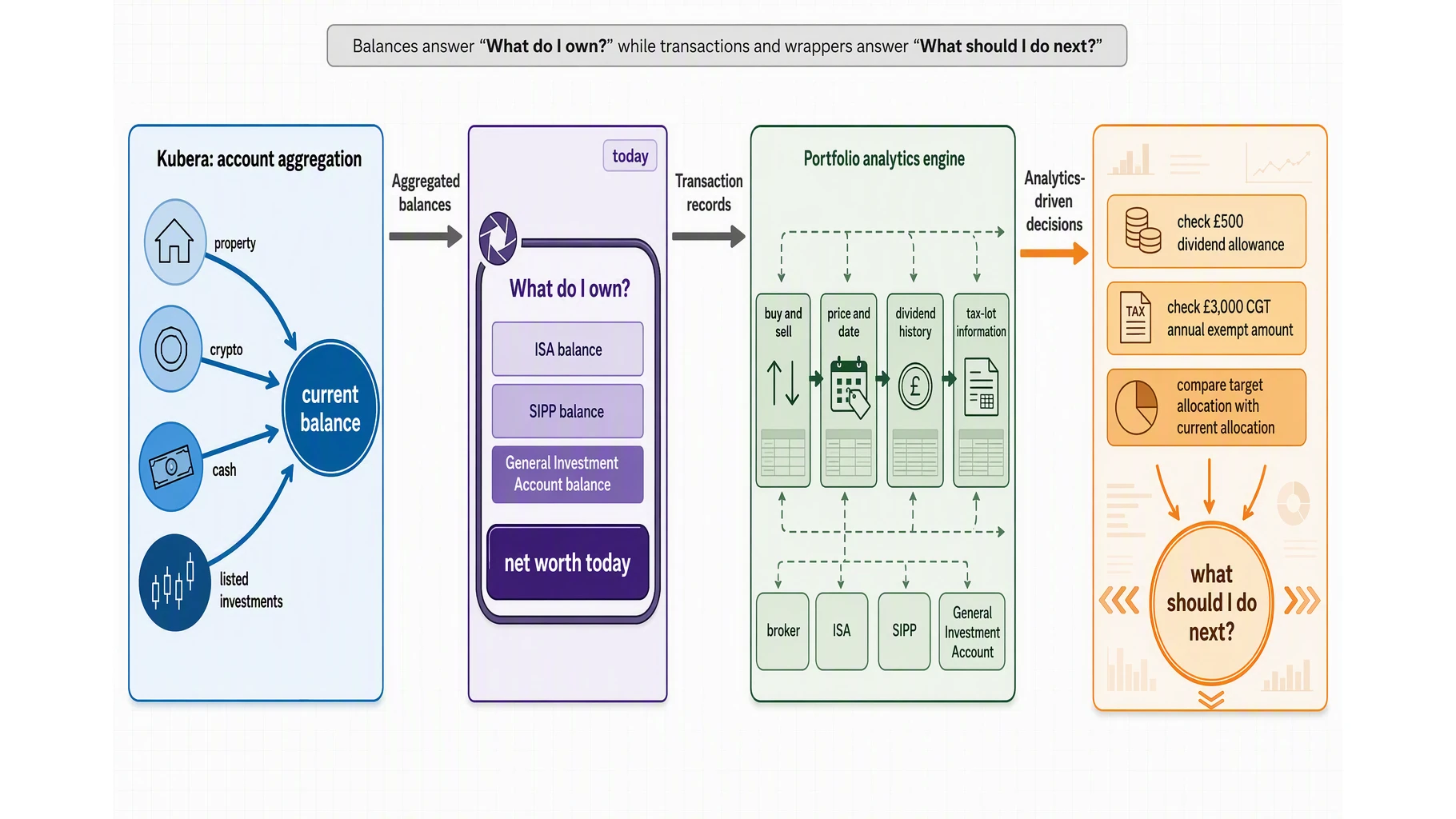
You pay Kubera $250/year (or $2,500/year for Kubera Black) for a net-worth portfolio tracker that is, at its core, a superb account aggregation tool. It pulls in your property, crypto, cash, and listed investments and presents them as one clean balance sheet. That is useful for the quarterly question: ‘What do I own?’ But for a UK self-directed investor managing an ISA, SIPP, and General Investment Account, the question you need answered every month — or every week — is different: ‘What should I do next?’
A true Kubera alternative is not simply a cheaper tracker. It is any platform that goes beyond the static snapshot to deliver tax-aware, actionable analytics. The gap is a matter of data model, not features. Kubera stores a list of positions. A portfolio analytics engine, by contrast, understands your dividend allowance (GBP 500 for 2026/27) , your CGT annual exempt amount (GBP 3,000) , and the tax wrappers around each holding — so it can tell you whether selling a specific London-listed share would trigger an unnecessary tax bill, or whether rebalancing inside your SIPP could harvest a gain without cost.
For retail investors, the difference between these two tools is the difference between knowing your net worth and optimising it. Industry research shows the premium for Kubera Black is 10× higher than Essentials — or 900% more — yet neither tier offers the portfolio optimisation or risk metrics that turn data into decisions. Compare this with a platform like ARIA PM, which is free for UK investors and built around the exact analytics Kubera omits: wrapper-aware dividend tracking, GBP ticker support, and portfolio calculator tools that model your efficient frontier.
The real alternative, therefore, is not a cheaper snapshot — it is a fundamentally different engine. Kubera tells you where you are. A proper Kubera alternative tells you what to do next, and paying $250/year for the former while ignoring the latter leaves your ISA subscription limit (GBP 20,000) and CGT allowances under-optimised against rules you already control. For a deeper comparison of tools in this category, see our guide to the Best Morningstar Portfolio Manager Alternative for UK Investors.
How portfolio analytics actually works: a plain-English breakdown
Here is the "How portfolio analytics actually works: a plain-English breakdown" section for the article:
Think of your net worth tracker, like Kubera, as a bathroom scale. It tells you a number: your weight this morning. It is accurate, useful for tracking a trend, and a static snapshot of where you stand. Portfolio analytics is a nutritionist who sits down with you, reviews your diet logs, checks your blood work, and explains that swapping your morning pastry for porridge will stabilise your energy and reduce a specific health risk. One tells you where you are; the other tells you what to do next.
This difference comes down to a fundamental shift in data structure. A net-worth tracker aggregates balances — it pulls the total value of your Stocks and Shares ISA from one feed, your SIPP from another, and your crypto wallet from a third, then adds them up. That is a photo.
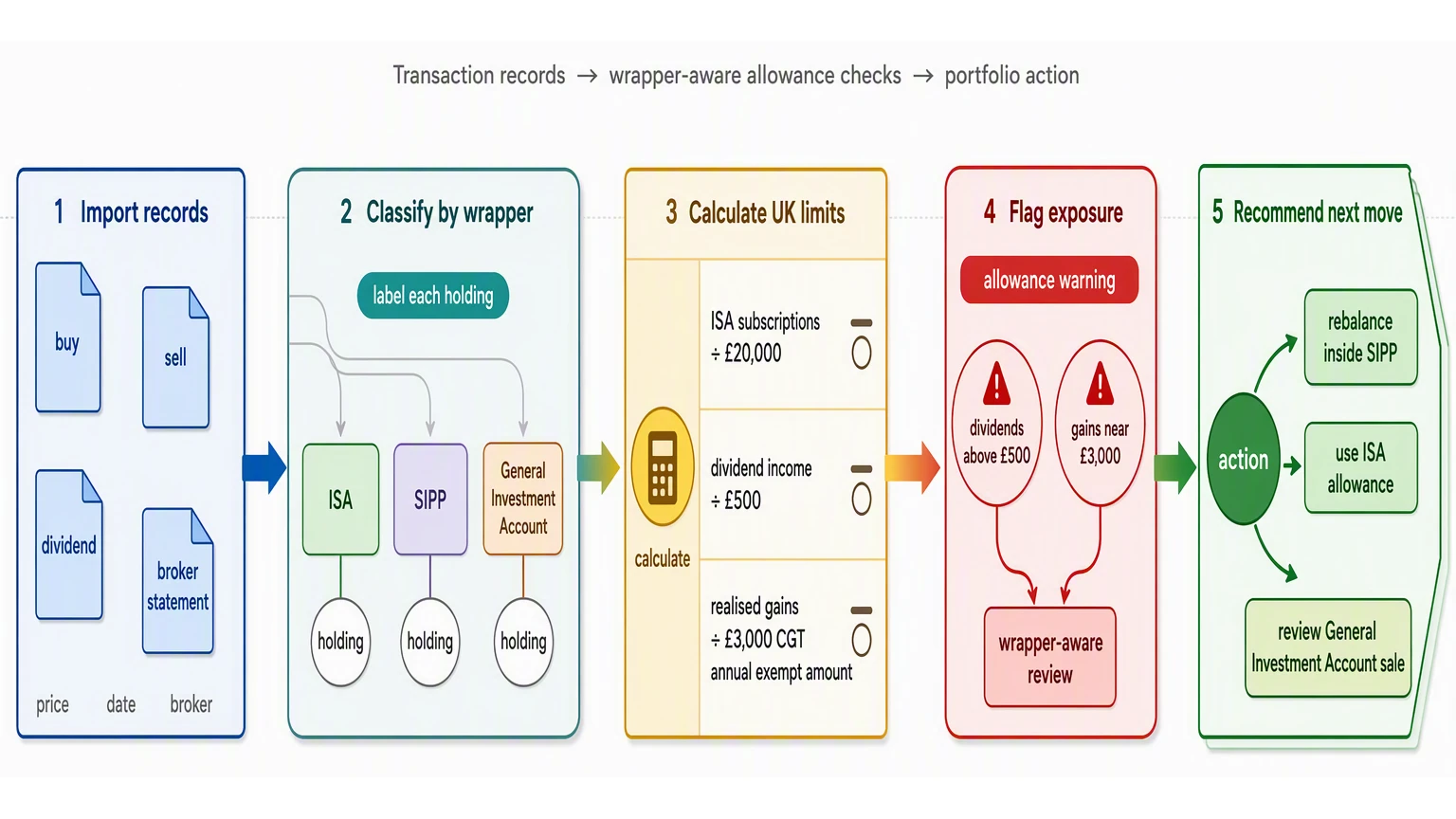
Portfolio analytics, as platforms like ARIA PM (free for UK investors) demonstrate, runs on a different engine: transaction-level data. It sees every single buy and sell you made — the price, the date, the number of shares, the broker. It integrates this with dividend histories and tax-lot information. The engine doesn't just calculate your total; it matches every trade against HMRC's tax rules in real time. It tracks your remaining ISA allowance (the £20,000 annual limit for 2026/27). It scans your dividend income from every holding and flags you the moment you approach the new £500 dividend allowance — after which your basic-rate tax liability kicks in. It calculates the accrued gains in your General Investment Account and alerts you when you near the £3,000 capital gains tax (CGT) annual exempt amount.
The investor does none of this maths. The engine runs silently in the background. Kubera’s $2.8 million in estimated annual recurring revenue (ARR), based on third-party estimates for 2025, comes from charging users for that static snapshot — $250/year for Essentials or $2,500/year for Black, prices confirmed in its help centre as of August 12, 2026. You pay for a chart of where you are. But paying for the photo while ignoring the engine leaves your ISA and SIPP sub-optimised against allowances you already control. For the UK investor, the gap between a tracker and true analytics is not a feature list — it is the difference between knowing you are overweight and knowing exactly which foods to cut, and when.
Kubera alternatives in practice: real tools and real numbers
When you look at the practical alternatives to Kubera for a UK portfolio, the choice comes down to what you need the tool to do after it shows you your balance. Kubera excels at the snapshot — it tracks property, crypto, and private assets alongside your listed investments in one place. But for a self-directed investor managing a SIPP and an ISA, the gap appears the moment you try to turn that snapshot into an action.
Sharesight is the most direct competitor for the listed-stock portion of a portfolio. Its free plan tracks up to 10 holdings across 60+ exchanges, which covers most UK investors who are concentrated in a few core positions. The paid tiers start at $84 per year — roughly 66% cheaper than Kubera Essentials — and the platform’s strength is dividend and capital gains reporting. Sharesight will calculate your dividend income across a tax year and show you your realised gains, which helps with the £3,000 CGT annual exempt amount. But the free tier’s 10-holding limit means you cannot track a full ISA, SIPP, and general account without upgrading.
Empower Personal Dashboard offers a free dashboard that aggregates accounts across brokerages and banks. The price is $0 — a 100% saving versus Kubera — and it provides cash-flow tracking and a net-worth overview. However, its US focus limits UK-specific features: it does not model ISA or SIPP tax wrappers, and it cannot pull data from many UK platforms automatically. You get the big picture, but you cannot optimise against the £500 dividend allowance from within the tool.
ARIA PM was built for this exact scenario. It is entirely free for UK investors and focuses on portfolio analytics rather than net-worth tracking. The data model is different: instead of a static list of what you own, it ingests your holdings and runs risk metrics, Sharpe Ratio calculations, and — crucially — tax-aware rebalancing suggestions for your ISA and SIPP wrappers.
Consider a concrete example. A UK investor has £50,000 spread across a SIPP and an ISA, earning £1,800 in dividends. Kubera shows the total and the asset split. That is useful, but it does not flag the problem: the investor is £200 over the £500 dividend allowance after the first £500 is tax-free. Any dividends above that are taxed at 10.75% (basic rate) or higher. ARIA PM would warn that the portfolio is pushing into the taxable zone and suggest rebalancing into the SIPP, where dividends are tax-free regardless of amount. That is not a feature upgrade — it is a different data model that makes the tax constraint visible before you submit your self-assessment.
For UK investors who want to understand their risk-return trade-off rather than just their balance, the choice is between a tracker and an engine. Kubera tells you where you are; ARIA PM tells you what to do next, specifically for the wrappers and allowances you already control.
The key metrics you need to understand in any tracker
The key metrics you need to understand in any tracker
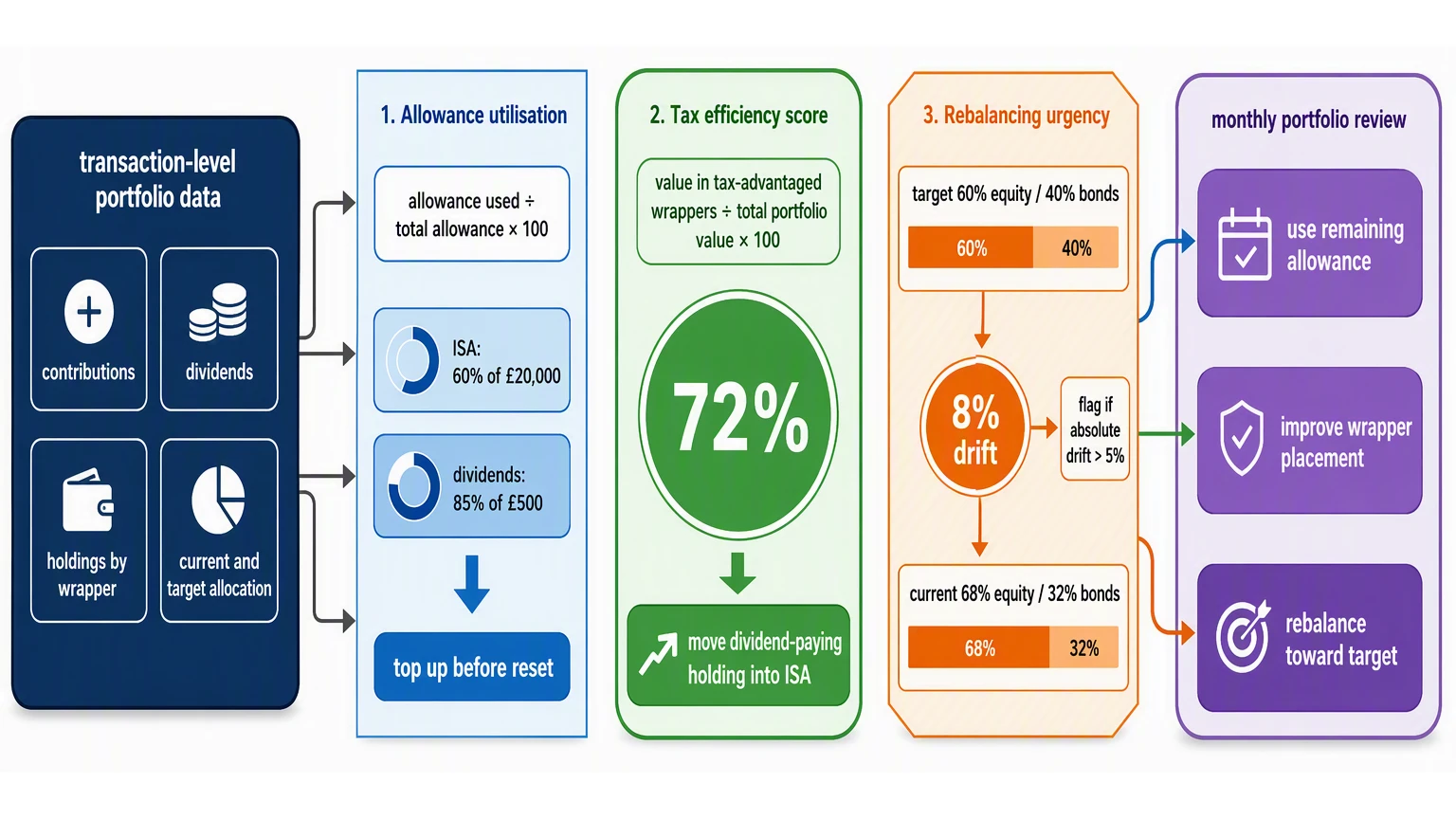
Kubera tells you what you own. A proper portfolio analytics platform — like ARIA PM for UK investors — tells you what to do next. The difference is not cosmetic; it is structural. Kubera uses a static data model: a snapshot of your holdings and their total value. A platform like ARIA PM Home uses a transaction-level model: every buy, sell, dividend, and corporate action is recorded and analysed. That is what makes tax-aware, risk-adjusted decisions possible. That means three numbers matter more than your net worth figure.
1. Allowance utilisation Formula: Allowance used ÷ total allowance × 100.
The single biggest advantage of a UK ISA or SIPP is the tax wrapper itself. Yet many investors let their £20,000 ISA subscription limit or £500 dividend allowance go unused year after year. A proper tracker surfaces this: "You have used 60% of your £20,000 ISA allowance year-to-date, and 85% of your £500 dividend allowance." Kubera cannot calculate that because it does not track cash flows into wrappers — it only sees balances. When you link ARIA PM to a broker like Hargreaves Lansdown or Interactive Investor, it automatically ingests transaction history, labels each contribution as ISA, SIPP, or general account, and calculates utilisation against the current tax year's limits. The insight is immediate: if you are at 40% allowance usage in February, you have ten months to top up before it resets.
2. Tax efficiency score Formula: (Value held in tax-advantaged wrappers ÷ total portfolio value) × 100.
This is a single plain number — say, "72%" — showing how much of your portfolio is sheltered from dividend tax and capital gains tax. In 2026/27, basic-rate taxpayers pay 10.75% on dividends above £500; higher-rate pay 35.75%. Moving a dividend-paying holding from a general account into an ISA (using up part of your £20,000 allowance) shelters those dividends from tax entirely. Kubera does not distinguish wrapper types; it treats a Vanguard FTSE All-World ETF in an ISA the same as one in a dealing account. ARIA PM surfaces the tax efficiency score by reading the account labels from your broker import — and if a holding is in the wrong wrapper, it flags it, pointing you to the next trade.
3. Rebalancing urgency Formula: Current allocation % — target allocation % = drift; if absolute drift > 5%, flag.
Portfolio drift creeps up silently. A 60/40 equity-bond split can become 68/32 after a strong equity rally, increasing your risk beyond your plan. Kubera shows you your current allocation if you manually enter categories, but it will not tell you whether that allocation is off-target. A proper platform compares actual weights to your target weights — a 7% drift in UK equities earns a rebalance alert. The Investment Calculator can help you model the impact of that drift over time, while Sharpe Ratio Explained: A UK Investor's Guide explains the risk-adjusted consequences. Each of these three metrics is automatically computed from transaction-level data — the same data that also powers capital gains reports and dividend forecasts. Kubera gives you the headline. An alternative that computes these three numbers gives you the next move.
Common mistakes investors make with net-worth trackers — and how to avoid them
The gap between a net-worth tracker and a true portfolio analytics platform isn't about feature counts. It's a fundamentally different data model: one is a static photo of what you own, the other is an engine for tax-aware, risk-adjusted decision-making. Kubera tells you where you are. Tools like ARIA PM (free for UK investors) tell you what to do next. Paying for the former while ignoring the latter leaves your ISA and SIPP under-optimised against dividend and CGT allowances you already control. Here are three specific pitfalls — and how to sidestep them.
Mistake 1: Overvaluing aesthetics over function
You're paying Kubera $250/year for a clean interface that displays your net worth beautifully. Meanwhile, free tools that prevent tax leaks sit unused. The fix: start with a free UK-specific tool that understands your wrappers. ARIA PM handles multi-currency analysis natively — converting, tracking and reporting your USD-denominated holdings alongside GBP assets to account for exchange rate impacts on returns. Kubera's interface might be prettier, but ARIA PM's tax-aware rebalancing prompts could save you more than the subscription cost in a single dividend month.
Mistake 2: Manual data paralysis — entering everything, analysing nothing
Investors commonly enter every collectible, vintage vehicle and small crypto holding into their tracker, then never revisit the portfolio insights. Data entry becomes the hobby, not the investing. The fix: automate your data feeds. Kubera requires manual updates for most UK platforms. A tool that syncs automatically — or lets you import broker statements in bulk — frees cognitive space for what matters. Once your data flows automatically, review the 'what to do' section of your analytics dashboard monthly, not the net worth figure. Check your Portfolio Rebalancing Spreadsheet: Free Excel Template for drift against targets, then act.
Mistake 3: Treating all trackers as interchangeable
Using a US-centric tool like Empower that doesn't understand UK tax rules is a category error. It won't flag that you're exceeding your £500 dividend allowance (taxed at 10.75% basic rate, 35.75% higher rate), or that you should harvest losses before the £3,000 CGT exempt amount resets. The fix: demand on-device encryption — your UK financial data should be encrypted and processed locally, not shipped to US servers under different privacy laws. Then use a tool that applies UK SDRT at 0.5% on purchases, subtracts the correct dividend tax, and understands that inside an ISA (your £20,000 allowance), gains and dividends are tax-free. ARIA PM's Minimum Variance Portfolio Calculator: Lowest-Risk Allocation helps you optimise within those constraints without exposing your data to third-party servers.
The bottom line
The best alternative to Kubera is the one that changes your behaviour, not just your dashboard. A tracker that auto-syncs, processes data locally, and flags actionable UK tax moves is worth more than any interface. Start with a free UK-specific tool, automate your data, and review your optimisation opportunities monthly — not your net worth.
Getting started with a Kubera alternative: your action plan for today
Here’s the "Getting started with a Kubera alternative: your action plan for today" section for your article.
Getting started with a Kubera alternative: your action plan for today
You can move from passive net-worth tracking to active, tax-aware portfolio management in less than an hour. Here is your three-step action plan — no spreadsheets, no coding, just concrete moves.
Step one: audit your current tracker. If you are paying $250/year for Kubera Essentials — or $2,500/year for Black — note exactly what you are not getting. Does it show you how close your dividend income is to the £500 tax-free allowance? Does it flag when a holding pushes your realised gains toward the £3,000 CGT exempt amount? Does it calculate rebalancing triggers for your ISA wrapper? If the answer is "no" to any of these, you are paying for a static photo of your wealth — not a decision engine. As G2’s competitive rating system reflects, Kubera scores 4.0/5 for breadth of asset tracking, but that metric does not measure UK-specific investment analytics. Write down one gap that matters to your portfolio today.
Step two: sign up for a free UK-focused alternative. Platforms like ARIA PM carry no charge at all — no tiers, no trials — so link your main broker accounts (Hargreaves Lansdown, AJ Bell, Interactive Investor, or Vanguard) and let the system import your holdings. If you prefer a gradual approach, Sharesight’s free tier also supports UK broker data. Both handle London-listed tickers, GBP pricing, and ISA/SIPP wrapper recognition automatically. The key difference from Kubera is the data model: where Kubera shows a single net-worth number, ARIA PM models every holding inside its tax wrapper, so it can calculate, for example, the dividend tax you would owe before you realise the income.
Step three: run the portfolio report and identify one concrete action. Open the tax dashboard. If your report shows £600 in dividend income across your general investment account, you have a clear move: transfer £100 of dividend-paying shares into your SIPP to stay under the £500 allowance. Next, check the capital gains report. If you have an unrealised gain of £3,200, consider selling £200 of that position before the tax year ends — the exempt amount is £3,000, and gains inside an ISA are tax-free anyway, so you might use your £20,000 allowance to rebuy inside the wrapper. One single action, executed today, recoups the annual cost of your old tracker.
The single most important insight is that the gap between a net-worth tracker and a true portfolio analytics platform is not "more features" but a fundamentally different data model: one is a static photo of what you own, while the other is an engine for tax-aware, risk-adjusted decision-making — meaning Kubera tells you where you are, but tools like ARIA PM (free for UK investors) tell you what to do next, and paying for the former while ignoring the latter leaves your ISA and SIPP under-optimised against dividend and CGT allowances you already control. The gap between knowing where you are and knowing what to do is the only metric that matters. Close your Kubera tab, open your new portfolio report, and take that one action today.
Key Takeaways
- Kubera charges $250-$2,500 a year merely to show you a static snapshot of what you own, but for UK investors the real gap is a fundamentally different data model — one that only starts to pay for itself when it treats your ISA, SIPP, and General Account as tax-wrappered engines for dividend and CGT allowance management, not just a list of positions.
- The single highest-use move for a UK self-directed investor is switching from a net-worth tracker to a portfolio analytics platform like ARIA PM (free), because the latter can algorithmically tell you whether selling a London-listed share would waste your £3,000 CGT exempt amount or miss your £500 dividend allowance — calculations Kubera's data model simply cannot perform.
- Paying 10× more for Kubera Black ($2,500/year) vs Essentials ($250/year) buys you zero of the tax-aware analytics you need; every pound spent on either tier is money that could instead be allocated to optimising the annual allowances you already control inside your SIPP and GIA.
- For UK investors holding London-listed shares, a portfolio engine that natively tracks GBP tickers and models wrapper-specific risk-adjusted returns lets you rebalance inside your SIPP to harvest gains tax-free — an action Kubera's static balance sheet will never prompt because it lacks the decision engine to ask "what should I do next?"
- The practical test: if your portfolio tool cannot generate a tax-aware rebalancing recommendation that accounts for your specific ISA, SIPP, and GIA wrappers, it is not a Kubera alternative — it is just a cheaper snapshot, and you are leaving your annual £500 dividend and £3,000 CGT allowances unharvested.
Table 1: Net-Worth Tracker vs Portfolio Analytics Platform
| Feature | Kubera (Net-Worth Tracker) | ARIA PM (Portfolio Analytics) | What This Means for Your UK Portfolio |
|---|---|---|---|
| Core purpose | Snapshot of what you own | Engine for what to do next | Kubera shows your balance; ARIA PM shows your next trade |
| Data model | Static, account-level aggregation | Dynamic, security-level and tax-lot data | Tax-lot tracking is essential for ISA and SIPP optimisation |
| UK tax awareness | Manual entry only | Built-in dividend and CGT allowance tracking | Kubera cannot alert you to unused £1,000 dividend allowance or £3,000 CGT allowance |
| Decision support | None (you interpret the numbers) | Risk-adjusted rebalancing and tax-harvesting signals | Paying Kubera $250/year leaves allowances under-optimised |
| Cost for UK investors | $250/year (or $2,500/year for Kubera Black) | Free | ARIA PM offers the analytics engine at zero cost |
Table 2: Key Metrics Comparison — What Each Tool Actually Tracks
| Metric | Kubera Tracks? | Portfolio Analytics Tracks? | Why This Matters for Your ISA and SIPP |
|---|---|---|---|
| Total net worth | Yes | Yes | Basic number — both tools do this |
| Individual security tax-lot cost basis | No | Yes | Without lot-level data, you cannot tax-harvest losses |
| Dividend income vs £1,000 allowance | No (manual calculation) | Yes (real-time tracker) | Kubera won't tell you when you exceed the allowance |
| Realised gains vs £3,000 CGT allowance | No | Yes (per tax year) | Missing this means paying unnecessary capital gains tax |
| Risk-adjusted allocation per asset class | No | Yes (with rebalancing triggers) | Kubera shows allocation; it does not tell you when to rebalance |
| What to do next (actionable signal) | No | Yes (e.g., "sell X, buy Y") | This is the gap between a static photo and an decision engine |
Sources
- Open finance roadmap: our vision for a smart data future | FCA — Outlines the FCA's vision for open finance and better data sharing for UK investors.
- fca.org.uk — Details regulatory rules for financial promotions and investment pathways in the UK.
- PS25/22: Supporting consumers’ pensions and investment decisions: rules for targeted support | FCA — Sets rules for targeted support to help consumers with pension and investment decisions.
- Pensions dashboards: how to connect to the ecosystem | FCA — Explains how firms connect to pensions dashboards, aiding UK investors in tracking savings.
- Kubera Essentials vs Black - Kubera Help Center — Compares Kubera Essentials and Black features, relevant for choosing a portfolio tracker.
- Financial Tools | Empower — Offers free financial tools for net worth tracking and investment analysis, a Kubera alternative.