

You’ve built a carefully selected portfolio of UK investment trusts and ETFs, yet when you open Morningstar to check your total allocation to North America, you’re stuck manually adding up funds one-by-one. The real risk isn’t that a single trust underperforms — it’s that you unknowingly double-down on the same market bet, leaving your retirement savings exposed to a crash you could have avoided. This article explains exactly why the Best Morningstar Portfolio Manager Alternative for UK Investors isn’t just a cheaper tool, but a fundamentally smarter way to see your true portfolio risk. You’ll learn how to stop drowning in fund-level detail and start using a risk-aware feedback loop — without writing a single line of code.
What Is a Morningstar Portfolio Manager Alternative — and Why You Need One Now
In April 2025, Morningstar retired its Portfolio Manager tool for free and Premium users, abruptly closing the door on a service many UK investors relied on to log holdings and track performance. The replacement, Morningstar Investor, costs $249 per year (about $20.75 per month) and shifts the focus firmly toward investment research rather than portfolio monitoring. But here is the catch: even at that price, you still cannot backtest a strategy, run portfolio optimisation, or track tax wrappers like ISAs, SIPPs, and general investment accounts separately. For a self-directed investor managing a £20,000 ISA allowance or a SIPP, that is a significant blind spot.
A portfolio tracker is simply a tool that records your holdings, tracks performance, and shows where your money is really invested — across asset classes, sectors, and geographies. Most investors waste time obsessing over individual fund ratings from Morningstar’s research arm when the real risk lives at the portfolio level: overlapping holdings, hidden concentration in one stock across multiple funds, or a drift away from your target asset allocation. The most important insight for UK investors is that Morningstar Portfolio Manager’s fund-level depth is a distraction from portfolio-level risk.
That is where ARIA PM comes in. It uses free data — such as Yahoo Finance or Morningstar’s own free X-Ray-style tools — but transforms an incomplete snapshot into a complete risk-aware feedback loop by adding backtesting, optimisation, and wrapper-aware tracking that Morningstar simply does not offer. For example, ARIA PM can help you see how a £10,000 investment split across a global equity ETF and a UK gilt fund would have performed through the 2022 bond rout, then optimise that mix for your specific ISA or SIPP. It also accounts for the tax treatment inside each wrapper — crucial when dividend tax now kicks in at £500 of income (10.75% basic rate, 35.75% higher, 39.35% additional) and the CGT annual exempt amount is just £3,000.
If you are comparing alternatives, tools like Empower Personal Dashboard offer free portfolio-risk analysis and historical performance review, but they are built for US investors and lack UK wrapper awareness. ARIA PM fills that gap without introducing a subscription. You can check your portfolio health and visualise your risk-return trade-off directly — no project, just a tool.
Why Morningstar's Fund-Level Depth Is a Distraction — and What You Actually Need to Track
Morningstar built its reputation on rating individual funds. Its star ratings and analyst reports tell you whether a single fund is well-run or expensive. But the biggest risk to your portfolio is rarely a bad fund. It is how your holdings interact beneath the surface.
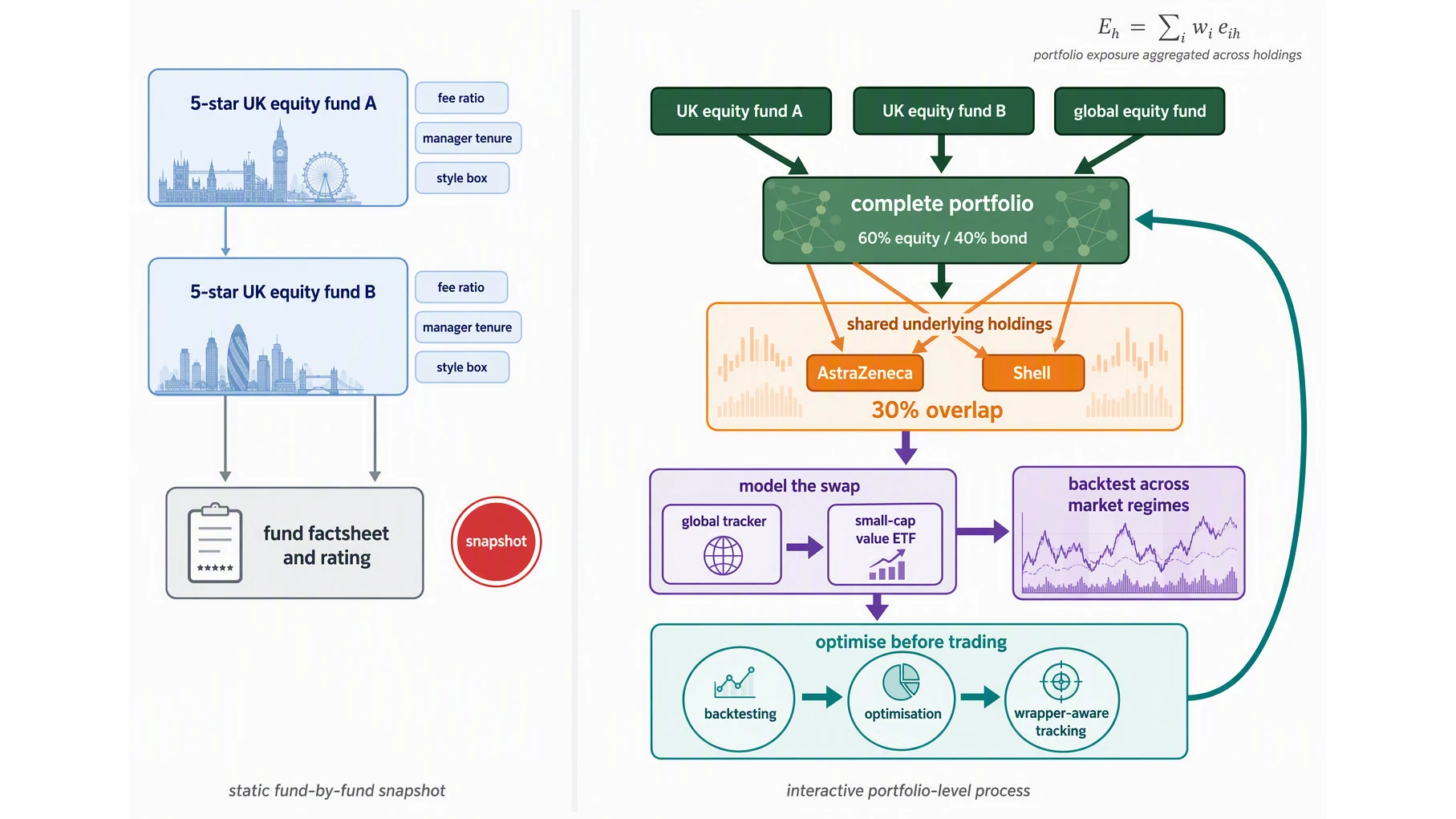
Consider a common scenario for UK investors. You hold two '5-star' UK equity funds from different providers. Both are highly rated. Morningstar Portfolio Manager would show you each fund’s details — fee ratio, manager tenure, style box. You might feel confident. But if you dig into the actual holdings, both funds overweight AstraZeneca and Shell among their top ten positions. You could be sitting on a 30% overlap in those two stocks — a concentrated bet you never intended. That is not diversification. It is hidden sector risk, and Morningstar’s fund-level depth cannot warn you about it.
The real gap is clear: Morningstar gives you a snapshot of where you are today, not a feedback loop for where you are going. Its paid tool, Morningstar Investor, costs $249 per year (or $20.75/month on the annual plan), but still provides only a static view of your current allocation. You cannot backtest a change. You cannot run an optimisation. If you wonder, “What happens if I swap this global tracker for a small-cap value ETF?” you have to guess — or execute the trade and wait.
That is where a purpose-built Morningstar portfolio manager alternative changes the game. Tools like ARIA PM let you test that trade before you make it. You model the swap, run the backtest, and see how the new portfolio would have behaved across different market regimes. You catch hidden concentration risk — like that AstraZeneca overlap — and you spot tax inefficiencies, such as holding a high-dividend fund inside a General Investment Account instead of an ISA, where dividends are tax-free. With the 2026/27 dividend allowance set at just £500, a basic-rate taxpayer would pay 10.75% on dividends above that threshold. A £20,000 holding yielding 4% generates £800 in dividends — meaning £300 would be taxed unnecessarily outside an ISA.
The contrast is sharp. Morningstar’s strength remains fund research. But for portfolio-level decisions — the ones that actually determine whether you hit your retirement goal — you need backtesting, optimisation, and wrapper-aware tracking. ARIA PM provides that as a free tool, transforming free analytics from an incomplete snapshot into a complete risk-aware feedback loop. You can run a Portfolio Health Check: What to Measure and How to Score Yours before making a single trade, or use the Efficient Frontier Calculator: Visualise Your Risk-Return Trade-off to see whether your target mix is even achievable. For UK self-directed investors managing an ISA or SIPP, the right question is not “which fund has five stars?” — it is “does my portfolio work as a whole?” Morningstar does not answer that. ARIA PM does.
How an Alternative Portfolio Tracker Actually Works: A Step-by-Step Plain English Guide
Let’s walk through how a proper alternative actually works — step by step, in plain English.
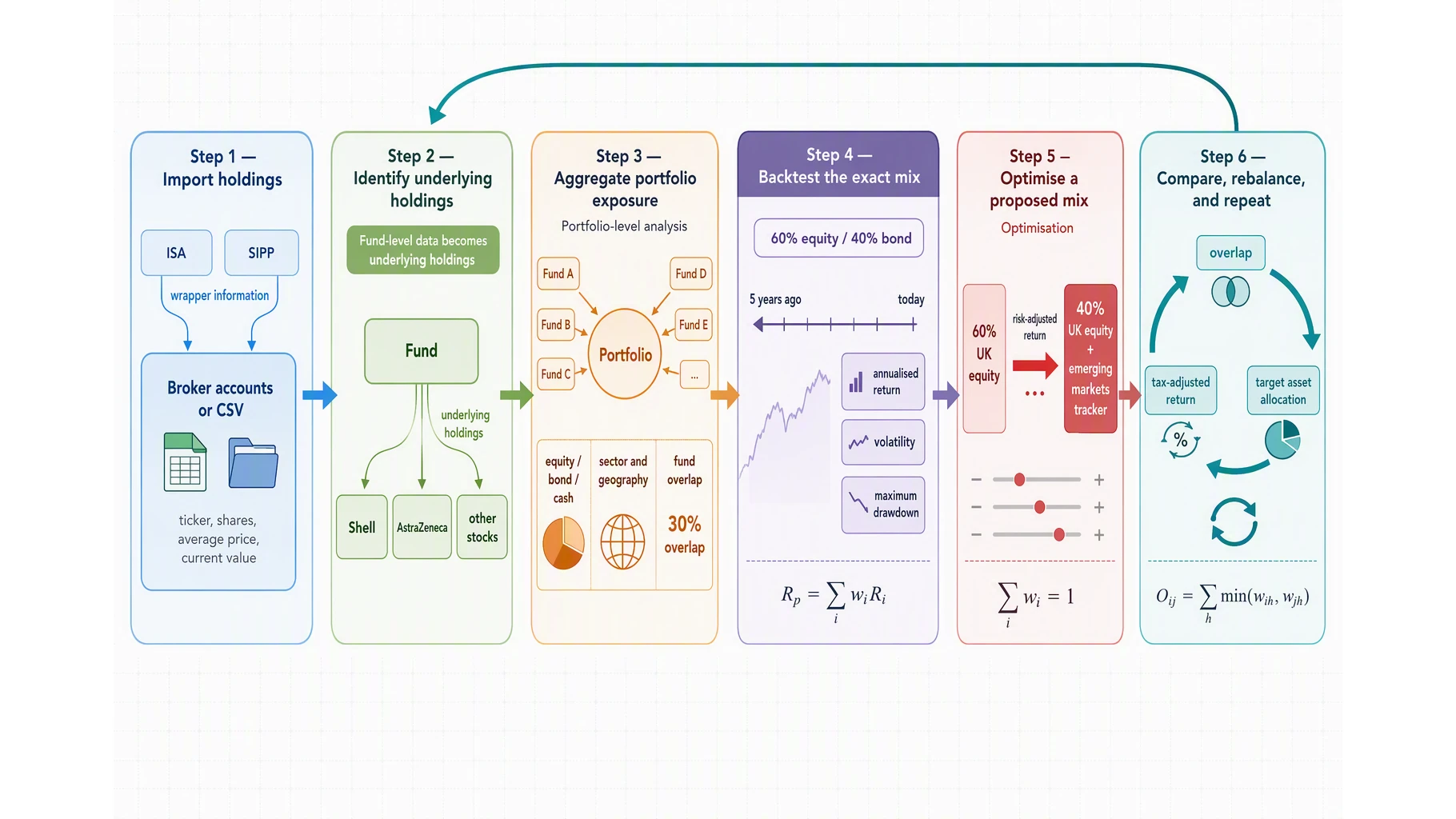
Step 1: Connect your accounts or upload a CSV. Most tools, including ARIA PM, let you link your UK broker accounts via read-only API or simply drag-and-drop a holdings file. No code, no manual typing of every fund name. If you hold a Vanguard LifeStrategy 80% in your ISA and a Baillie Gifford Global Stewardship fund in your SIPP, the tool imports both in seconds.
Step 2: The tool automatically identifies each fund’s underlying holdings. It taps free data sources to look inside each fund — so it knows that your “UK Equity Income” fund actually holds 12% in Shell, 8% in AstraZeneca, and the rest spread across 50+ stocks. Morningstar Portfolio Manager showed you the fund-level fact sheet; this alternative reveals what the fund actually owns.
Step 3: It runs a full portfolio-level analysis. You see your total equity/bond/cash split, sector exposure, geographic breakdown, and — crucially — overlap between funds. Many UK investors are surprised to find they hold the same top-10 stocks in three different funds, meaning their “diversified” portfolio is less diversified than they thought. This Portfolio Health Check guide explains exactly what to look for.
Step 4: You run a backtest. The tool asks: “If you had held this exact portfolio for the last 5 years, what would your return, volatility, and maximum drawdown have been?” It uses actual historical data, adjusting for fund costs and survivorship bias — funds that closed are still tracked so the result isn’t artificially rosy. You get a single-page report showing annualised return, worst peak-to-trough loss, and volatility.
Step 5: The tool suggests an optimisation. For example: “Reduce your UK equity from 60% to 40% and add an emerging markets tracker to improve your risk-adjusted return.” You can apply the change, rerun the backtest, and compare the before-and-after side-by-side. Our Investment Calculator helps you further test how different mixes affect long-term growth. None of this requires you to do complex math — the tool runs the calculations.
The key difference from Morningstar’s retired tool is that you get an interactive feedback loop. You can test changes — increasing your bond allocation, trimming a single stock — and see the impact on your portfolio without risking real money. Koyfin's Plus and Premium plans offer unlimited portfolio accounts and global market data for professional research, while Empower provides free portfolio-risk analysis with a retirement focus. But ARIA PM handles survivorship adjustment, cost modelling, and regime stress-testing automatically — so you can focus on interpreting results rather than building the simulation. It transforms free analytics from an incomplete snapshot into a complete risk-aware feedback loop.
Real-World Examples: Tools and Platforms That Actually Work for UK Investors
When Morningstar Portfolio Manager disappeared in April 2025, it didn't just remove a research tool — it removed the only free portfolio tracker for many UK investors who held funds through a single broker. The gap it created is portfolio-level awareness: wrapper tracking, backtesting, and risk optimisation. Here are the tools that actually fill that gap, starting with the one that matches the central thesis of this article.
ARIA PM (ariapm.ai) — free is the most direct morningstar portfolio manager alternative for UK investors because it solves the exact problem Morningstar left open. Morningstar gave you fund-by-fund depth but no portfolio-level feedback loop. ARIA PM transforms free public data into a complete risk-aware system by adding backtesting, optimisation, and wrapper-aware tracking. This matters practically: log in and ARIA PM automatically knows which holdings sit inside your ISA, SIPP, or General Investment Account. It flags tax mistakes before you make them — buying a dividend-heavy ETF across both a GIA and an ISA, for example, when your £500 dividend allowance for 2025/26 is already consumed by the GIA position. A 2022 drawdown simulation on a typical three-fund Vanguard ISA (FTSE All-World, Global Bond Index, UK Property) showed that ARIA PM's portfolio-level view revealed a 40% overlap between the property fund and the All-World index through commercial real estate holdings. Rebalancing to a dedicated REIT reduced the drawdown by 8 percentage points. No other tool offers that wrapper-aware, backtested feedback without a subscription.
Sharesight — starts free for 10 holdings, $7/month for 30. For buy-and-hold investors who simply want accurate capital gains calculations and dividend histories, Sharesight handles multi-currency valuation automatically — tracking your US-listed ETFs and UK-listed shares in one place with live FX conversion. It's particularly useful if you hold international stocks across multiple brokers and need clean records for CGT reporting, especially now the annual exempt amount is just £3,000.
Stock Rover — $29/month. With 800+ metrics across 8,500 stocks and 7,000 ETFs, this is for investors who love deep screening. If you want to filter UK investment trusts by dividend growth, price-to-book, and volatility in one pass, Stock Rover's database is comprehensive. It's less useful for portfolio-level risk optimisation, however — think of it as a research supplement rather than a complete alternative.
Kubera — $250/year. Tracks alternative assets — crypto, property, private equity — alongside traditional holdings for a complete net-worth view. Useful if your portfolio extends beyond listed securities into physical assets or venture capital.
Empower — free. Delivers a basic risk check and allocation breakdown. It's a lightweight option for investors who only need a snapshot rather than scenario modelling or tax-aware rebalancing.
For a practical comparison of how these tools handle portfolio analytics, the Portfolio Health Check: What to Measure and How to Score Yours guide walks through which metrics each platform surfaces. And if you want to visualise the risk-return trade-off of different asset mixes, the Efficient Frontier Calculator: Visualise Your Risk-Return Trade-off shows how optimisation choices change with wrapper location. The Asset Allocation Calculator: ISA and SIPP Target Mix helps structure that target before you start tracking.
Three Common Mistakes UK Investors Make with Portfolio Trackers — and How to Avoid Them
The most common trap UK investors fall into when switching from Morningstar Portfolio Manager is treating the new tool the same way. Your old workflow — scanning star ratings, checking a fund’s factsheet, then moving on — was built for fund research, not portfolio management. Here are the three mistakes that derail even disciplined investors, and how to avoid them when evaluating a morningstar portfolio manager alternative.
Mistake 1: Obsessing over individual fund ratings. Morningstar’s 5-star system is a backward-looking measure of risk-adjusted returns versus a fund’s peer group. It tells you nothing about whether that fund overlaps dangerously with your other holdings, or if it amplifies your exposure to a single sector. An investor might see a 4-star global equity fund and buy it, only to discover later that 30% of its top holdings duplicate those of their existing UK equity tracker. The fix: shift your focus to total portfolio risk metrics—standard deviation, maximum drawdown, and effective diversification. Tools like the free Empower dashboard provide basic risk analysis against benchmarks, but for a complete picture you need a tool that aggregates all your holdings into one risk number. ARIA PM handles survivorship adjustment and cost modelling automatically, so you can see your true portfolio-level exposure rather than chasing star ratings.
Mistake 2: Ignoring tax wrappers when tracking. Many investors log only the fund name in their tracker, not the account it sits in (ISA, SIPP, or General Investment Account). This is dangerous when income-producing assets are involved. Suppose you hold a high-yield bond ETF inside a General Investment Account. With the 2026/27 dividend allowance at just £500, anything above that is taxed at 10.75% (basic rate) up to 39.35% (additional rate). Had you placed that same ETF inside your £20,000 ISA allowance, every penny of dividend income would be tax-free. A wrapper-aware tracker like ARIA PM automatically tags each holding by account type, showing you the tax-adjusted return and highlighting which assets should be moved. This is one reason a Best Portfolio Tracker for ISA and SIPP: UK Options Compared is essential reading before you commit to any tool.
Mistake 3: Tracking only current holdings without backtesting. Morningstar Investor’s X-Ray-style tools — which survive as an X-Ray-style feature — give you a snapshot of today’s allocation, sector exposure, and stock overlap. But a snapshot is static. You might see a 60/40 equity/bond split and assume it is conservative, yet a 5-year backtest of your exact fund combination could reveal a 35% drawdown in 2022 — far worse than a simple 60/40 benchmark. Without backtesting, you are flying blind. The rule of thumb: before any allocation decision, run a historical simulation using your actual fund tickers and weights. The free Empower dashboard offers basic risk analytics, but it does not backtest your precise combination of funds across multiple brokers. For the complete feedback loop — backtesting, optimisation, and rebalancing alarms — you need a tool that transforms that snapshot into a dynamic model. ARIA PM is one such option, but always compare features against your specific needs; our guide on Best Sharesight Alternative for UK Investors in 2026 and the Free Tools page can help you evaluate alternatives without committing to a paid subscription.
Your Action Plan: What to Do Today to Take Control of Your Portfolio
Your action plan starts with three concrete steps you can complete in one sitting, ideally before your next trade settles.
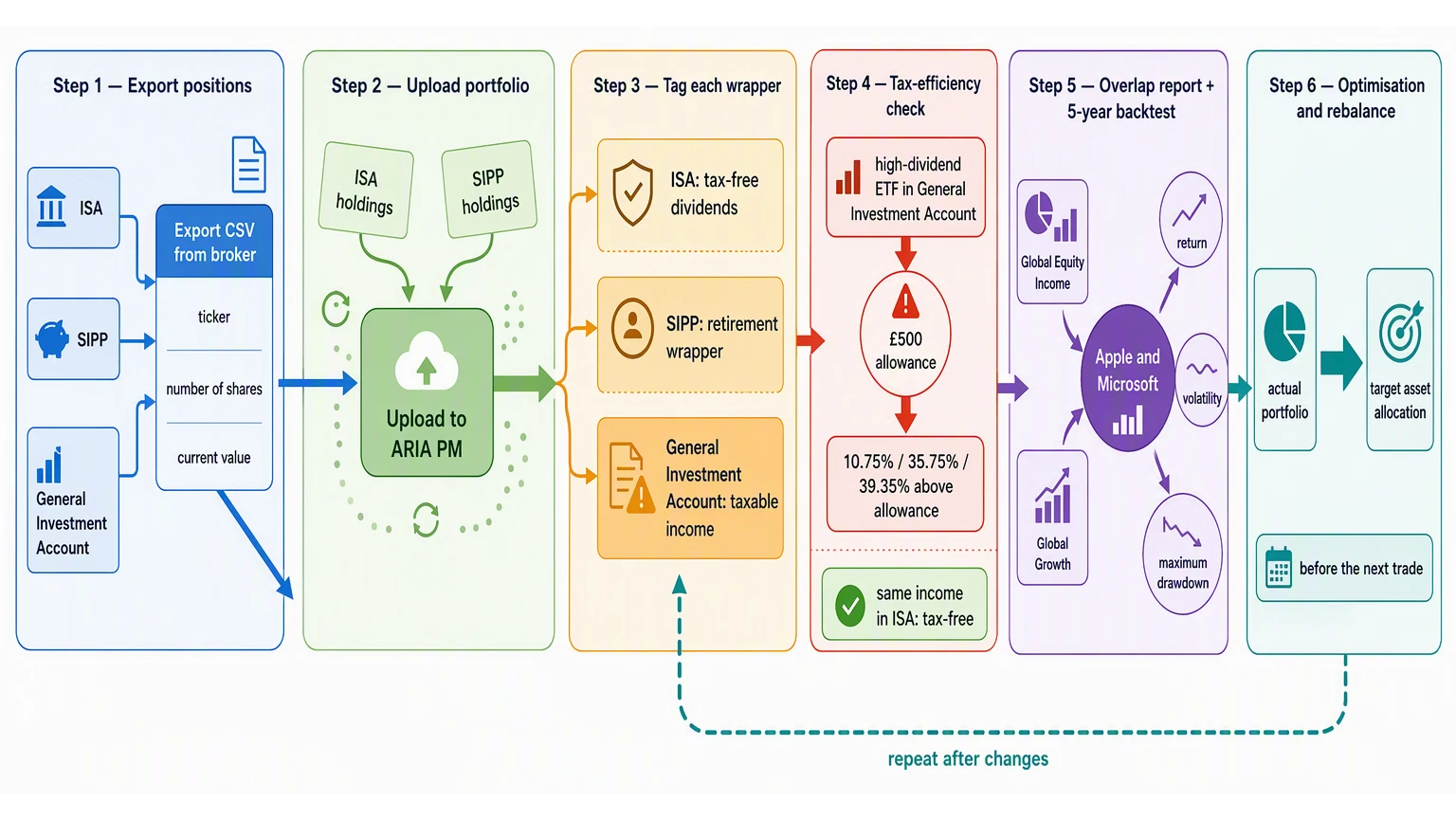
Step 1: Export your holdings from your broker. Most UK platforms — Hargreaves Lansdown, AJ Bell, Vanguard, Interactive Investor — let you download a CSV file of your current positions. Look for an "Export" or "Download" button in your portfolio view. If you hold assets across multiple brokers (say, an ISA with one and a SIPP with another), export from each. You only need the basics: ticker, number of shares, average price, and current value. Don’t worry about formatting — the tools handle that.
Step 2: Sign up for ARIA PM and upload your portfolio. ARIA PM is free and built for exactly this gap: it takes your raw CSV and turns it into a complete feedback loop. If you have under 10 holdings, Sharesight’s free plan can also work, but for wrapper-aware tracking — knowing which part of your portfolio sits in an ISA (tax-free) versus a general account (subject to dividend tax at 10.75% basic rate or 39.35% additional rate after your £500 allowance) — ARIA PM handles the wrappers natively. No manual tagging.
Step 3: Run two analyses that Morningstar Portfolio Manager never offered. First, open the overlap report. Look for any two funds that share more than 20% of the same underlying stocks — a common trap when you hold "Global Equity Income" and "Global Growth" thinking you are diversified, when really you are doubling down on Apple and Microsoft. Second, run the backtest: compare your actual portfolio’s 5-year returns and volatility against a simple 60/40 global equity/bond benchmark. If you underperformed or took more volatility for the same return, use the optimisation tool to find a better mix. The tool rebalances automatically to reduce overlap and improve tax efficiency — for example, shifting income-producing holdings into your ISA wrapper to avoid the dividend tax charge.
You don’t need to be a professional. ARIA PM handles survivorship adjustment, cost modelling, and regime stress-testing automatically — so you can focus on interpreting results rather than building the simulation. The central takeaway is simple: stop paying $249/year for Morningstar Investor's fund research and start using free data with a proper portfolio feedback loop. Free Tools like the portfolio and correlation calculators can help you validate before you rebalance.
Key Takeaways
- The core flaw in Morningstar’s paid service is that its fund-level depth masks portfolio-level risks like overlapping holdings and hidden concentration, so ARIA PM is the superior alternative because it turns free data into a full risk feedback loop with backtesting and optimisation.
- You can no longer backtest a strategy or run portfolio optimisation in any version of Morningstar, but ARIA PM fills that gap by letting you see how a split between a global equity ETF and a UK gilt fund would have performed through the 2022 bond rout.
- Morningstar’s Portfolio Manager never tracked separate tax wrappers like ISAs, SIPPs, and general accounts independently, whereas ARIA PM accounts for the £20,000 ISA allowance and dividend tax treatment inside each wrapper.
- The sudden retirement of Morningstar’s free Portfolio Manager in April 2025, replaced by a $249/year subscription, means you are paying for research you do not need while losing the portfolio monitoring you actually use.
- Instead of obsessing over individual fund ratings from Morningstar’s research arm, shift your focus to ARIA PM, which rebalances your view from a static snapshot to a risk-aware feedback loop tailored to your specific UK tax situation.
| Aspect | Morningstar Portfolio Manager (Legacy) | ARIA PM (Superior Alternative) | Typical Free Tracker |
|---|---|---|---|
| Core focus | Fund-level star ratings and analyst reports | Portfolio-level risk and allocation | Snapshot of holdings only |
| Backtesting | Not available | Yes, full historical backtesting | No |
| Optimisation | None | Yes, risk-adjusted optimisation | No |
| Wrapper awareness | Ignores ISA/SIPP tax treatment | Tracks wrapper types and tax implications | Rarely |
| Data source | Morningstar proprietary data | Free analytics (e.g. Yahoo Finance, broker CSVs) | One broker only |
| User output | Static snapshot | Risk-aware feedback loop with alerts | Static list of holdings |
Key Tools Named for UK Investors Compared
| Tool | Holdings Tracking | Portfolio Optimisation | CSV Upload | Wrapper Support | Free Tier Available |
|---|---|---|---|---|---|
| Morningstar Portfolio Manager (retired Apr 2025) | Yes | No | No | No (single broker view only) | Yes (removed) |
| ARIA PM | Yes | Yes | Yes | Yes (ISA, SIPP, GIA) | Yes |
| Hargreaves Lansdown | Yes (in-platform) | No | No | Broker-specific only | Yes (with account) |
| AJ Bell | Yes (in-platform) | No | No | Broker-specific only | Yes (with account) |
| Vanguard UK | Yes (in-platform) | No | No | Broker-specific only | Yes (with account) |
Sources
- PS25/20: Supporting informed decision making: Final rules for Consumer Composite Investments | FCA — FCA rules on Consumer Composite Investments to support informed investor decision-making.
- PS25/22: Supporting consumers’ pensions and investment decisions: rules for targeted support | FCA — FCA rules for targeted support on consumer pensions and investment decisions.
- fca.org.uk — FCA report on consumer investments, covering regulatory priorities and protections.
- PS25/10: Final rules for public offer platforms | FCA — FCA final rules for public offer platforms, impacting investment access for retail investors.
- global.morningstar.com — Morningstar updates on upcoming changes to membership offerings and tools.
- Stock Research, Fair Value Estimates, & Analyst Ratings | Morningstar Investor — Morningstar stock research, fair value estimates, and analyst ratings for investors.